
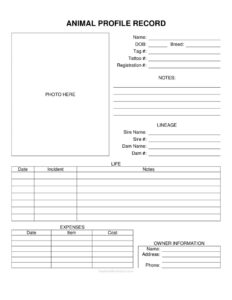
Animal Profile Record
Download a free Animal Profile Record template to track an animal's breed, lineage, costs, and health history — free PDF and DOCX download, no signup.
PDF
DOC
4 downloads
0
likes
Download Files
- DOC
An Animal Profile Record is a single-animal document that captures identity details, breeding lineage, ownership, costs, and a running history of incidents and notes. Farmers, breeders, and hobbyists use it most often to keep one trustworthy reference for each animal in the herd or flock. It’s free to download here in both PDF and DOCX formats, with no signup required.
What Is an Animal Profile Record?
An Animal Profile Record is a recordkeeping form that consolidates everything you know about one specific animal onto a single sheet. It is typically maintained by the owner, breeder, or farm manager and serves as the animal’s reference file from birth through its productive life. The form documents identity (name, tag, tattoo, registration), parentage (sire and dam), physical traits like breed, financial details such as cost and expenses, and a log of incidents and notes. Rather than scattering this information across receipts, registry papers, and memory, the profile keeps it in one place. It supports better breeding decisions, accurate sale disclosures, vet visits, and overall herd management.
When Do You Need an Animal Profile Record?
This record is useful any time an animal’s individual details matter for management, value, or compliance. Common situations include:
- Acquiring a new animal — log the cost, source, breed, and registration details the day it arrives.
- Managing a breeding program — track sire and dam lineage so you can plan matings and avoid inbreeding.
- Preparing for a sale — give buyers a clear, documented history of identity, parentage, and care.
- Veterinary or health events — note injuries, illness, treatments, and outcomes under incidents.
- Registry and show paperwork — keep registration, tattoo, and tag numbers handy for associations.
- Tracking profitability — record ongoing expenses against the purchase cost to evaluate each animal’s value.
What an Animal Profile Record Should Have
A complete profile ties identity to history. At minimum it should include a clear way to identify the animal beyond its name — tag, tattoo, or registration numbers — because names can be duplicated within a herd. It should capture breed and date of birth, full lineage through the sire and dam, owner and farm contact information, and financial fields for cost and expenses. A photo and a dated log of incidents and notes round out the record so anyone reviewing the file can verify the animal and understand its history. The more consistently each field is filled in, the more useful the record becomes over the animal’s life.
How to Fill Out an Animal Profile Record
- Date: Enter the date you create or update the record so entries stay in chronological order.
- Name & Photo Here: Write the animal’s name and attach or paste a current photo for visual identification.
- Breed and Dob: Record the breed and date of birth, which anchor age-based decisions and registry eligibility.
- Tag #, Tattoo #, Registration #: Enter every identifier the animal carries so it can be matched against ear tags, tattoos, and association papers.
- Sire Name & Sire #, Dam Name & Dam #: Document both parents by name and number to establish verifiable lineage.
- Lineage: Add any further pedigree notes — grandparents, bloodlines, or registry classes.
- Owner Information, Farm, Address, Phone: Fill in who owns the animal and where it is kept, with a contact number.
- Cost, Item, Expenses: Log the purchase cost and ongoing expense line items as they occur.
- Incident, Life, Notes: Record health events, milestones, and general observations over the animal’s life.
Using the Lineage and Identification Fields Effectively
The sire and dam fields are the backbone of any breeding record, so enter both the registered name and the assigned number for each parent. Numbers prevent confusion when several animals share similar names within a bloodline. The Lineage field is your space to expand on pedigree — note grandparents, breed percentages, or registry tiers that affect value. For identification, fill in the Tag #, Tattoo #, and Registration # whenever they exist, even if only one applies; redundant identifiers protect you if a tag is lost or a tattoo fades. Keeping these fields current also speeds up registry submissions and reduces disputes at sale time, since buyers can independently verify the animal against association databases.
Tracking Costs and Incidents Over Time
The financial and history sections turn a static profile into a living management tool. Use Cost to record what you paid at acquisition, then add each Item and its Expenses entry — feed, vaccinations, breeding fees, or boarding — so the running total reflects the animal’s true investment. The Incident and Notes fields work like a diary: date each entry and describe what happened, who was involved, and the outcome. Over the animal’s Life, this log becomes invaluable for spotting recurring health problems, demonstrating responsible care to a buyer, or justifying a culling decision. Consistent, dated entries make patterns visible that would otherwise be lost.
Common Mistakes to Avoid
- Relying on the name alone — always record at least one number (tag, tattoo, or registration) to avoid mixing up similar animals.
- Leaving sire or dam numbers blank — incomplete parentage weakens registry value and breeding decisions.
- Skipping the photo — a current image makes identification and recovery far easier.
- Logging expenses only when convenient — undated or missing entries distort the animal’s true cost.
- Vague incident notes — write dates and specifics so the history is actually useful later.
- Keeping only one copy — store a backup digitally so a lost or damaged sheet doesn’t erase the animal’s history.
Frequently Asked Questions
What is an Animal Profile Record used for? It is used to keep all of one animal’s important information — identity, breeding lineage, ownership, costs, and health history — in a single organized document. Farmers and breeders use it for herd management, registry paperwork, and sales. It serves as a permanent reference file for the animal’s entire life.
How do I fill out the sire and dam fields? Enter the registered name of each parent along with its assigned identification number in the Sire #/Sire Name and Dam #/Dam Name fields. Using both name and number prevents confusion between animals with similar names. This information also supports registry submissions and breeding plans.
Is an Animal Profile Record a legal document? On its own it is a private management and recordkeeping tool, not an official certificate. Formal proof of pedigree usually comes from a breed association or registry. However, a well-kept profile can support sale disclosures and verify details against official records.
Do I need to include a photo? A photo is highly recommended because it makes identification quick and reliable, especially when tags fade or tattoos become hard to read. The form includes a dedicated Photo Here space. A current image is also useful for sale listings and insurance documentation.
How much does this template cost? The Animal Profile Record template is completely free to download from Business Forms Pro in both PDF and DOCX formats. There is no signup or payment required. You can print it as-is or edit the DOCX version to fit your operation.
Can I use one form for my whole herd? No — this profile is designed for a single animal so each one has its own complete history. Print or duplicate the template for every animal you manage. Keeping them separate makes lineage, costs, and incidents far easier to track and compare.
This template is provided as a general example for informational purposes only and does not constitute legal, financial, tax, or veterinary advice. Recordkeeping and registry requirements vary by jurisdiction and breed association — consult a qualified professional or your relevant registry for guidance specific to your situation.
Related Forms
- Field Productivity Record
- Apiary Record Form
- Farm Store Order Form
- Detailed Egg Production Record
- Farm Inventory Record
- Field Planning Worksheet
Browse more in Agriculture.