
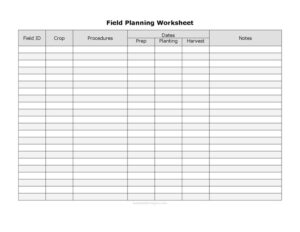
Field Planning Worksheet
Plan crops, planting, prep, and harvest with this free Field Planning Worksheet template—organize your farm season and download free in PDF or DOCX.
PDF
DOC
8 downloads
0
likes
Download Files
- DOC
A Field Planning Worksheet is a simple farm document used to map out what you’ll grow on each field, when you’ll prepare and plant it, and when you expect to harvest. Growers reach for it most often at the start of a season to organize crop rotations and field tasks in one place. It’s free to download here in both PDF and DOCX formats, with no signup required.
What Is a Field Planning Worksheet?
A Field Planning Worksheet is a working record that documents the planned activity for one or more fields across a growing season. It is typically filled out by a farmer, farm manager, or agronomist who needs to coordinate land preparation, seeding, and harvest timing. The worksheet captures the crop assigned to each field, the key dates involved, the procedures to be followed, and any notes that affect the outcome. Rather than keeping plans in your head or scattered across notebooks, this single sheet turns intentions into an actionable schedule. It supports better decisions on inputs, labor, equipment, and rotation, and it becomes a useful reference you can compare against actual results once the season ends.
When Do You Need a Field Planning Worksheet?
This worksheet earns its place any time field activity needs to be organized in advance or tracked through the season. Common situations include:
- Pre-season crop planning — deciding which crop goes on which field and locking in a planting and harvest timeline.
- Crop rotation management — recording what was grown previously so you can avoid back-to-back plantings that deplete soil or invite pests.
- Coordinating labor and equipment — scheduling prep work, seeding, and harvest so machinery and crews are available when needed.
- Managing multiple fields — keeping each parcel’s plan distinct using a Field ID so nothing is double-booked or overlooked.
- Tracking progress against plan — comparing planned dates with actual dates to refine next year’s schedule.
- Reporting and recordkeeping — providing documentation for lenders, crop insurance, certification programs, or farm partners.
What a Field Planning Worksheet Should Have
A complete worksheet ties each field to a clear, dated plan. The essentials include a unique identifier for the field, the crop selected, the prep work required, planting timing, expected harvest, the procedures to follow, and a place for notes. Together these elements answer the basic questions of any field plan: what, where, when, and how. Strong worksheets also leave room to record variety details, seeding rates, or weather observations under notes, so the document grows more useful as the season unfolds. The goal is a sheet that anyone on the operation could pick up and understand without extra explanation.
How to Fill Out a Field Planning Worksheet
- Field ID: Enter the unique label for the field or block—for example “North 40,” “Field B,” or a parcel number. Use one row or sheet per field so plans stay separate.
- Crop: Write the crop you intend to grow, and add the variety or hybrid if relevant (e.g., “Corn – Pioneer P1234” or “Romaine lettuce”).
- Prep: List the land preparation tasks—tillage, soil amendments, fertilizer application, bed forming, or irrigation setup—and when each should occur.
- Planting: Note the planned planting method, seeding rate or spacing, and the target window for seeding or transplanting.
- Dates: Record the key dates for prep, planting, and any in-season milestones so the timeline is clear at a glance.
- Procedures: Outline the routine operations expected during the season—irrigation schedule, fertilizing, pest or weed control, and scouting checkpoints.
- Harvest: Enter the expected harvest window and any details on method, yield goal, or post-harvest handling.
- Notes: Capture anything else that matters—soil test results, weather concerns, equipment needs, or reminders for next season.
Tips for Getting the Most From Your Worksheet
Treat the worksheet as a living document rather than a one-time form. Fill it out during winter planning, then update it as conditions change—a late frost, a wet spring, or a pest outbreak can shift your dates. Keep last year’s completed worksheets nearby so you can review what worked and feed those lessons into the new plan. If you manage several fields, consider color-coding crops or numbering your worksheets to match a field map. When you record actual dates alongside planned dates in the notes column, you build a year-over-year history that makes each season’s plan sharper and more realistic.
How It Fits With Other Farm Records
The Field Planning Worksheet is a planning tool, not a replacement for detailed operational logs. It sets the strategy; daily activity records, input application logs, and harvest yield sheets capture the execution. Used together, the worksheet gives you the big-picture schedule while your other records fill in the granular numbers. For operations pursuing organic certification or crop insurance, the worksheet can serve as supporting documentation of your intended practices, while your activity logs prove what actually happened. Keeping the planning document and the execution records aligned makes audits, renewals, and end-of-season reviews far easier.
Common Mistakes to Avoid
- Vague Field IDs — labeling fields inconsistently makes it hard to track which plan belongs to which parcel.
- Skipping the prep details — planting dates mean little if the land won’t be ready in time.
- Setting dates too rigidly — leave realistic windows rather than single days, since weather rarely cooperates exactly.
- Forgetting rotation history — assigning a crop without checking what grew there last can hurt yields and soil health.
- Leaving procedures blank — an empty procedures section invites missed irrigation, fertilizing, or scouting tasks.
- Not updating after the season — failing to note actual outcomes wastes the worksheet’s biggest long-term benefit.
Frequently Asked Questions
What is a Field Planning Worksheet used for? It is used to plan and organize the activity on each field for a growing season, including the crop, prep work, planting and harvest timing, and the procedures you’ll follow. It keeps the whole plan in one place so labor, equipment, and inputs can be coordinated. Many growers also use it as a record to compare planned versus actual results.
How do I fill out the worksheet for multiple fields? Use one row or one sheet per field and give each a unique Field ID. This keeps prep, planting, and harvest dates from overlapping or being confused between parcels. You can then review all of your fields together to balance the season’s workload.
Does a Field Planning Worksheet need to be signed or notarized? No. It is an internal planning and recordkeeping tool, so it does not require signatures, witnesses, or notarization. That said, you may choose to have a manager initial it for accountability on larger operations.
Can I use this worksheet for crop insurance or certification records? It can serve as helpful supporting documentation of your intended practices, but most programs also require detailed activity and input logs. Check the specific requirements of your insurer or certifying agency. Keeping your worksheet aligned with those records makes any review smoother.
How far in advance should I complete it? Most growers fill it out during the off-season or several weeks before prep work begins, then update it as conditions change. Planning early gives you time to order seed and inputs and to schedule equipment. Treat the dates as flexible windows that you adjust through the season.
Is this Field Planning Worksheet really free? Yes. You can download it free in PDF or DOCX with no signup required, and the editable DOCX lets you customize fields to match your operation. Print as many copies as you need for each field and season.
This Field Planning Worksheet template is provided as a general example for informational purposes only and does not constitute agronomic, legal, financial, or business advice. Growing conditions, regulations, and certification requirements vary by region and crop—consult a qualified agronomist or relevant professional for guidance specific to your operation.
Related Forms
- Spray Record
- Detailed Egg Production Record
- Animal Profile Record
- Farm Inventory Record
- Farm Equipment Record
- Farmers Market Sales Record
Browse more in Agriculture.