
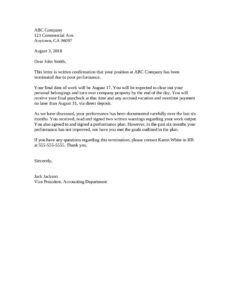
Employee Termination For Poor Performance
Download a free Employee Termination for Poor Performance letter template to document a fair, clear dismissal — free PDF and DOCX download, no signup.
DOCX
1 downloads
0
likes
Download Files
- DOCX
An Employee Termination for Poor Performance letter is a formal document an employer issues to end an employee’s job because they have not met required work standards despite warnings and support. It is most commonly used to close out a dismissal cleanly after a performance improvement process has run its course, leaving a written record of the decision. You can download this template free in PDF and DOCX formats, with no signup required.
What Is an Employee Termination for Poor Performance Letter?
An Employee Termination for Poor Performance letter is a written notice from an employer to an employee confirming that their employment is ending due to unsatisfactory job performance. It is usually drafted by a manager, HR representative, or business owner and delivered after coaching, reviews, or a performance improvement plan (PIP) have failed to produce the needed change. The letter documents the reason for separation, the effective date, and practical details about final pay, benefits, and the return of company property. Beyond informing the employee, it serves as an official record that the decision was communicated professionally and consistently — an important reference if questions or disputes arise later about how and why the separation occurred.
When Do You Need an Employee Termination for Poor Performance Letter?
This letter is appropriate whenever a documented performance issue leads to dismissal. Common situations include:
- An employee fails to meet measurable targets after a formal performance improvement plan has concluded.
- Repeated quality problems, missed deadlines, or errors continue despite written warnings and coaching.
- A probationary or new hire does not reach the agreed standard within the review period.
- An individual’s output remains below team or role expectations after additional training and support.
- HR needs a clear, dated written record to accompany an at-will or contractual separation.
- A manager wants to ensure the termination message is delivered consistently and professionally rather than verbally only.
In each case, the letter turns a difficult conversation into a documented, defensible decision and gives the departing employee a clear written summary of what happens next.
What an Employee Termination Letter Should Have
A complete poor-performance termination letter is factual, respectful, and specific. The strongest versions include the company name and contact details, the employee’s full name and job title, and the date the letter is issued. They state plainly that employment is being terminated and give the effective last day of work. Crucially, the letter references the performance concerns and the prior steps taken — warnings, reviews, or a PIP — without exaggerating or inventing details. It should also cover the logistics of separation: final paycheck timing, any accrued leave payout, benefits or COBRA-type continuation information, return of company property, and a point of contact for follow-up questions. A signature line for the issuing manager or HR representative finishes the document.
How to Fill Out an Employee Termination for Poor Performance Letter
- Enter the date the letter is issued at the top, followed by your company name and address.
- Add the employee’s full name, job title, and address so the recipient is clearly identified.
- Open with a direct statement that their employment is being terminated and specify the effective date of separation.
- Reference the reason — unsatisfactory performance — and briefly cite the prior steps taken, such as written warnings, reviews, or the performance improvement plan and its dates.
- Explain final compensation: last paycheck, any accrued but unused leave, and how and when it will be paid.
- Outline benefits details, continuation options, and any insurance end dates.
- List instructions for returning company property such as keys, laptops, badges, or documents.
- Provide a contact name and number for questions about the transition.
- Close with a professional sign-off, then add the signature, printed name, and title of the issuing manager or HR representative.
Documenting Performance Before You Terminate
A termination letter is most defensible when it sits at the end of a clear paper trail. Ideally, the performance concerns referenced in the letter were already raised in writing through documented evaluations, coaching notes, written warnings, or a formal PIP with measurable goals and a deadline. Keep the language in the letter consistent with that earlier documentation — do not introduce new reasons that were never discussed with the employee. If you maintained records of meetings, target metrics, and the support offered, the letter becomes a summary of an established process rather than a surprise. This consistency protects both the organization and the employee by showing the decision was fair, gradual, and based on job performance rather than unrelated factors.
Delivering the News Professionally
How a termination letter is delivered matters as much as its wording. Many employers hand the letter over during a private, in-person meeting (or a secure video call for remote staff) so the employee hears the decision directly and can ask questions. Keep the meeting brief, factual, and calm; let the written letter carry the formal details. Have HR present where possible, and be ready to explain final-pay timing and property return on the spot. Treating the person with dignity reduces friction, protects your company’s reputation, and makes the transition smoother for everyone involved, including the remaining team.
Common Mistakes to Avoid
- Vague reasoning: Stating only “poor performance” without referencing prior warnings or specific concerns can make the letter feel arbitrary.
- Inconsistent dates: Make sure the effective termination date, final-pay timing, and benefit end dates all align.
- Adding new accusations: Do not introduce reasons or incidents the employee was never told about during the process.
- Emotional or judgmental language: Keep the tone neutral and professional; avoid blame or personal criticism.
- Forgetting logistics: Omitting final pay, benefits, or property-return details creates confusion and follow-up problems.
- Skipping legal review: Failing to check local employment rules before sending the letter can expose the company to risk.
Frequently Asked Questions
What is an Employee Termination for Poor Performance letter? It is a formal written notice confirming that an employee’s job is ending because they did not meet required work standards. It documents the reason, the effective date, and key separation details like final pay and property return. The letter serves as both a courtesy to the employee and an official company record.
How do I fill out the letter? Start with the date and company details, then identify the employee and state clearly that employment is being terminated as of a specific date. Reference the performance concerns and prior steps taken, explain final pay and benefits, list property to return, and sign as the issuing manager or HR representative.
Does this letter need to be signed or witnessed? It should be signed and dated by the manager or HR representative issuing it, and many employers ask the employee to acknowledge receipt. Witnesses or notarization are generally not required, but having an HR representative present during delivery is a common best practice. Requirements can vary, so check your internal policies.
Is an Employee Termination letter legally binding? The letter formally communicates and records a termination decision, but the legality of the dismissal depends on employment laws, contracts, and how the process was handled. A well-documented letter helps demonstrate the decision was fair and consistent. Always confirm your situation complies with applicable local rules.
Should I document warnings before terminating for performance? Yes. A clear paper trail of evaluations, written warnings, or a performance improvement plan strengthens the fairness and defensibility of the termination. The letter should be consistent with that prior documentation rather than raising new issues.
How much does this template cost? This Employee Termination for Poor Performance letter template is completely free to download from Business Forms Pro in both PDF and DOCX formats. There is no signup or payment required, and you can edit the DOCX version to fit your company’s details and tone.
This template is a general example provided for informational purposes only and is not legal, HR, or employment advice. Employment laws and termination requirements vary by jurisdiction and by individual circumstances. Consult a qualified employment attorney or HR professional before terminating an employee or relying on this document.
Related Forms
- Employee Termination For Theft
- New Sale Announcement
- Congratulations on Anniversary
- Recognizing a Suggestion
- Welcome to a New Employee
- Notification of Canceled Contract
Browse more in Business Letters.