
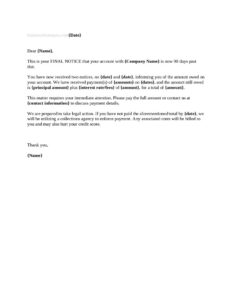
90 Days Past Due Letter
Use this free 90 days past due letter template to firmly collect seriously overdue invoices and warn of next steps — free download in PDF and DOCX.
DOCX
0
likes
Download Files
- DOCX
A 90 days past due letter is a formal collection notice a business sends when an invoice remains unpaid three full months after its due date. It signals that the account has moved from a routine reminder into a serious delinquency, and it is often the final written warning before escalation to a collection agency or legal action. You can download this template free in PDF and DOCX — no signup required.
What Is a 90 Days Past Due Letter?
A 90 days past due letter is a written demand for payment issued by a creditor — typically a vendor, contractor, freelancer, or service provider — to a customer whose balance is now ninety days overdue. It documents the outstanding amount, references the original invoice, and states firmly that immediate payment is expected. Unlike a gentle 30-day reminder, this letter carries a tone of urgency and usually names the consequences of continued nonpayment. It serves two purposes at once: prompting the debtor to act and creating a paper trail that proves you made reasonable, good-faith efforts to collect before pursuing tougher remedies.
When Do You Need a 90 Days Past Due Letter?
This letter fits situations where earlier, softer reminders have gone unanswered and the debt has aged significantly. Common scenarios include:
- An invoice is now three months overdue despite prior 30- and 60-day notices.
- A client has stopped responding to emails and phone calls about an outstanding balance.
- You need a final documented demand before referring the account to a collection agency.
- You are preparing to involve an attorney or file in small claims court and want a written record of your collection efforts.
- A long-standing customer has slipped into serious delinquency and you want to give one last chance to resolve it directly.
- Your accounting team is closing the quarter and needs to formally pursue or write off aged receivables.
What a 90 Days Past Due Letter Should Have
To be effective and credible, the letter should clearly identify both parties, reference the specific invoice and its original due date, and state the exact outstanding amount including any late fees or interest that have accrued. It should specify a firm deadline for payment, describe acceptable payment methods, and plainly state the consequences of continued nonpayment — such as referral to collections, suspension of services, or legal action. A professional but firm tone, accurate figures, and your contact information for resolving the matter round out a complete notice.
How to Fill Out a 90 Days Past Due Letter
Because this is a letter rather than a fixed-field form, complete it in a logical order:
- Add your company name, address, phone, and email at the top, followed by the date you are sending the letter.
- Enter the customer’s name, company, and mailing address as the recipient block.
- Open with a clear statement that the account is now 90 days past due.
- Reference the original invoice number and its due date so there is no confusion about which charge is unpaid.
- State the total amount owed, broken out into the principal balance plus any late fees or interest.
- Set a firm payment deadline — for example, within ten days of receiving the letter.
- List how the customer can pay (check, bank transfer, online portal, card) and where to send it.
- Spell out the consequences of inaction, such as referral to a collection agency or legal proceedings.
- Close with a contact name and number for questions, then sign your name and title.
Tone and Escalation: Getting It Right
At ninety days, the balance between firmness and professionalism matters more than ever. The letter should leave no doubt about the seriousness of the situation, yet remain free of threats you do not intend to carry out or language that could be read as harassment. State facts and consequences plainly. Many businesses use a tiered approach — a friendly reminder at 30 days, a more pointed notice at 60 days, and this final demand at 90 — so the recipient understands this is the culmination of repeated attempts to resolve the matter. If you intend to refer the account to collections or an attorney, saying so directly often prompts payment faster than vague warnings.
What Happens After You Send It
Keep a copy of the signed letter along with proof of delivery, such as a certified mail receipt or email read confirmation. If the customer pays, send a brief acknowledgment and update your records. If the deadline passes with no response, you have documented your good-faith effort and can move forward with your stated next step — whether that is engaging a collection agency, consulting an attorney, or filing a small claims action. Maintaining this paper trail strengthens your position considerably if the dispute ever reaches a third party or a court.
Common Mistakes to Avoid
- Stating an incorrect balance or forgetting to add accrued late fees, which undermines your credibility.
- Failing to reference the specific invoice number and original due date.
- Using vague language like “please pay soon” instead of a firm deadline.
- Threatening actions you have no intention of taking, which can backfire legally and practically.
- Sending the letter by a method with no delivery proof, leaving you unable to show it was received.
- Skipping a contact name and number, making it harder for a willing customer to actually resolve the debt.
Frequently Asked Questions
What is a 90 days past due letter? It is a formal collection notice telling a customer their invoice is now ninety days overdue and that immediate payment is required. It is typically the strongest written warning a creditor sends before escalating to a collection agency or legal action. The letter documents the debt and your effort to collect it.
How do I write a 90 days past due letter? Start with your company details and the date, then identify the customer and the specific unpaid invoice. State the total owed including late fees, set a firm payment deadline, list how to pay, and explain the consequences of continued nonpayment. Close with your signature and a contact for questions.
Is a 90 days past due letter legally binding? The letter itself is a demand, not a contract, so it does not create new legal obligations on its own. However, it can serve as important evidence that you made reasonable efforts to collect a legitimate debt. Collection practices are regulated in many places, so keep the language factual and avoid harassment.
Should I send it by certified mail? Certified mail or another trackable method is strongly recommended at this stage. It gives you documented proof the customer received the notice, which is valuable if you later pursue collections or court action. Keep the receipt with your copy of the letter.
What should I do if the customer still does not pay? Once your stated deadline passes, you can act on the consequence you outlined — referring the account to a collection agency, consulting an attorney, or filing a small claims case. Your documented letters demonstrate a good-faith collection effort that supports any next step.
Is this template really free? Yes. You can download this 90 days past due letter template free in both PDF and DOCX formats with no signup required, then edit it to match your business name, invoice details, and amounts owed.
This template is a general example provided for informational purposes only and is not legal, financial, or tax advice. Debt collection rules and consumer protection laws vary by jurisdiction. Consult a qualified attorney or licensed professional before pursuing collection action.
Related Forms
- Complaint Disavowal
- Customer Appreciation Letter
- Warranty Claim on a Product
- Disputed Invoice
- Landlord Temporary Repairs
- Introducing New Salesperson
Browse more in Business Letters.