
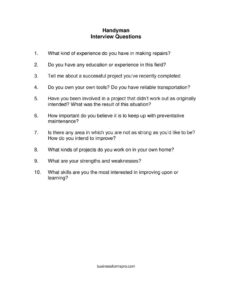
Handyman Interview Questions
Download a free Handyman Interview Questions template with proven questions to hire skilled, reliable maintenance pros — free PDF and DOCX download.
PDF
DOCX
1 downloads
0
likes
Download Files
- DOCX
The Handyman Interview Questions form is a ready-to-use list of questions employers, property managers, and homeowners use to screen candidates for general repair and maintenance work. Most people reach for it when they need a structured, fair way to compare applicants and confirm a handyman has the hands-on skills the job requires. It’s free to download in both PDF and DOCX, with no signup needed.
What Is a Handyman Interview Questions Form?
A Handyman Interview Questions form is a prepared set of questions designed to assess a candidate’s repair experience, technical skills, reliability, and problem-solving approach during a hiring conversation. It is typically used by property management companies, facilities teams, contractors, and individual homeowners looking to bring on a maintenance worker or repair person. The form documents the topics you intend to cover and gives every applicant the same starting point, which makes comparisons more consistent. Because handyman roles cover a wide range of tasks — from plumbing and carpentry to drywall, painting, and electrical fixes — the questions focus on practical experience, ownership of tools, transportation, and how the person handles projects that don’t go as planned.
When Do You Need a Handyman Interview Questions Form?
- You’re a property manager hiring an on-site maintenance technician for an apartment community or commercial building.
- You run a handyman or contracting business and need to vet subcontractors before adding them to your crew.
- You’re a homeowner interviewing candidates for ongoing repair work and want to confirm real, verifiable skills.
- A facilities department is filling a general maintenance position and needs a repeatable, fair interview process.
- You manage rental properties and want to screen for someone who understands preventative maintenance, not just one-off fixes.
- You’re comparing several applicants and want every candidate answering the same questions so the decision is defensible.
What a Handyman Interview Questions Form Should Have
A strong handyman interview form goes beyond a simple skills checklist. It should probe direct repair experience, any formal training or apprenticeships, and a concrete example of a completed project. It should confirm logistical essentials — whether the person owns their own tools and has reliable transportation — because these directly affect their ability to show up and do the work. Good questions also explore how a candidate handles setbacks, their view on preventative maintenance, and their honest assessment of strengths and weaknesses. Including a space for notes beside each question helps you record answers and rate candidates fairly afterward.
How to Fill Out a Handyman Interview Questions Form
- Open with experience: ask “What kind of experience do you have in making repairs?” to gauge breadth and depth of hands-on work.
- Cover training next with “Do you have any education or experience in this field?” — note apprenticeships, trade school, or certifications.
- Ask for a recent win: “Tell me about a successful project you’ve recently completed” reveals real, verifiable work.
- Confirm logistics with “Do you own your own tools? Do you have reliable transportation?” — both affect day-to-day performance.
- Probe problem-solving via “Have you been involved in a project that didn’t work out as originally intended? What was the result?”
- Assess mindset using “How important do you believe it is to keep up with preventative maintenance?”
- Explore honesty and growth: “Is there any area in which you are not as strong as you’d like to be? How do you intend to improve?”
- Ask “What kinds of projects do you work on in your own home?” to see genuine interest and initiative.
- Cover “What are your strengths and weaknesses?” and “What skills are you most interested in improving or learning?” Record answers beside each question for later scoring.
How to Get the Most From Each Question
The value of this form comes from how you listen, not just what you ask. When a candidate describes a recently completed project, follow up on the specifics: what materials they used, how long it took, and whether anything went wrong. The question about a project that didn’t work out as intended is one of the most revealing — a strong candidate will own the mistake, explain what they learned, and describe how they corrected it, while a weaker one may blame others or gloss over the problem. The preventative maintenance question separates someone who only reacts to breakdowns from someone who anticipates them, which matters enormously for ongoing property care.
Tips for a Fair, Effective Interview
- Ask every applicant the same core questions so you can compare answers side by side.
- Take brief notes during the conversation rather than relying on memory afterward.
- Where possible, pair the interview with a short hands-on test or a request for references and photos of past work.
- Listen for specifics — names of tools, types of repairs, real timelines — rather than vague generalities.
- Stay consistent with your scoring so the final decision is fair and easy to justify.
Common Mistakes to Avoid
- Skipping the tools-and-transportation question, then discovering on day one the candidate can’t reach the job or supply basic equipment.
- Accepting vague answers like “I can fix anything” without asking for concrete examples or recent projects.
- Talking more than you listen — let the candidate fill the silence and reveal their real experience.
- Failing to take notes, which makes comparing multiple applicants nearly impossible later.
- Ignoring the answer to the “project that didn’t work out” question, which is often the most honest insight you’ll get.
- Asking inconsistent questions across candidates, which undermines fair comparison and can raise concerns about a biased process.
Frequently Asked Questions
What is a Handyman Interview Questions form used for? It’s a structured list of questions for screening candidates for general repair and maintenance roles. Employers, property managers, and homeowners use it to assess skills, experience, reliability, and problem-solving in a consistent way. Using the same questions for every applicant makes hiring decisions fairer and easier to compare.
How do I fill out the form during an interview? Ask the questions in order, starting with experience and training, then moving through a project example, logistics, and self-assessment. Write brief notes next to each question as the candidate answers, and follow up with clarifying questions when answers are vague. After the interview, review your notes to score and compare applicants.
Can I customize the questions for my specific needs? Yes. The DOCX version is fully editable, so you can add questions about specialties like plumbing, electrical, drywall, or HVAC, or remove ones that don’t apply to your role. Many users also add a space to rate each answer and a section for references.
Should I add a hands-on skills test to the interview? A practical test is often a smart complement to the interview, since it confirms claimed skills in real time. A short task — such as fixing a leaky faucet or patching drywall — can reveal far more than answers alone. The interview questions help you identify which candidates are worth advancing to a hands-on assessment.
Are these questions legally appropriate to ask? The questions on this template focus on job-related skills, experience, and reliability, which are generally appropriate. Avoid asking about protected characteristics such as age, religion, disability, or family status. Employment laws vary by location, so review your local hiring rules before finalizing your process.
Is this Handyman Interview Questions template really free? Yes. You can download it free in PDF or DOCX with no signup or payment required. Use it as-is or edit it to match your hiring needs, and reuse it for every candidate you interview.
This template is a general example provided for informational purposes only and does not constitute legal, employment, or HR advice. Hiring and interview laws vary by jurisdiction, and what is appropriate to ask can change accordingly. Consult a qualified HR or legal professional before finalizing your interview and hiring practices.
Official resource: for the rules that apply to your situation, see the U.S. Department of Labor.
Related Forms
- Retail Team Member Interview Questions
- Computer Programmer Interview Questions
- Sales Representative Interview Questions
- Janitor Interview Questions
- HR Specialist Interview Questions
- Childcare Provider Interview Questions
Browse more in Interview Questions.