
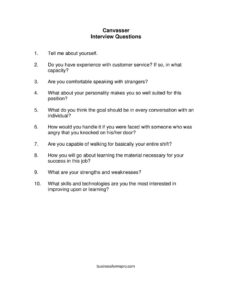
Canvasser Interview Questions
Use this free Canvasser Interview Questions template to screen door-to-door and field canvassers consistently and fairly — free download in PDF and DOCX.
PDF
DOCX
10 downloads
0
likes
Download Files
- DOCX
The Canvasser Interview Questions template is a ready-made list of structured questions employers use to screen candidates for door-to-door, field, or street canvassing roles. Hiring managers most often reach for it to evaluate communication skills, stamina, and comfort approaching strangers before making an offer. It’s free to download here in both PDF and DOCX, with no signup required.
What Is a Canvasser Interview Questions Form?
A Canvasser Interview Questions form is a structured interview guide containing a fixed set of questions asked of every applicant for a canvassing position. It is typically used by campaign managers, nonprofit field directors, sales team leads, and recruiting coordinators who need to assess people-facing skills quickly. The document standardizes how candidates are evaluated, capturing responses about customer service background, personality fit, physical readiness, and willingness to learn. Because canvassing involves repeated face-to-face contact with the public — often unsolicited — the form focuses heavily on interpersonal confidence and resilience. Used consistently, it helps interviewers compare applicants on the same criteria rather than relying on gut feeling, which makes hiring decisions more defensible and fair.
When Do You Need a Canvasser Interview Questions Form?
This template fits any situation where you are bringing on people to engage the public in person. Common scenarios include:
- Political campaigns staffing up for voter outreach, petition drives, or get-out-the-vote efforts before an election deadline.
- Nonprofits and advocacy groups hiring fundraising or awareness canvassers to work neighborhoods and public spaces.
- Door-to-door sales companies recruiting reps for home services, solar, telecom, or pest control.
- Market research firms needing field interviewers to collect survey responses in person.
- Community organizing groups onboarding seasonal staff for membership or signature collection drives.
- Staffing agencies screening multiple candidates in a single hiring day and needing a repeatable format.
What a Canvasser Interview Questions Form Should Have
A useful canvasser interview guide covers more than rapport-building chit-chat. It should probe the candidate’s customer service experience, comfort with rejection and confrontation, physical capacity for long shifts on foot, self-motivation in learning scripts and materials, and an honest read on strengths and weaknesses. It should also leave room for the interviewer to take notes and score answers. The strongest versions balance open-ended questions that reveal personality with practical questions that confirm a candidate can physically and emotionally handle the work. This template includes ten questions that hit each of those areas, giving you a complete, reusable framework.
How to Fill Out a Canvasser Interview Questions Form
Use the form as your interview script and note-taking sheet. Work through it in order:
- Open with “Tell me about yourself” to settle the candidate and gauge communication style.
- Ask about customer service experience and in what capacity to understand their people-facing background.
- Confirm they are comfortable speaking with strangers, the core of the job.
- Probe what makes their personality well suited to canvassing — listen for energy and warmth.
- Ask what the goal of every conversation should be to test their understanding of the role’s purpose.
- Use the angry homeowner scenario to assess composure under hostility.
- Verify they can walk for an entire shift — a real physical requirement.
- Explore how they’ll learn the material for success, revealing initiative.
- Capture their strengths and weaknesses for an honest self-assessment.
- Finish with skills and technologies they want to improve to gauge growth mindset. Record notes and a score beside each answer.
How to Evaluate the Answers
The questions only help if you interpret the responses well. For the customer service and stranger-comfort questions, look for specific examples rather than vague reassurances — “I worked retail for two summers and handled returns daily” beats “I’m a people person.” The angry-homeowner scenario is the single most revealing item: strong candidates describe staying calm, apologizing, respecting the person’s space, and disengaging politely, while weaker ones get defensive or freeze. For the goal-of-conversation question, the best answers connect to the organization’s actual objective, whether that’s a signature, a sale, a donation, or simply a respectful impression. Treat the strengths-and-weaknesses answer as a self-awareness test, not a trick, and weight the learning and technology questions as signals of how much training effort a new hire will require.
Tips for a Fair, Consistent Interview
Ask every candidate the same questions in the same order so your comparisons are valid. Take brief notes during, not after, each answer while details are fresh. Avoid leading questions that hint at the “right” response, and resist the urge to fill silences — canvassers must be comfortable with pauses, so let candidates demonstrate that. Keep your questions focused on the job and steer clear of topics that touch on protected characteristics such as age, religion, national origin, disability, or family status. If a role has a hard physical requirement like walking for hours, state it plainly as a job function rather than asking about a candidate’s health.
Common Mistakes to Avoid
- Skipping the physical-stamina question and then losing new hires in their first week of long shifts.
- Asking questions inconsistently, which makes it impossible to compare candidates fairly.
- Ignoring the angry-homeowner answer, even though confrontation tolerance predicts on-the-job success.
- Talking too much and not giving the candidate room to reveal their communication style.
- Failing to take notes, leaving you relying on memory after a full day of interviews.
- Drifting into personal or illegal questions instead of staying on job-related topics.
Frequently Asked Questions
What is a Canvasser Interview Questions form used for? It is a structured guide that standardizes the questions you ask every applicant for a canvassing or door-to-door role. It helps you assess communication skills, stamina, and resilience consistently, so hiring decisions are based on the same criteria for each candidate.
How do I use this template in an actual interview? Print it or open the DOCX, then read each question in order and jot notes or a score beside the candidate’s response. Using the identical sequence for everyone makes your comparisons fair and your final decision easier to justify.
Can I edit or add my own questions? Yes. The DOCX version is fully editable, so you can add organization-specific questions, scoring scales, or scenarios relevant to your campaign, product, or cause while keeping the core ten questions as a foundation.
Are these questions legally safe to ask? The questions here focus on job-related skills and requirements, which is the right approach. You should still avoid topics that touch on protected characteristics and frame physical requirements as job functions; employment rules vary by jurisdiction, so confirm your local guidelines.
What makes a strong canvasser candidate? Look for genuine comfort approaching strangers, composure when facing rejection or hostility, physical readiness for walking shifts, and a willingness to learn scripts and materials quickly. Specific examples from past experience are a better signal than confident generalities.
Is this Canvasser Interview Questions template free? Yes, it is completely free to download in both PDF and DOCX formats with no signup or payment required. You can reuse it for as many candidates and hiring rounds as you need.
This Canvasser Interview Questions template is a general example provided for informational purposes only and does not constitute legal, HR, or employment advice. Hiring and interview laws vary by jurisdiction — consult a qualified professional to ensure your process complies with applicable regulations.
Official resource: for the rules that apply to your situation, see the U.S. Department of Labor.
Related Forms
- Handyman Interview Questions
- Server Interview Questions
- Dispatcher Interview Questions
- Business Development Manager Interview Questions
- Home Healthcare Assistant Interview Questions
- Technical Writer Interview Questions
Browse more in Interview Questions.