
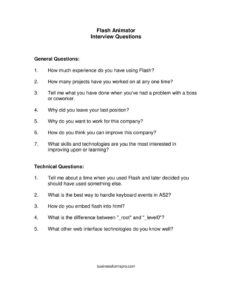
Flash Animator Interview Questions
Download a free Flash Animator interview questions template to structure your hiring process and assess candidates fairly — free PDF and DOCX download.
PDF
DOCX
2 downloads
0
likes
Download Files
- DOCX
The Flash Animator Interview Questions template is a ready-made set of general and technical prompts hiring managers use to evaluate candidates for animation and interactive media roles. Most teams reach for it to bring structure and consistency to interviews so every applicant is judged against the same benchmarks. It’s free to download in PDF and DOCX, with no signup required.
What Is a Flash Animator Interview Questions Template?
A Flash Animator Interview Questions template is a curated list of questions an interviewer asks a candidate applying for a Flash animation, motion graphics, or interactive content position. It blends behavioral and background questions with hands-on technical probes covering ActionScript, event handling, and web embedding. Hiring managers, creative directors, recruiters, and lead developers use it to assess both a candidate’s portfolio experience and their practical command of the tools. The document captures what matters most in one place — past project workload, problem-solving under pressure, and depth of technical knowledge — so the conversation stays focused. Because the questions are written out in advance, the same framework can be reused across multiple candidates, making side-by-side comparison far easier.
When Do You Need a Flash Animator Interview Questions Template?
This template earns its keep any time you’re evaluating talent for animation or interactive web work. Common situations include:
- Hiring a full-time Flash or motion animator for an in-house creative or product team.
- Screening freelance or contract candidates for a short-term interactive campaign.
- Building a consistent interview rubric so multiple interviewers ask the same baseline questions.
- Training a junior recruiter or hiring manager who needs a vetted starting point for a technical role.
- Conducting a phone or video pre-screen before inviting a candidate to a portfolio review.
- Refreshing an outdated interview script to make sure both soft skills and technical depth get covered.
General Versus Technical Questions
The template is intentionally split into two halves, and each serves a distinct purpose. The general questions explore experience level, workload capacity, motivation, and how the candidate handles conflict — the human factors that predict whether someone will thrive on your team. The technical questions dig into real working knowledge: ActionScript 2 keyboard events, HTML embedding, the subtle distinction between _root and _level0, and familiarity with adjacent web technologies. Using both sections together gives you a rounded view, so you don’t end up hiring a strong personality with shallow skills or a technical specialist who can’t collaborate.
What a Good Interview Question Set Should Have
A complete interview document for this role should include a clear separation between behavioral and technical questions, room for the interviewer to take notes on each answer, and space to score or rate responses. It should cover the candidate’s hands-on experience, how many concurrent projects they can realistically manage, their reasons for moving roles, and their genuine interest in your company. On the technical side, it should test practical decision-making — not just memorized definitions — by asking about times a tool choice went wrong and how the candidate would solve specific implementation problems.
How to Fill Out the Flash Animator Interview Questions Template
Work through the form in order, recording each answer as you go:
- Open with experience: ask how much experience the candidate has using Flash and note years, versions, and project types.
- Probe capacity by asking how many projects they’ve handled at one time to gauge their multitasking limits.
- Explore temperament with the prompt about a past problem with a boss or coworker and how they resolved it.
- Ask why they left their last position, listening for tone and professionalism.
- Cover motivation: why they want to work for your company and how they think they could improve it.
- Note the skills and technologies they most want to learn to assess growth mindset.
- Move to technical depth: ask about a time they used Flash but should have chosen something else, the best way to handle keyboard events in AS2, how to embed Flash into HTML, the difference between _root and _level0, and what other web interface technologies they know.
Tips for Getting Honest, Useful Answers
Questions are only as good as the follow-ups they inspire. When a candidate gives a brief reply about concurrent projects, ask how they prioritized when deadlines collided. If they describe a tool they’d swap out, ask what they’d choose instead and why — that distinguishes someone who memorized an answer from someone who reasons through trade-offs. For the technical items, listen for whether they can explain why, not just recite a definition; understanding the difference between _root and _level0 matters less than knowing when each could cause bugs in a multi-SWF project. Keep your tone conversational so candidates relax and reveal how they actually think.
Adapting the Template for Modern Roles
Because Flash has been deprecated in favor of HTML5, Canvas, and JavaScript-based animation, you may want to treat several questions as a window into transferable skills rather than current-day requirements. A candidate’s reasoning about keyboard events, embedding, and scope still demonstrates how they approach interactive development. Consider adding parallel questions about HTML5 animation, Adobe Animate, GreenSock, or WebGL so the template reflects the technologies your team actually ships with today.
Common Mistakes to Avoid
- Reading questions verbatim without follow-ups — you’ll miss the depth behind a candidate’s answers.
- Weighting technical questions so heavily that you ignore collaboration and conflict-resolution signals.
- Letting the "why did you leave" question turn into negativity without redirecting to lessons learned.
- Failing to take consistent notes, which makes comparing candidates later nearly impossible.
- Treating outdated technical questions as pass/fail rather than as indicators of reasoning ability.
- Skipping a portfolio or practical exercise — interviews alone rarely reveal real production skill.
Frequently Asked Questions
What is a Flash Animator Interview Questions template? It is a structured list of general and technical questions used to evaluate candidates for Flash animation and interactive media roles. It helps interviewers cover experience, motivation, and hands-on skills in one consistent format. You can download it free and adapt it to your specific opening.
How do I use this template in an interview? Start with the general questions to understand the candidate’s background and motivation, then move into the technical section to gauge their practical knowledge. Take notes beside each answer and use follow-up questions to dig deeper. Reusing the same set across candidates makes fair comparison much easier.
Are these questions still relevant now that Flash is deprecated? The technical questions are tied to a specific era of web development, but they still reveal how a candidate reasons about scope, events, and embedding. Many teams use them as transferable-skill prompts or pair them with modern HTML5 and JavaScript questions. Feel free to update or supplement the list to match your current tech stack.
Can I edit the questions in this template? Yes. The DOCX version is fully editable, so you can add role-specific questions, remove anything that doesn’t apply, or insert a scoring column. Tailoring the document to your actual job description will always produce better results than using it as-is.
How much does this template cost? It is completely free to download from Business Forms Pro in both PDF and DOCX formats. There is no signup, subscription, or payment required. You can use it for as many interviews as you like.
Should I combine this with a practical test? Absolutely. Interview questions reveal how a candidate communicates and reasons, but a portfolio review or short hands-on exercise shows what they can actually build. Pairing the two gives you a far more reliable picture of a candidate’s abilities.
This template is provided as a general example for informational purposes only and does not constitute legal, HR, or hiring advice. Employment and interview practices vary by jurisdiction and organization — consult a qualified human resources or legal professional to ensure your hiring process complies with applicable laws.
Official resource: for the rules that apply to your situation, see the U.S. Department of Labor.
Related Forms
- Computer Programmer Interview Questions
- Technical Writer Interview Questions
- Housekeeper Interview Questions
- IT Operations Manager Interview Questions
- Floral Designer Interview Questions
- Home Healthcare Assistant Interview Questions
Browse more in Interview Questions.