
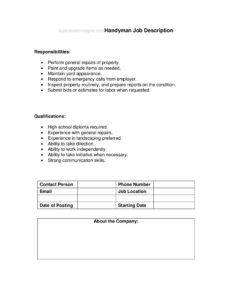
Handyman Job Description
Use this free Handyman job description template to outline duties, skills, and qualifications, then attract qualified candidates — free download in PDF and DOCX.
PDF
DOCX
0
likes
Download Files
- DOCX
A Handyman job description is a document employers use to define the repair, maintenance, and general upkeep duties of a handyman role, the most common reason being to attract qualified candidates and set clear expectations before hiring. It typically splits into two core areas — Responsibilities and Qualifications — so applicants know exactly what the work involves and whether they’re a fit. This template is free to download in PDF and DOCX, with no signup required.
What Is a Handyman Job Description?
A Handyman job description is a written summary of the tasks, skills, and experience expected of a person hired to perform general maintenance and minor repairs around a property, business, or facility. It is usually created by a hiring manager, property owner, facilities supervisor, or HR coordinator. The document communicates what the job entails day to day — such as fixing fixtures, patching walls, and handling small carpentry, plumbing, or electrical tasks — and what background a candidate needs to do it safely. Beyond recruiting, it serves as a reference point for performance reviews, onboarding, and clarifying scope once someone is hired. A well-written version reduces confusion and helps both sides agree on responsibilities from the start.
When Do You Need a Handyman Job Description?
You’ll reach for this document anytime you need to define, advertise, or formalize a handyman position. Common situations include:
- Posting a job opening on job boards, social media, or your company website to draw qualified applicants.
- Hiring your first maintenance employee for an apartment complex, office building, or property management firm.
- Replacing a departing handyman and wanting to clarify or update the duties before re-listing the role.
- Bringing on a part-time or contract handyman and needing a clear scope of work to avoid disputes.
- Standardizing roles across multiple properties so every site’s maintenance staff has consistent expectations.
- Conducting performance reviews where you measure an existing worker against agreed-upon responsibilities.
Types of Handyman Roles to Adapt It For
The same template flexes to fit several arrangements. A residential property handyman focuses on tenant requests and unit turnovers. A commercial facilities handyman handles office repairs, lighting, and minor HVAC upkeep. A self-employed or contract handyman might use the description as a service-scope outline for clients. Adjust the Responsibilities and Qualifications to match whichever situation applies.
What a Handyman Job Description Should Have
A complete handyman job description gives candidates a clear, honest picture of the role. The key elements to include are:
- A short job summary or overview describing the role’s purpose.
- A detailed Responsibilities section listing the actual tasks performed.
- A Qualifications section covering required skills, experience, certifications, and physical demands.
- Reporting lines — who the handyman answers to.
- Work schedule, location, and whether on-call or weekend availability is needed.
- Tools or transportation expectations, if the worker must supply their own.
- Any licensing or insurance requirements relevant to your jurisdiction.
How to Fill Out a Handyman Job Description
This template centers on two headings — Responsibilities and Qualifications — so most of your effort goes into populating each clearly. Follow these steps:
- Add a job title and brief intro at the top, such as “Handyman / General Maintenance Technician,” with one or two sentences on the role’s purpose.
- Complete the Responsibilities section. List concrete, action-driven duties: “Perform minor plumbing and electrical repairs,” “Patch and paint walls,” “Assemble and install fixtures,” “Conduct routine inspections,” and “Respond to maintenance requests within set timeframes.” Use bullet points and lead with verbs.
- Complete the Qualifications section. Specify the experience level (e.g., “2+ years in general maintenance”), required skills, any certifications or licenses, a valid driver’s license if needed, and physical requirements like lifting ability.
- State reporting and logistics. Note who the handyman reports to, the work location, and the schedule.
- Add compensation and how to apply if you’re using it as a job posting.
- Review and trim so the listing stays focused and realistic.
Tips for Writing Responsibilities and Qualifications That Attract the Right People
Be specific without overloading the list — eight to twelve focused responsibilities read better than a wall of thirty. Separate “must-have” qualifications from “nice-to-have” ones so you don’t accidentally screen out solid applicants. Use plain language a tradesperson would actually use, and avoid corporate jargon. If certain tasks dominate the role, list them first. Mention any safety expectations, since maintenance work involves real hazards. Finally, keep tone honest about the physical nature of the job; setting accurate expectations up front reduces early turnover and saves you from re-hiring.
How It Differs From a Contract or Offer Letter
A job description is not a binding employment agreement. It describes the role and is typically used to recruit, evaluate, and onboard. An offer letter formally extends a position with pay and start date, while an employment contract sets out enforceable terms. Many employers attach or reference the job description within onboarding paperwork, but the description itself is a planning and communication tool rather than a legal commitment. Keep that distinction in mind when wording it.
Common Mistakes to Avoid
- Being too vague — “handle repairs” tells candidates nothing; specify the trades and task types.
- Listing unrealistic qualifications that scare off capable applicants or don’t match the pay offered.
- Ignoring physical and safety demands, leading to mismatched hires who can’t meet the job’s reality.
- Forgetting licensing rules — some plumbing or electrical work requires a licensed professional in your area.
- Mixing responsibilities and qualifications into one jumbled list instead of keeping the two sections distinct.
- Leaving out schedule and on-call expectations, which often surface as disputes after hiring.
Frequently Asked Questions
What is a Handyman job description? It is a document that outlines the maintenance and repair duties of a handyman role along with the skills and experience required. Employers use it to advertise openings, set expectations, and guide performance reviews. It centers on two key sections: Responsibilities and Qualifications.
How do I fill out this Handyman job description template? Start with a job title and short summary, then list specific duties under Responsibilities and required skills, experience, and certifications under Qualifications. Add reporting lines, schedule, and how to apply if you’re posting it publicly. Keep each section focused and written in plain, action-oriented language.
Is a job description a legally binding document? Generally no — a job description describes a role for recruiting and management purposes rather than serving as an enforceable contract. Binding terms usually live in an offer letter or employment agreement. Still, write it accurately, since it may be referenced during onboarding or disputes.
What qualifications should a handyman have? This varies by role, but common ones include general maintenance experience, basic plumbing, electrical, carpentry, and painting skills, the ability to lift and stand for long periods, and often a valid driver’s license. Some tasks may legally require a licensed tradesperson depending on your jurisdiction. Separate must-haves from preferred skills to widen your candidate pool.
How much does this template cost? It is completely free to download from Business Forms Pro in both PDF and DOCX formats, with no signup or payment required. You can edit it freely to match your company, property, or specific role. Reuse it as often as you need.
Can I customize it for a contractor or part-time role? Yes. Adjust the Responsibilities to reflect the actual scope and edit the Qualifications and schedule sections for part-time, contract, or self-employed arrangements. The two-section structure adapts easily to residential, commercial, or independent handyman work.
This template is a general example provided for informational purposes only and does not constitute legal, employment, or HR advice. Hiring rules, licensing requirements, and labor laws vary by jurisdiction — consult a qualified professional or your local authority before finalizing or posting a job description.
Official resource: for the rules that apply to your situation, see the U.S. Department of Labor.
Related Forms
- Landscaper Job Description
- Project Manager Job Description
- HR Specialist Job Description
- Sales Representative Job Description
- Hairstylist Job Description
- Finance Manager Job Description
Browse more in Job Descriptions.