
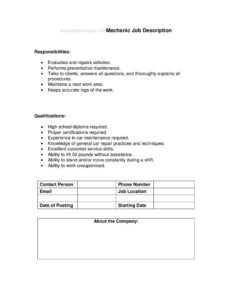
Mechanic Job Description
Download a free Mechanic Job Description template to outline responsibilities, qualifications, and skills and attract the right mechanics fast.
PDF
DOCX
4 downloads
0
likes
Download Files
- DOCX
A Mechanic Job Description is a document that defines the duties, qualifications, and expectations for a mechanic role, helping employers attract qualified candidates and giving applicants a clear picture of the job. The most common reason people use it is to write a consistent, professional job posting before advertising an open position. You can download this template free in PDF and DOCX with no signup required.
What Is a Mechanic Job Description?
A Mechanic Job Description is a written summary of what a mechanic role involves, typically issued by an employer, hiring manager, shop owner, or HR department. It documents the core responsibilities the mechanic will perform — such as diagnosing, repairing, and maintaining vehicles or equipment — alongside the qualifications, certifications, and skills needed to do the job well. The purpose is twofold: it serves as a recruiting tool when posted on job boards, and it acts as an internal reference that clarifies expectations once someone is hired. A clear job description reduces hiring mismatches, supports fair performance reviews, and helps the whole team understand where one role’s duties begin and end.
When Do You Need a Mechanic Job Description?
This document is useful any time a role needs to be defined, advertised, or clarified. Common situations include:
- Hiring a new mechanic: You need a job posting for a job board, your website, or a staffing agency.
- Filling a specialty role: You are recruiting a diesel technician, brake specialist, or heavy-equipment mechanic and want to list the right certifications.
- Replacing a departing employee: A senior mechanic is leaving and you want to capture exactly what the role covers before backfilling it.
- Restructuring your shop: You are splitting duties among several technicians and need each role clearly documented.
- Setting performance expectations: You want a written baseline to use during reviews, probation periods, or coaching conversations.
- Standardizing your hiring process: Your business posts for mechanics regularly and you want a reusable, consistent template.
Types of Mechanic Roles to Tailor For
Although the template uses two simple sections — Responsibilities and Qualifications — the way you fill them in should match the specific role. An automotive mechanic focuses on passenger vehicles, while a diesel mechanic works on trucks and heavy engines. A fleet mechanic maintains a company’s vehicles on a preventive schedule, and a motorcycle or small-engine mechanic handles specialized equipment. An aircraft or industrial maintenance mechanic requires stricter certifications. Decide which type you are hiring before writing, so the responsibilities and qualifications reflect the real demands of that position.
What a Mechanic Job Description Should Have
A complete and effective job description usually includes more than the two core headings, even though Responsibilities and Qualifications are the backbone. Consider adding a job title and brief role summary, the type of employment (full-time, part-time, contract), the work location and shift, and a short line about your shop or company. Within Responsibilities, list specific, action-driven duties. Within Qualifications, separate required items from preferred ones. Where relevant, mention physical requirements, certifications like ASE, tool ownership expectations, and any reporting structure. The clearer and more specific each element is, the better your applicant pool will match the role.
How to Fill Out a Mechanic Job Description
- Add a job title and summary: At the top, name the role precisely (for example, “Automotive Service Technician”) and write one or two sentences describing its purpose.
- Complete the Responsibilities section: List the day-to-day duties as bullet points. Use strong action verbs such as diagnose, inspect, repair, replace, test, and document. Examples: perform routine maintenance like oil changes and tire rotations; diagnose mechanical and electrical faults; repair brakes, transmissions, and suspension components; and maintain accurate service records.
- Complete the Qualifications section: List what a candidate must bring to the role — a high school diploma or equivalent, a valid driver’s license, hands-on experience, relevant certifications, and the technical and soft skills you need.
- Separate required from preferred: Mark must-haves clearly and place “nice to have” items in a preferred group so you do not screen out good candidates.
- Add logistics: Note schedule, location, pay range if you disclose it, and how to apply.
- Review and finalize: Read the whole posting from a candidate’s perspective, tighten the language, and save your PDF or DOCX copy.
Writing Responsibilities and Qualifications That Work
The quality of your applicants depends heavily on how you phrase these two sections. For Responsibilities, keep each bullet to a single clear duty and lead with a verb, so candidates can quickly self-assess. Aim for six to ten bullets that cover the most important and most frequent tasks rather than an exhaustive list. For Qualifications, be realistic: requiring excessive years of experience or rare certifications can shrink your pool unnecessarily. Distinguish between technical qualifications (engine diagnostics, electrical systems, familiarity with diagnostic software) and personal qualities (reliability, attention to detail, communication with customers). When both sections are specific and honest, candidates can decide whether to apply, and you spend less time screening poor fits.
Common Mistakes to Avoid
- Being too vague: “Repair vehicles” tells a candidate nothing — specify the systems, tasks, and tools involved.
- Listing every possible duty: An overloaded list discourages strong applicants; focus on the core of the job.
- Confusing required with preferred: Demanding too many must-haves filters out otherwise excellent candidates.
- Ignoring physical and safety realities: Mechanic work involves lifting, standing, and hazards; mention key physical requirements honestly.
- Forgetting certifications and licenses: If ASE certification or a specific license matters, state it clearly under Qualifications.
- Skipping logistics: Leaving out shift, location, or how to apply leads to confused candidates and missed applications.
Frequently Asked Questions
What is a Mechanic Job Description? It is a document that outlines the responsibilities, qualifications, and skills required for a mechanic position. Employers use it to advertise open roles and to set clear expectations once someone is hired. It typically centers on two sections: what the mechanic will do and what they need to bring to the job.
How do I fill out the Responsibilities and Qualifications sections? Under Responsibilities, list the specific duties the mechanic will perform using action verbs like diagnose, repair, and maintain. Under Qualifications, list the education, certifications, experience, and skills required to do those duties well. Keep each bullet concise and tailored to the exact role you are hiring for.
Should I include a salary range? Including a pay range is optional, but many candidates expect it and some jurisdictions require pay transparency in job postings. Listing a range can increase the number and quality of applicants by setting clear expectations. Check your local rules, since requirements vary by location.
Is a job description a legally binding contract? A job description is generally not an employment contract on its own; it is a description of the role and its expectations. However, the language you use can have legal implications, especially around discrimination and accommodation. To keep postings compliant, focus on the essential functions of the job and avoid requirements unrelated to performing it.
What certifications should I list for a mechanic? This depends on the role, but common ones include ASE certifications for automotive work, a valid driver’s license, and any manufacturer-specific or specialty credentials. List truly required certifications as must-haves and others as preferred. Match the credentials to the type of mechanic you are hiring.
Is this Mechanic Job Description template really free? Yes. You can download it free in both PDF and DOCX formats with no signup required. Edit it freely to match your shop, role, and local requirements before posting.
This Mechanic Job Description template is a general example provided for informational purposes only and is not legal, HR, or employment advice. Hiring and posting requirements vary by jurisdiction and may change over time, so consult a qualified HR or legal professional to ensure your job description complies with applicable laws.
Official resource: for the rules that apply to your situation, see the U.S. Department of Labor.
Related Forms
- Hotel Front Desk Staff Job Description
- Mortgage Loan Officer Job Description
- HR Specialist Job Description
- Internet Marketing Director Job Description
- Car Salesperson Job Description
- Web Developer Job Description
Browse more in Job Descriptions.