
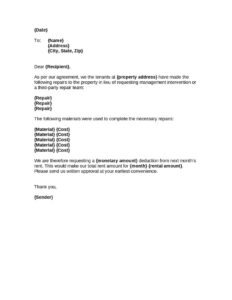
Tenant Repair Deductible
Use this free Tenant Repair Deductible letter template to request a rent deduction for repairs you completed yourself, with a free PDF and DOCX download.
DOCX
2 downloads
0
likes
Download Files
- DOCX
A Tenant Repair Deductible letter is a written request from a renter asking a landlord to deduct the cost of repairs the tenant completed themselves from an upcoming rent payment. People most often use it when they fixed something around the property — with the landlord’s prior agreement — and want to be reimbursed cleanly through their rent rather than waiting on a separate check. You can download this template free in both PDF and DOCX formats, with no signup required.
What Is a Tenant Repair Deductible Letter?
A Tenant Repair Deductible letter is a formal notice a tenant sends to a landlord or property manager documenting repairs they performed and the materials they paid for, then requesting that the total be subtracted from the next month’s rent. It serves as a paper trail showing what was fixed, what it cost, and exactly how much the tenant expects to deduct. Because it references an existing agreement to handle the work in lieu of management intervention, it ties the request back to the understanding both parties reached. The letter also invites the landlord to respond in writing, which protects both sides and avoids confusion when rent comes due.
When Do You Need a Tenant Repair Deductible Letter?
This letter fits situations where a renter has spent their own money on a repair and needs to settle up through rent. Common scenarios include:
- You and your landlord agreed you would handle a minor repair yourself, and now you need to claim the cost back.
- A faucet, toilet, or pipe was leaking, and you bought parts and fixed it rather than waiting for a repair crew.
- You replaced a broken appliance component, light fixture, or door hardware out of pocket.
- An urgent issue arose — like a failing lock or a clogged drain — and you addressed it immediately with the landlord’s blessing.
- You paid for materials such as caulk, paint, or weather-stripping to complete a repair the landlord approved.
- You want a documented record of the deduction so next month’s rent payment isn’t flagged as short.
What a Tenant Repair Deductible Letter Should Have
A complete letter leaves no room for a dispute over numbers. It should clearly identify the date, the landlord or property manager being addressed, and the rental property in question. It needs a description of each repair performed, an itemized list of the materials used with their individual costs, and a clear total deduction amount. Critically, it should state what next month’s rent will be after the deduction is applied, name the month affected, and request written approval. A polite, businesslike tone and a signature from the tenant round it out and keep the exchange professional.
How to Fill Out a Tenant Repair Deductible Letter
- Enter the Date you are writing the letter at the top.
- In the address block, fill in the recipient’s Name, Address, and City, State, Zip — this is your landlord or property management company.
- Open with the greeting and insert the Recipient name after “Dear.”
- Confirm the property address where you are a tenant so the repairs are tied to the correct unit.
- List each Repair you completed in the three repair lines, describing the work clearly (for example, “replaced kitchen faucet washer”).
- In the materials table, enter each Material alongside its Cost, using as many of the five rows as you need. Keep receipts to back up every figure.
- State the requested monetary amount for the rent deduction — this should equal the sum of your material costs.
- Fill in the month the deduction applies to and the resulting rental amount after subtracting the deduction.
- Sign off with your name in the Sender field and request written approval before submitting.
Get Written Approval Before You Deduct
The single most important step is securing the landlord’s written approval before you actually reduce your rent payment. This template specifically asks the recipient to “send us written approval at your earliest convenience” for exactly this reason. Even when you had a verbal agreement to perform the repair, deducting money without confirmation can be treated as a partial nonpayment of rent. By waiting for a written reply — an email, text, or signed copy of this letter — you turn an informal understanding into clear evidence. Keep that approval, along with your receipts and photos of the completed work, in case any question arises later. Many regions have specific “repair and deduct” rules with notice requirements and dollar caps, so confirming the process locally protects you.
Itemize Honestly and Keep Receipts
The materials table is the backbone of your request, so accuracy matters. Only list materials you actually purchased to complete the approved repairs, and match each cost to a receipt. Do not include your own labor unless the landlord specifically agreed to compensate it, since most repair-deduct arrangements cover materials and contractor invoices rather than a tenant’s time. Round to the exact figures on your receipts rather than estimating. If a single repair required several items, give each its own line so the landlord can verify the math at a glance. A transparent, itemized list makes approval far more likely and far faster.
Common Mistakes to Avoid
- Deducting before approval. Reducing your rent without written confirmation can be treated as unpaid rent.
- Skipping receipts. Without proof of cost, a landlord can reasonably dispute the deduction amount.
- Math errors. Make sure the deduction equals your itemized totals and that the new rent figure is calculated correctly.
- Vague repair descriptions. “Fixed bathroom” tells the landlord little; specify exactly what was repaired.
- Doing major work without permission. This letter is for agreed-upon repairs, not unilateral renovations.
- Forgetting to name the affected month. Clarify which rent payment the deduction applies to so there’s no confusion when it’s due.
Frequently Asked Questions
What is a Tenant Repair Deductible letter? It is a written request from a tenant asking the landlord to subtract the cost of repairs the tenant completed from next month’s rent. The letter itemizes each repair, lists the materials and their costs, and states the exact deduction amount. It also requests written approval to keep the arrangement documented.
Can I deduct repair costs from rent without asking first? Generally no — you should have an agreement in place and obtain written approval before reducing your payment. Deducting money on your own can be treated as failing to pay full rent, even when the repair was legitimate. This template is built around getting that approval first.
What should I include in the materials list? List each material you purchased to complete the approved repair alongside its actual cost, using the rows provided. Match every figure to a receipt and avoid estimating. Stick to materials and parts unless your landlord specifically agreed to cover labor.
Does this letter need to be notarized or witnessed? No, a repair deduction request typically does not require notarization or witnesses. It is a routine communication between a tenant and landlord. What matters most is keeping a copy and obtaining the landlord’s written approval before applying the deduction.
Is a Tenant Repair Deductible letter legally binding? The letter itself is a request, not a binding agreement, until the landlord approves it in writing. Once both parties agree on the deduction in writing, that exchange documents the arrangement. Local “repair and deduct” laws may also govern when and how much a tenant can deduct.
How much does this template cost? Nothing — you can download the Tenant Repair Deductible letter free in PDF and DOCX formats with no signup required. Open it, fill in your repairs, materials, and deduction amount, and send it to your landlord. You can reuse and customize it for any approved repair situation.
This template is a general example provided for informational purposes only and is not legal, financial, or tax advice. Landlord-tenant laws and repair-and-deduct rules vary by state and locality. Consult a qualified attorney or your local housing authority before deducting any amount from your rent.
Official resource: for the rules that apply to your situation, see HUD.
Related Forms
- Tenant Lease Breaking Request Letter
- Tenant Property Damage Letter
- Move In Letter
- Eviction Notice
- Agreement On Tenant Alterations To Rental Unit
- Pre-Rental Comparison Checklist
Browse more in Landlord Documents.