
Request Transcript
Download a free Request Transcript letter template to order official school transcripts quickly and clearly — free PDF and DOCX download, no signup.
DOCX
2 downloads
0
likes
Download Files
- DOCX
A Request Transcript letter is a short, formal letter you send to a school’s registrar to ask for official copies of your academic transcript. People most often use it when applying to another college, a graduate program, or a job that requires proof of completed coursework. You can download this template free in PDF and DOCX, with no signup required.
What Is a Request Transcript Letter?
A Request Transcript letter is a written notice from a former or current student to a college, university, or high school requesting that an official copy of their academic record be released. It identifies who is asking, which transcripts they want, where to send them, and confirms that any required processing fees are included. The registrar uses this letter to verify your identity, confirm you have no outstanding holds, and process the release. Although many institutions now offer online ordering, a signed paper letter remains a reliable and widely accepted method — especially for older records, mail-only requests, or situations where a physical signature is preferred for verification.
When Do You Need a Request Transcript Letter?
This letter is useful any time you must formally ask an institution to release your academic record. Common situations include:
- Applying to another school — undergraduate transfer, graduate, or professional programs that require an official transcript sent directly from the issuing institution.
- Job applications — employers in fields such as teaching, government, finance, or licensing sometimes verify your degree through an official transcript.
- Professional licensing or certification boards that require proof of completed coursework or a conferred degree.
- Personal records — keeping an official copy for your own files, scholarship applications, or immigration paperwork.
- Transferring credits when re-enrolling after a break in study, so your new program can evaluate prior coursework.
- Replacing lost copies — requesting additional official transcripts after misplacing earlier ones.
What a Request Transcript Letter Should Have
A complete request gives the registrar everything needed to act without contacting you for clarification. It should include your full name and current contact details, the registrar’s name and the school address, the date, the number of official copies you want, and the fee you are enclosing. It should also state relevant identifying details — your student identification number, your degree and graduation date — and confirm you have no financial holds that would block release. Finally, it should specify the delivery address and be signed.
How to Fill Out a Request Transcript Letter
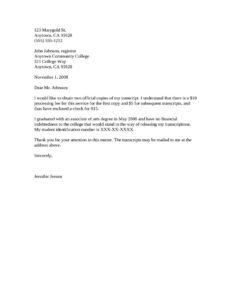
- Add your return address. At the top, enter your street address, city, state, and ZIP, plus a phone number (for example, 123 Marygold St., Anytown, CA 95928, (555) 555-1212).
- Address the registrar. Write the registrar’s name (e.g., John Johnson, registrar), the institution name, and its full mailing address.
- Date the letter. Include the date you are sending it.
- Open with a salutation. Use a formal greeting such as “Dear Mr. Johnson:”.
- State your request. Specify exactly how many official copies you need — for example, two official copies of your transcript.
- Address the fee. Note the processing fee you understand applies (such as $10 for the first copy and $5 for each additional) and the total enclosed (for example, a $15 check).
- Provide identifying details. List your degree and graduation date (e.g., associate of arts, May 2008) and your student identification number.
- Confirm no holds. State that you have no financial indebtedness to the school that would prevent release.
- Give delivery instructions. Indicate where the transcripts should be mailed.
- Close and sign. End with “Sincerely,” and your signature and printed name.
Fees, Holds, and Processing Time
Most institutions charge a per-copy processing fee, and the amounts vary widely — the $10-first-copy and $5-each-additional figures in this sample are only an example, so check your school’s current rates before enclosing a check. Confirm the accepted payment method, since some offices take checks while others require online payment or money orders. Be aware that registrars typically will not release a transcript if you have an unpaid balance, an unreturned library book, a parking fine, or another administrative hold; clearing those first prevents delays. Processing times also vary, from a few business days to a couple of weeks during peak periods such as the start of a term or graduation season.
Official vs. Unofficial Transcripts
An official transcript is printed on secure paper, bears the registrar’s seal or signature, and is often sent directly to the receiving institution in a sealed envelope. An unofficial transcript is usually a copy you can view or print yourself and is acceptable for personal reference but not for formal applications. This letter is written to request official copies, which is why it specifies the number of certified copies and includes the processing fee. If a program asks for a transcript sent directly to them, note that delivery address in the letter rather than your own.
Common Mistakes to Avoid
- Omitting your student ID number — without it, the registrar may be unable to locate your record promptly.
- Guessing the fee — enclosing the wrong amount can delay processing; verify the current cost first.
- Forgetting to sign — many offices require a signature to verify identity before releasing records.
- Not specifying the number of copies or where to send them, which forces the office to follow up.
- Ignoring outstanding holds — unpaid balances or unreturned materials will stop the release entirely.
- Listing an outdated address — confirm your current mailing address and contact number so the transcripts reach you.
Frequently Asked Questions
What is a Request Transcript letter? It is a formal written request asking a school’s registrar to release official copies of your academic transcript. It identifies you, states how many copies you need, includes any required fee, and tells the office where to send the records. It is a reliable alternative to online ordering, especially for mailed or older requests.
How do I fill out a Request Transcript letter? Add your return address and date, address the registrar by name, state the number of official copies you want, note the fee enclosed, and provide your student ID, degree, and graduation date. Confirm you have no financial holds, specify the delivery address, then sign the letter. Following the template’s order ensures nothing is missed.
Does this letter need to be notarized? No, a transcript request typically does not need notarization. Most registrars only require your signature to verify the request came from you. Some schools may ask for additional identity verification for sensitive or older records, so check your institution’s policy.
How much does it cost to request a transcript? The template itself is free to download here. The school’s own processing fee varies by institution — the dollar amounts shown in the sample are only an example, so confirm the current rates with your registrar before enclosing payment.
How long does it take to receive my transcript? Processing times vary, generally from a few business days to about two weeks. Requests can take longer during busy periods such as the start of a semester or graduation season. Submitting a complete, signed letter with the correct fee helps avoid delays.
Can I request transcripts be sent to a third party? Yes. Simply state the recipient’s name and full mailing address in the delivery instructions instead of your own. Many institutions and employers require official transcripts to be sent directly to them in a sealed envelope, so confirm their preferred delivery method.
This template is a general example provided for informational purposes only and is not legal or professional advice. Transcript policies, fees, and procedures vary by institution and jurisdiction. Confirm requirements directly with your school’s registrar or a qualified professional before submitting your request.
Related Forms
- Book Club Ballot
- Letter to Legislator Showing Concern
- Fire Escape Plan Template
- Copyright Notice
- Course Syllabus
- Dressing Room Numbers
Browse more in Miscellaneous.