
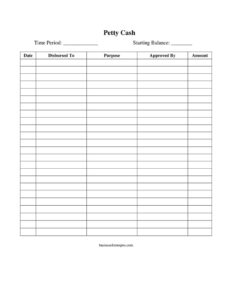
Petty Cash
Free petty cash log template in PDF & DOCX. Learn what petty cash is, how to manage a petty cash fund, and how to reconcile it — download and print today.
PDF
DOCX
2 downloads
0
likes
Download Files
- DOCX
Petty cash is a small amount of physical money a business keeps on hand for minor, everyday expenses. A petty cash log records every disbursement so the fund stays balanced and accountable. Download the free petty cash log below in PDF or DOCX. No signup or email required.
What Is Petty Cash?
Petty cash is a small reserve of cash a business keeps for small purchases that aren’t worth writing a check or running a card for — things like postage, office supplies, a quick delivery, or reimbursing an employee a few dollars. Rather than route every tiny expense through accounts payable, the business sets aside a fixed amount, keeps it in a locked box or drawer, and draws from it as needed. The key to petty cash is accountability: because it’s loose cash, it’s easy to lose track of, so every dollar that leaves the box should be recorded with what it was for and who approved it. That’s exactly what the petty cash log is for.
Why Businesses Use Petty Cash
Even in a card-and-app world, a small cash fund is still handy. It covers minor costs quickly without the paperwork or delay of a purchase order or expense reimbursement, it keeps employees from fronting their own money for small errands, and it provides an easy way to handle the occasional cash-only situation. The trade-off is control: cash is harder to track than electronic payments, which is why a disciplined log and a single responsible custodian matter so much. Used properly, petty cash is a small convenience that saves a surprising amount of administrative friction.
How a Petty Cash Fund Works
A petty cash fund runs on a simple “imprest” system. The business decides on a fixed float — say $100 or $200 — and puts that amount in the box. As money is spent, each disbursement is logged and a receipt is kept, so at any moment the cash remaining plus the receipts should equal the original float. When the cash runs low, the custodian totals the receipts and the fund is “replenished” back up to the float with a single transaction. This keeps the fund at a steady, known amount and makes it easy to see exactly where the money went.
How to Fill Out the Petty Cash Log
- At the top, record the time period the log covers and the starting balance (the float you began with).
- For each expense, enter the date it was paid out.
- Note who the money was disbursed to and the purpose of the expense.
- Record who approved it, so every disbursement has accountability.
- Enter the amount taken from the fund, and keep the matching receipt.
- Subtract each amount from the running balance so you always know how much should be left in the box.
How to Reconcile Petty Cash
Reconciling is the check that keeps the fund honest. Periodically — and always before replenishing — count the cash actually in the box, then add up the receipts and logged disbursements. The cash on hand plus the total spent should equal your starting float. If they match, the fund is balanced. If they don’t, investigate before topping it up: a small shortfall is usually a missing receipt or an unlogged purchase, while repeated discrepancies are a sign the controls need tightening. Once reconciled, replenish the fund back to its float and start the next period.
Common Mistakes to Avoid
- Letting anyone dip into the box without logging the disbursement
- Not keeping receipts, so expenses can’t be verified at reconciliation
- Skipping the “approved by” step, which removes accountability
- Using petty cash for large purchases it was never meant to cover
- Failing to reconcile, so a small problem grows unnoticed
Setting Up a Petty Cash Fund
Starting a petty cash fund takes only a few decisions. First, choose a fixed float — a sensible amount for your needs, often $50 to $200 — and withdraw it from the bank as cash. Next, appoint a single custodian who is responsible for the box and the log, so accountability is clear. Store the cash somewhere secure, such as a locked drawer or cash box, and set a simple rule that nothing leaves the box without a receipt and a recorded approval. Finally, decide when you’ll replenish it — usually when the cash runs low or at the end of each period. With those basics in place, the fund largely runs itself.
Petty Cash and Your Books
In accounting terms, petty cash is a current asset that sits alongside your other cash until it’s spent. When you replenish the fund, you don’t record the top-up itself as an expense — instead, you record the individual expenses the receipts represent (postage, supplies, and so on) and bring the cash balance back up to the float. This is why keeping every receipt matters so much: those receipts are what let your bookkeeper categorize the spending correctly at replenishment time and keep the fund auditable.
Frequently Asked Questions
What is petty cash? It’s a small amount of cash a business keeps on hand for minor, everyday expenses that are too small to justify a check or card payment.
Is petty cash an asset? Yes. On the balance sheet, petty cash is a current asset — it’s part of the company’s cash on hand until it’s spent.
Why do businesses use a petty cash fund? To pay for small, immediate costs quickly without the paperwork of a purchase order or reimbursement, and to avoid employees fronting their own money.
How do you manage petty cash? Set a fixed float, keep it secure with one responsible custodian, log every disbursement with a receipt and approval, and reconcile the box against the log before replenishing it.
How do you reconcile a petty cash fund? Count the cash, add the receipts and logged expenses, and confirm the total equals the starting float. Investigate any difference before topping the fund back up.
How much does this template cost? It’s free to download in PDF and DOCX.
Related Forms
Petty Cash Voucher · Expense Report · Cash Receipts · Check Register · Account Reconciliation Form
This template is provided for general informational purposes only and is not financial or accounting advice. Follow your organization’s internal controls and consult an accountant for your bookkeeping needs.
Official resource: for the rules that apply to your situation, see the Consumer Financial Protection Bureau.
Related Forms
- Entertainment Cash Envelope
- Petty Cash Out
- Home Business Worksheet
- Fun Cash Envelope
- Payment Calculator per $1000
- Travel Cash Envelope
Browse more in Money.