
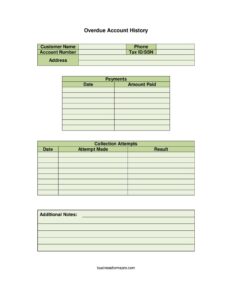
Overdue Account History
Track late payments and collection efforts with a free Overdue Account History template, available as a free download in PDF and DOCX formats.
PDF
DOCX
2 downloads
0
likes
Download Files
- DOCX
An Overdue Account History is a record-keeping document that tracks a customer’s delinquent account, every payment received, and each attempt made to collect the outstanding balance. Businesses most often use it to maintain an organized, chronological paper trail when a customer falls behind on payments. You can download this Overdue Account History template free in both PDF and DOCX formats — no signup required.
What Is an Overdue Account History?
An Overdue Account History is an internal tracking form used by businesses, credit departments, and collections teams to document the full life cycle of a past-due account. It captures who owes money, how much, and what has been done to recover it. The form consolidates customer contact details, account identifiers, a running ledger of payments made, and a log of collection attempts and their results. Rather than relying on scattered notes or memory, staff use this document to see the complete status of an account at a glance, hand off accounts between team members, and support any escalation to a collection agency or legal proceedings. It serves as both a working tool and a historical reference.
When Do You Need an Overdue Account History?
This form is valuable any time a customer’s balance moves past its due date and active follow-up begins. Common situations include:
- A customer misses an invoice due date and your team begins making collection calls and sending reminders.
- You operate a credit or accounts-receivable department and need a standardized way to document delinquent accounts.
- An account is being transferred between collectors and the new staff member needs the full backstory.
- You are preparing to send an account to a third-party collection agency and need a clear record of prior contact attempts.
- You want to document partial payments over time to show good-faith arrangements or repayment progress.
- You may eventually pursue legal action and need a chronological history of communications, payments, and outcomes.
What an Overdue Account History Should Have
A complete and useful Overdue Account History combines identifying information with two ongoing logs. The identifying section should clearly tie the record to a specific customer and account so there is no ambiguity. The payment log should show every amount received and when, while the collection log should capture each outreach attempt and what came of it. Together, these elements answer three essential questions: Who owes the money? How much have they paid so far? And what have we done to collect the rest? A strong form is dated, kept current, and stored securely because it contains sensitive personal and financial identifiers.
How to Fill Out an Overdue Account History
- Customer name: Enter the full legal name of the individual or business that holds the overdue account.
- Phone: Record the best contact number, including any alternate numbers used to reach the customer.
- Account number: Add your internal account or invoice number so the record links to the correct file.
- Tax ID/SSN: Enter the applicable identifier only if your business legitimately requires it; treat this as confidential data.
- Address: Provide the customer’s current mailing or billing address for written notices.
- Payments: Begin the payment ledger that captures each amount received over time.
- Date: For each payment, note the exact date it was received.
- Amount paid: Record the dollar figure for that payment so the running balance stays accurate.
- Collection attempts: Start the outreach log documenting every effort to recover the balance.
- Attempt made: Describe each specific action — phone call, letter, email, or in-person visit — and its date.
- Result: Note the outcome, such as “left voicemail,” “promised payment by Friday,” “disputed charge,” or “no answer.”
Protecting Sensitive Information on This Form
Because the Overdue Account History captures a Tax ID or Social Security Number alongside contact and financial details, it qualifies as sensitive personal information. Store completed forms in a secure, access-controlled location — whether a locked file or an encrypted system — and limit access to staff who genuinely need it. Only collect the Tax ID/SSN if your business has a legitimate reason and the customer’s consent or a lawful basis to hold it; many internal tracking forms can function with the account number alone. When an account is resolved or you no longer need the record, follow a documented retention and disposal policy. Mishandling this data can expose your business to privacy complaints, so build good handling habits from the first entry.
Keeping the Log Accurate and Useful
The value of this form lies in consistency. Update it in real time, immediately after each call or payment, rather than reconstructing events later. Use objective, factual language in the result column — record what the customer said and what was agreed, not opinions. Date every single entry so the chronology holds up if the account is escalated. If a payment plan is arranged, note the agreed amounts and dates so future entries can be checked against the plan. A well-maintained history also helps you spot patterns: a customer who repeatedly promises to pay but never does signals that a different collection strategy or escalation may be warranted.
Common Mistakes to Avoid
- Leaving entries undated, which makes it impossible to prove the sequence of payments and contact attempts.
- Writing vague results like “called” without noting whether you reached the customer or what they said.
- Forgetting to log partial payments, which throws off the running balance and undermines the record.
- Recording opinions or emotional remarks instead of factual, professional notes.
- Storing the form insecurely despite the sensitive Tax ID/SSN and financial data it contains.
- Failing to update the form promptly, so details are lost or reconstructed inaccurately later.
Frequently Asked Questions
What is an Overdue Account History used for? It is an internal tracking document that records a delinquent customer’s details, payments made, and every collection attempt and its outcome. Businesses use it to keep an organized, chronological record of past-due accounts. This makes follow-up, account handoffs, and any escalation far easier to manage.
Is this form a legal document? The Overdue Account History is primarily an internal record-keeping tool rather than a contract or legally binding agreement. That said, an accurate, dated history can serve as valuable supporting documentation if a dispute, escalation, or legal action arises. Keep entries factual and current so the record holds up if it is ever reviewed.
Do I have to include the customer’s Tax ID or SSN? Only if your business has a legitimate need and a lawful basis to collect it. Many businesses can manage the account effectively using the account number and contact details alone. If you do record it, treat that data as confidential and store the form securely.
How often should I update the Overdue Account History? Update it immediately after every payment received and every collection attempt made. Real-time entries are far more accurate than reconstructing events from memory days later. Consistent, dated updates keep the running balance correct and the timeline reliable.
Can I use this when sending an account to a collection agency? Yes. A complete history of prior contact attempts, results, and payments gives a collection agency or attorney the context they need to proceed. It also demonstrates that your business made reasonable efforts to collect before escalating.
How much does this template cost? Nothing — this Overdue Account History template is completely free to download from Business Forms Pro in both PDF and DOCX formats. There is no signup required. You can edit the DOCX version to add your company name, logo, or extra columns to fit your workflow.
This Overdue Account History template is provided as a general example for informational purposes only and does not constitute legal, financial, tax, or debt-collection advice. Laws governing debt collection, privacy, and the handling of personal data vary by jurisdiction. Consult a qualified professional to ensure your collection practices and recordkeeping comply with applicable regulations.
Official resource: for the rules that apply to your situation, see the Consumer Financial Protection Bureau.
Related Forms
- Side Hustle Income Tracker
- Hair Cash Envelope
- Fund Raiser Source Log
- Payroll Budget Estimate
- Roommate Expense Tracker
- Large Check Register
Browse more in Money.