
Home Office Tax Deductions
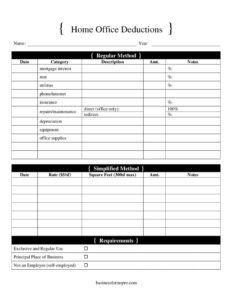
Use this free Home Office Tax Deductions worksheet template to track and calculate your home office expenses with free download in PDF and DOCX.
PDF
DOCX
4 downloads
0
likes
Download Files
- DOCX
A Home Office Tax Deductions worksheet is a simple form that helps self-employed people, freelancers, and small business owners organize and total the expenses tied to working from home so they can claim the appropriate deduction. The most common reason people use it is to gather square footage, utilities, rent or mortgage figures, and other costs in one place before filing taxes. It is free to download in both PDF and DOCX, with no signup required.
What Is a Home Office Tax Deductions Worksheet?
A Home Office Tax Deductions worksheet is an organizing document used to record the home-related expenses that may qualify as a business deduction when you use part of your home regularly and exclusively for work. It is typically used by sole proprietors, independent contractors, and small business owners who file a business return or a personal return with self-employment income. The worksheet documents the size of your office relative to your home, your direct and indirect expenses, and the resulting deductible amount. It is not the official tax form itself but a preparation tool that makes completing your return — or handing information to your accountant — faster, clearer, and easier to support if questions ever arise.
When Do You Need a Home Office Tax Deductions Worksheet?
This worksheet is useful any time a portion of your home is dedicated to earning income. Common situations include:
- Running a business from home — you operate as a sole proprietor or single-member LLC and use a dedicated room as your principal place of business.
- Freelancing or contracting — you do design, writing, consulting, or trade work and need a quiet, exclusive workspace at home.
- Comparing deduction methods — you want to test both the simplified square-footage method and the actual-expense method to see which gives a larger deduction.
- Year-round expense tracking — you log utilities, repairs, and insurance monthly so you are not scrambling at tax time.
- Preparing for your accountant — you want a clean summary to hand over so your tax preparer can work quickly and accurately.
- Keeping audit-ready records — you want supporting documentation in case a tax authority requests proof of the expenses you claimed.
What a Home Office Deduction Worksheet Should Have
A complete worksheet captures the details needed to calculate a defensible deduction. It should include your name and tax year, the total square footage of your home, and the square footage used exclusively for business so you can compute the business-use percentage. It should separate direct expenses (costs that apply only to the office, such as painting that room) from indirect expenses (whole-home costs like rent, mortgage interest, property taxes, utilities, homeowners or renters insurance, and general repairs). Finally, it should provide space to apply the business-use percentage to indirect expenses and arrive at a total deductible amount, along with a section comparing the simplified method against the actual-expense method.
How to Fill Out a Home Office Tax Deductions Worksheet
- Enter your identifying details. Write your name, business name if applicable, and the tax year the worksheet covers.
- Measure your space. Record the total square footage of your home and the square footage of the area used regularly and exclusively for business.
- Calculate the business-use percentage. Divide office square footage by total square footage and enter the resulting percentage.
- List direct expenses. Add costs that apply only to the office, since these are generally fully deductible.
- List indirect expenses. Enter rent or mortgage interest, property taxes, electricity, gas, water, internet, insurance, and maintenance for the full home.
- Apply the percentage. Multiply each indirect expense by your business-use percentage and record the deductible portion.
- Total the deduction. Add direct expenses plus the prorated indirect expenses for your actual-expense total.
- Compare methods. Calculate the simplified method (a flat rate per square foot up to the allowed limit) and note which method gives the larger benefit.
Simplified Method vs. Actual-Expense Method
Most home office filers can choose between two approaches, and this worksheet helps you weigh both. The simplified method multiplies your office square footage by a flat per-square-foot rate, capped at a set number of square feet — it requires far less recordkeeping but may yield a smaller deduction. The actual-expense method tallies your real costs and prorates them by business-use percentage, which often produces a larger deduction for those with higher rent, mortgage interest, or utility bills. Running the numbers both ways each year is wise because the better option can shift as your expenses change.
Recordkeeping and Supporting Documents
The worksheet is only as strong as the records behind it. Keep receipts, utility statements, mortgage or rent documents, and insurance bills that support every figure you enter. Note the date you began using the space exclusively for business, and retain a floor plan or measurements that justify your square-footage calculation. Good documentation lets you reconstruct your figures years later and respond confidently to any inquiry.
Common Mistakes to Avoid
- Claiming non-exclusive space — a room used for both work and personal activities generally does not qualify, so be honest about exclusive use.
- Mixing direct and indirect expenses — direct office-only costs and prorated whole-home costs are treated differently.
- Guessing square footage — measure accurately rather than estimating, since the percentage drives the entire calculation.
- Forgetting to compare methods — defaulting to one method can leave money on the table.
- Losing receipts — undocumented expenses are hard to defend if questioned.
- Including ineligible items — costs unrelated to your business use of the home do not belong on the worksheet.
Frequently Asked Questions
What is a Home Office Tax Deductions worksheet? It is a preparation tool that organizes the home-related expenses you may be able to deduct for business use of your home. It records square footage, direct and indirect expenses, and the calculated deduction. It is not the official tax filing form but supports it.
How do I fill out the home office worksheet? Enter your details and tax year, measure your home and office, calculate the business-use percentage, then list direct and indirect expenses. Apply the percentage to indirect costs and total your deduction. Finally, compare the result to the simplified method.
Who can use the home office deduction? Generally, self-employed people who use part of their home regularly and exclusively for business may qualify. Eligibility rules vary, and employees often face different limitations, so confirm your situation before claiming. A tax professional can clarify whether your workspace meets the requirements.
Is this worksheet legally binding? No, the worksheet is an organizing and calculation aid, not a contract or an official government form. You still report the deduction on your actual tax return using the appropriate forms. Keep the worksheet and supporting documents with your tax records.
How much does this template cost? Nothing — it is completely free to download in PDF and DOCX with no signup required. You can fill it out by hand or edit the DOCX version on your computer. Reuse it each tax year as your expenses change.
Which method gives a bigger deduction? It depends on your specific costs. The actual-expense method often wins when rent, mortgage interest, and utilities are high, while the simplified method saves time with less recordkeeping. Calculating both on the worksheet shows you the better choice for the year.
This template is a general example provided for informational purposes only and is not legal, financial, or tax advice. Tax rules, deduction limits, and eligibility requirements vary by jurisdiction and change over time. Consult a qualified tax professional before claiming any home office deduction.