
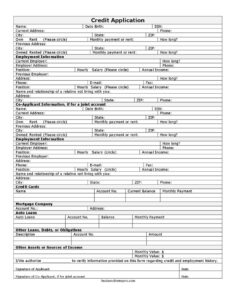
Credit Application
Download a free Credit Application template in PDF or DOCX to collect applicant identity, employment, and debt details before extending credit. Free download.
PDF
DOC
1 downloads
0
likes
Download Files
- DOC
A Credit Application is a standardized form a business or lender uses to collect an applicant’s personal, employment, and financial information before deciding whether to extend credit or a payment account. The most common reason people use it is to evaluate whether a customer can reliably pay for goods, services, or a loan over time. This template is free to download in both PDF and DOCX, with no signup required.
What Is a Credit Application?
A Credit Application is a document submitted by a person (or co-applicant) requesting the ability to buy now and pay later, open a line of credit, or take out a loan. It is typically issued by a seller, lender, landlord, or service provider and completed by the applicant. The form documents who the applicant is, where they live, how they earn money, and what existing debts and assets they carry. Together, this information helps the credit grantor judge creditworthiness, calculate debt-to-income ratios, and verify identity. It also creates a written record of what the applicant represented at the time of application, which can be referenced if a dispute arises later.
When Do You Need a Credit Application?
This form comes into play any time a business or individual is asked to deliver value before receiving full payment. Common scenarios include:
- Opening a net-30 or net-60 trade account with a wholesaler or supplier who will ship goods before being paid.
- Financing a vehicle, equipment, or appliance where the buyer pays in installments rather than upfront.
- Extending a store credit line so a repeat customer can charge purchases and settle later.
- Evaluating a loan request where a lender needs a full picture of income, obligations, and assets.
- Screening a tenant or service customer who will incur recurring charges over a contract term.
- Adding a co-applicant or guarantor whose income strengthens an otherwise marginal application.
In each case, the Credit Application gives the grantor a consistent, comparable snapshot so decisions are based on facts rather than guesswork.
What a Credit Application Should Have
A complete Credit Application captures enough information to verify identity, confirm ability to pay, and assess existing obligations. Key elements include the applicant’s full legal name, date of birth, and Social Security number for identity verification and credit-bureau lookups; current address and phone number for contact and residency history; housing status (own or rent) with monthly payment and length of residence; employment information including current employer and position; co-applicant details when a second party shares responsibility; and a financial picture covering credit cards, mortgage company, auto loans, other loans, debts, obligations, and other assets or sources of income. A strong form also includes a signature line and a statement authorizing the grantor to verify the information provided.
How to Fill Out a Credit Application
- Name and date: Enter your full legal name exactly as it appears on official ID, plus the date you complete the form.
- Date of birth and SSN: Provide your date of birth and Social Security number so the grantor can confirm identity and pull a credit report.
- Current address, city, state, phone: List your residential address, city, state, and a reliable phone number where you can be reached.
- Housing status: Check own or rent, then enter your monthly payment and how long you have lived there.
- Employment information: Name your current employer and your position, and add any income figures requested.
- Co-applicant information: If a spouse or partner shares the obligation, complete the matching co-applicant fields.
- Debts and obligations: Itemize credit cards, your mortgage company, auto loans, and any other loans, debts, or recurring obligations.
- Assets and income: List other assets or sources of income, then review, sign, and date the form.
How Credit Grantors Use the Information
Once submitted, the grantor typically verifies the data and weighs it against internal credit policies. The SSN and date of birth allow a credit-bureau inquiry that returns a score and payment history. Housing status, monthly payment, and employment establish stability and income, while the listed credit cards, mortgage, auto loans, and other obligations are used to calculate a debt-to-income ratio. The assets and additional income fields can offset a high debt load. Co-applicant information lets the grantor consider combined household resources. Based on this analysis, the applicant may be approved at a requested limit, approved at a lower limit, asked for a deposit or guarantor, or declined. A clear, complete application speeds this review and reduces back-and-forth.
Tips for a Stronger Application
Accuracy and completeness matter more than presentation. Use exact figures rather than estimates, especially for monthly payments and loan balances, because grantors cross-check them against credit reports. List every obligation honestly; omitting a debt that later surfaces can look like misrepresentation. If your income includes bonuses, freelance work, or investment returns, capture them under other assets or sources of income so your full earning power is visible. When a co-applicant is involved, make sure both parties review the form before signing, since both may share liability for the account.
Common Mistakes to Avoid
- Leaving fields blank: Missing employment or debt details often triggers a denial or a request for resubmission.
- Estimating instead of stating actual numbers: Round figures for monthly payments and balances can conflict with verified records.
- Omitting existing debts: Failing to list a loan or card may be treated as a material misstatement.
- Entering an inconsistent name or SSN: Mismatches with credit files delay or block verification.
- Skipping the co-applicant section when required: If a second party is needed to qualify, an incomplete section weakens the application.
- Forgetting to sign and date: An unsigned form is usually not processed, since the signature authorizes verification.
Frequently Asked Questions
What is a Credit Application used for? It is used to collect the personal, employment, and financial details a lender or seller needs to decide whether to extend credit, open a payment account, or approve a loan. The form documents identity, income, housing, and existing debts so the grantor can assess ability to pay.
How do I fill out a Credit Application? Start with your name, date of birth, SSN, and contact details, then complete your housing status, monthly payment, and how long you have lived there. Add your employment information, any co-applicant, and a full list of debts, loans, assets, and income before signing and dating the form.
Do I have to provide my Social Security number? Most credit grantors request an SSN so they can verify your identity and obtain a credit report, and many will not process an application without it. If you have concerns, ask the grantor how the number will be stored and protected before submitting.
Is a Credit Application legally binding? The application itself is generally a request and an authorization to verify information rather than a binding credit agreement. The binding obligation typically arises from a separate contract or account agreement signed once credit is approved.
Does a Credit Application need to be notarized? No, a Credit Application usually does not require notarization or witnesses. A dated signature from the applicant (and co-applicant, if any) is normally sufficient to authorize verification.
How much does this Credit Application template cost? Nothing — you can download it here for free in both PDF and DOCX with no signup required. You are welcome to customize the fields and branding to match your business or lending process.
This Credit Application template is a general example provided for informational purposes only and is not legal, financial, or tax advice. Credit, lending, and consumer-protection requirements vary by jurisdiction, and proper handling of personal data such as Social Security numbers carries legal obligations. Consult a qualified professional before relying on this form for any specific situation.
Need to work out sales tax? Use our free Sales Tax Calculator to add or remove sales tax from any amount in seconds.
Official resource: for the rules that apply to your situation, see the U.S. Small Business Administration.
Related Forms
- Ebay Auction Worksheet
- Items to Sell
- Election To Cancel Contract
- Request For Appointment
- Transmittal Letter
- Cancel Stop Payment And Honor Check
Browse more in Sales.