
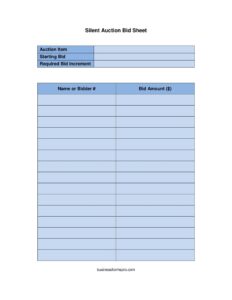
Silent Auction Bid Sheet
Download a free Silent Auction Bid Sheet template in PDF and DOCX to track item names, starting bids, increments, and bidder offers at any fundraiser.
PDF
DOCX
5 downloads
0
likes
Download Files
- DOCX
A Silent Auction Bid Sheet is a single-page form placed beside each auction item that lets guests record their offers in writing, with the highest written bid winning when bidding closes. Event organizers reach for it because it keeps an entire room of donated items moving without an auctioneer or constant staff attention. You can download our Silent Auction Bid Sheet free in both PDF and DOCX formats, with no signup required.
What Is a Silent Auction Bid Sheet?
A Silent Auction Bid Sheet is a paper (or printable) form used during a silent auction to collect competing bids for one specific item. Instead of bidders shouting offers, each guest writes their name or assigned bidder number and the dollar amount they are willing to pay on consecutive lines. The sheet sits next to the item — a gift basket, a vacation package, a piece of art — and displays the item name, the starting bid, and the minimum increment by which each new bid must rise. When the auction closes, the last and highest valid entry on the sheet identifies the winner. It is the official record of the sale and the document used to settle payment.
When Do You Need a Silent Auction Bid Sheet?
Any event that auctions donated goods or experiences without a live auctioneer relies on these sheets. Common situations include:
- A school PTA or booster club raising money through a gala or fun night with dozens of donated items.
- A nonprofit or charity fundraiser pairing a silent auction with a dinner or reception.
- A church, synagogue, or community group holding an annual benefit.
- A workplace or corporate event collecting bids to support a chosen cause.
- A sports team, club, or alumni association funding equipment, scholarships, or travel.
- A wedding, reunion, or memorial event with a small auction table for a meaningful purpose.
In each case the bid sheet does double duty: it encourages friendly competition that drives up the final price, and it gives you a clean paper trail for collecting payment and reporting proceeds.
What a Silent Auction Bid Sheet Should Have
A complete bid sheet makes the rules obvious at a glance so guests bid confidently and disputes stay rare. It should clearly display the auction item name and a short description, the starting bid that opens the lot, and the required bid increment so every new offer rises by at least the set amount. Below that, it needs a column for each bidder’s name or bidder number and a matching column for the bid amount in dollars, with enough numbered lines to capture an active back-and-forth. Many organizers also add a fair-market value, a closing time, and an optional “buy it now” price. Plenty of writing space and legible columns prevent the messy scribbles that cause confusion at checkout.
How to Fill Out a Silent Auction Bid Sheet
Organizers complete the top of the sheet before the event; guests fill in the bidding lines during it. Work through the fields in order:
- Auction item: Enter the name of the item or package, such as “Weekend Cabin Stay” or “Handmade Quilt.” Add a brief description and donor credit if space allows.
- Starting bid: Write the opening price, typically 25–40% of the item’s value, low enough to invite the first bid.
- Required bid increment: Set the minimum step between bids — for example $5, $10, or $25 — so the price climbs steadily.
- Name or bidder #: Each guest writes their printed name or pre-assigned bidder number on the next open line.
- Bid amount ($): On the same line, the bidder records their offer, which must equal or exceed the previous bid plus the increment.
Bidding continues line by line until closing. The last legible, valid entry is the winner.
Tips for Running a Smooth Silent Auction
Place each sheet on a clipboard or in a clear stand so it stays flat and readable. Print a pen for every table or attach one to each sheet with string. Announce the closing time clearly and have volunteers stand by popular tables to draw lines and confirm winners the moment bidding ends. Pre-printing bidder numbers at registration lets guests bid faster and keeps the columns tidy. Consider a “buy it now” price on hot items so an eager guest can lock in a sale and free up the sheet. After closing, circle the winning line and route the sheet to your checkout station.
Settling Up After the Auction
Once bidding stops, the winning bid sheet becomes your invoice. Match the winning name or bidder number to your registration list, total each guest’s wins, and collect payment at checkout. Keep the signed sheets as receipts and as a record of total proceeds, which is useful for treasurer reports and donor acknowledgments. If a winner is unavailable, your event rules should state whether the next-highest bidder is offered the item.
Common Mistakes to Avoid
- Leaving the starting bid or required bid increment blank, which lets guests under-bid and undercuts your fundraising.
- Setting the increment too high and scaring off small bidders, or too low so the price barely climbs.
- Not printing enough bid lines, forcing late bidders onto cramped margins.
- Allowing illegible names or numbers that make the winner impossible to confirm at checkout.
- Failing to mark a clear closing time, leading to arguments over which entry was last.
- Forgetting to circle and remove the winning sheet promptly, which invites tampering or extra bids.
Frequently Asked Questions
What is a Silent Auction Bid Sheet used for? It is the form that records competing written bids for one auction item at a silent auction. The highest valid bid when bidding closes identifies the winner, and the sheet then serves as the receipt for collecting payment.
How do I fill out a Silent Auction Bid Sheet? Organizers fill in the item name, starting bid, and required increment at the top before the event. During the auction, each guest writes their name or bidder number and their bid amount on the next open line, raising the previous bid by at least the set increment.
What is a bid increment and how do I set it? The bid increment is the minimum amount each new bid must rise above the last one. A common rule is to set it at roughly 10% of the item’s value — small increments for low-value items and larger steps for premium lots — so the price climbs without discouraging bidders.
Should I use names or bidder numbers on the sheet? Either works, but assigning bidder numbers at registration is faster, neater, and protects guest privacy. Numbers also speed up checkout because you can match the winning line directly to your registration list.
Is a Silent Auction Bid Sheet legally binding? A bid is generally treated as a commitment to purchase at your event, but enforceability depends on your stated rules and local laws. Posting clear terms — such as that the highest bid at closing wins and is expected to pay — helps set expectations.
How much does this Silent Auction Bid Sheet template cost? Nothing — it is completely free to download here in both PDF and DOCX formats with no signup required. You can print it as-is or open the DOCX to customize the item details, increments, and number of bid lines.
This Silent Auction Bid Sheet template is a general example provided for informational purposes only and is not legal, financial, or tax advice. Rules for auctions, sales, and charitable fundraising vary by jurisdiction, so consult a qualified professional or your local authorities for guidance specific to your event.
Related Forms
- Daycare Sheet Multiple
- IT Request Form
- Sign Up Sheet
- Workshop Registration Form
- Sign In Sheet
- Meeting Room Reservation Request
Browse more in Sign In / Sign Up Sheets.