
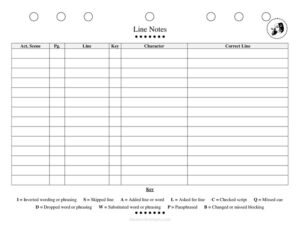
Line Notes
Track dropped, paraphrased, and missed lines with our free Line Notes template for theater rehearsals — accurate script delivery made easy, free download.
PDF
DOC
5 downloads
0
likes
Download Files
- DOC
Line Notes are a structured rehearsal document that a stage manager or assistant director uses to record exactly where an actor deviated from the written script, so corrections can be passed along privately and quickly. The most common reason people use Line Notes is to clean up paraphrased, dropped, or jumped lines during the rehearsal process and ahead of opening night. This template is free to download in PDF and DOCX, with no signup required.
What Is a Line Notes Form?
A Line Notes form is a tracking sheet used in theater productions to document discrepancies between an actor’s spoken delivery and the published script. It is typically issued by the stage manager (SM), assistant stage manager (ASM), or a designated line-note taker who follows the script in hand during a run-through. Each entry notes the character or actor, the page or scene, the line as scripted, what was actually said, and the type of error. The completed form is then distributed to performers so they can study and correct their work before the next rehearsal, helping the company arrive at a precise, polished performance.
When Do You Need a Line Notes Form?
Line Notes become essential once a cast moves “off book” — performing without scripts in hand. They are useful in a wide range of situations:
- During off-book rehearsals when actors first attempt full scenes from memory and accuracy starts to slip.
- For productions of published or licensed plays where the playwright’s exact wording must be preserved for contractual or artistic reasons.
- In musicals and verse plays, where rhythm, meter, or cue lines depend on word-for-word delivery.
- When a single dropped or jumped line risks confusing a scene partner or skipping an important plot point.
- Throughout tech and dress rehearsals, when a director wants performers locked in so attention can turn to lights, sound, and staging.
- For long-running shows, where actors gradually drift from the text and periodic line notes keep the production sharp.
What a Line Notes Form Should Have
A complete Line Notes sheet captures enough detail that an actor can immediately understand and fix the error without a confusing conversation. Strong line notes include the production title and rehearsal date, the actor or character name, a clear location reference (act, scene, page, or line number), the correct scripted text, the words actually delivered, and a category for the type of mistake — such as paraphrase, dropped line, added word, or jumped cue. Many forms also include a column for the note-taker’s initials or a check box the actor can mark once they have reviewed the correction. Keeping the layout consistent makes the notes fast to write during a live run and easy to scan afterward.
How to Fill Out a Line Notes Form
Because Line Notes are taken in real time while following a moving rehearsal, speed and clarity matter. Work through the form like this:
- Production and date: Fill in the show title and the rehearsal date at the top so notes can be filed and tracked across the rehearsal calendar.
- Identify the performer: Record the actor’s name or character so the note routes to the right person when distributed.
- Mark the location: Note the act, scene, page number, or line reference so the actor can find the exact moment in their script.
- Write the scripted line: Enter what the text actually says, word for word, as the correct version.
- Note what was said: Record the actor’s delivered words or describe the error (for example, “skipped to next sentence”).
- Categorize the error: Tag it as a paraphrase, dropped line, added word, transposition, or jumped cue.
- Add initials or a follow-up box: Mark who took the note and leave space for the actor to confirm review.
Types of Line Errors to Track
Not every slip is the same, and labeling the type helps actors target their corrections. Paraphrasing is the most common — delivering the meaning but not the exact words. A dropped line means an entire line or phrase was omitted. Added words insert text that isn’t written, which can throw off scene partners. Transpositions swap the order of words or sentences. Jumped cues occur when an actor skips ahead, potentially cutting another performer’s material. Tracking these categories over several rehearsals reveals patterns — for instance, a particular monologue that keeps getting paraphrased — so the director and SM can focus attention where it is needed most.
Best Practices for Distributing Line Notes
How notes are delivered is as important as how they are recorded. Line notes are generally given privately, on paper or by email, rather than called out in front of the full company, which keeps the rehearsal room positive and professional. Many stage managers distribute notes at the end of a rehearsal or post them on a callboard. Keep the tone neutral and factual — the form documents the text, not a judgment of the actor. Encourage performers to review notes before the next run and to ask the SM if a correction is unclear. Consistency in timing and format builds trust and makes the off-book process noticeably smoother.
Common Mistakes to Avoid
- Writing notes too vaguely — “messed up Act 2” gives the actor nothing actionable; always include the exact scripted line.
- Forgetting the page or scene reference, forcing the actor to hunt through the script.
- Mixing several actors’ notes together without clear names, so corrections get misrouted.
- Over-noting minor stumbles during an early off-book rehearsal, which can overwhelm and discourage a cast.
- Delivering notes verbally in front of the whole company instead of in writing and in private.
- Failing to date the sheet, making it impossible to track whether an error has been corrected over time.
Frequently Asked Questions
What are line notes in theater? Line notes are written records of where an actor’s spoken delivery differed from the written script during rehearsal. They document paraphrased, dropped, added, or jumped lines so performers can correct them before the next run. The stage manager or a designated note-taker usually keeps them.
Who is responsible for taking line notes? Typically the stage manager, assistant stage manager, or an assistant director takes line notes while following the script during a run-through. On larger productions, a dedicated person may be assigned solely to this task. The key is having someone with the script in hand who can track the text accurately as the scene unfolds.
How do I fill out a line notes form? Enter the production title and date, then for each error record the actor or character, the act/scene/page reference, the correct scripted line, what was actually said, and the type of error. Add your initials and leave space for the actor to confirm they reviewed the note. Keep entries short but specific enough to act on.
When should line notes start in a rehearsal process? Line notes generally begin once actors go off book and start performing scenes from memory. At that point, comparing delivery to the script becomes meaningful. They continue through tech, dress, and even into the run of long-engagement productions to keep the text sharp.
Is a line notes form legally binding? No, a line notes form is an internal rehearsal tool, not a contract or legal document. It exists to help a production deliver the script accurately, which can matter for licensing agreements that require the playwright’s exact text. The form itself simply organizes corrections for the cast.
How much does this line notes template cost? This line notes template is completely free to download in PDF and DOCX formats, with no signup or payment required. You can print it for in-room note-taking or edit the DOCX to add columns that fit your production’s workflow. Use it for as many shows and rehearsals as you like.
This Line Notes template is provided as a general example for informational purposes only and is not legal, contractual, or professional advice. Licensing and production requirements vary by show and by agreement with the rights holder — consult your production’s licensing terms and a qualified professional where appropriate.
Related Forms
- Props Scene List
- Entrance Exit Tracker
- Audition Checklist
- Understudy Tracker
- Preliminary Script Analysis
- Production Meeting Notes
Browse more in Theater.