
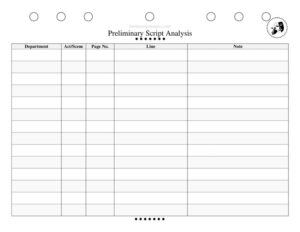
Preliminary Script Analysis
Download a free Preliminary Script Analysis template to organize production notes by department, act, scene, page, and line for any theater script.
PDF
DOCX
2 downloads
0
likes
Download Files
- DOCX
A Preliminary Script Analysis is a working document that theater teams use to break down a play script line by line and capture early production notes for each department. The most common reason people reach for one is to organize first-read observations — staging, lighting, sound, props, and costume cues — before formal production meetings begin. You can download it free in PDF and DOCX with no signup required.
What Is a Preliminary Script Analysis?
A Preliminary Script Analysis is a structured note-taking form used by directors, stage managers, designers, and production teams during the earliest stage of mounting a play. It documents specific moments in the script — identified by act, scene, page, and line — alongside notes about what each department needs to address. Rather than relying on scattered margin scribbles, it centralizes observations into a single, searchable record. The form is typically created during early script readings and revisited throughout pre-production. It bridges the gap between reading the text and building a production plan, ensuring that no cue, transition, or technical requirement slips through the cracks before rehearsals and design meetings ramp up.
When Do You Need a Preliminary Script Analysis?
- During the first table read of a new script, when the director and stage manager flag moments that will require technical support.
- When a design team is assembling, and lighting, sound, costume, and set departments each need to log their initial questions and ideas.
- While preparing for a production meeting, so each department arrives with documented notes tied to exact script locations.
- When a director wants to track recurring themes, mood shifts, or staging challenges across the entire play.
- For educational settings, where students learning dramaturgy or stagecraft analyze a script systematically as a class exercise.
- During revivals or remounts, when a team compares notes against a previous production’s approach.
What a Preliminary Script Analysis Should Have
A complete analysis form gives each note a precise home in the script and a clear owner. The essential elements include a department column so notes can be sorted by who is responsible, and a location reference — act/scene, page number, and line — that pinpoints exactly where in the text the note applies. The note field itself holds the actual observation, question, or instruction. Together these fields let a team filter by department, jump directly to the relevant passage, and avoid ambiguity. A good form is consistent across every entry, uses the same edition of the script for page and line references, and leaves room for notes to evolve as decisions are made.
How to Fill Out a Preliminary Script Analysis
- Department: Enter the team the note belongs to — for example, Lighting, Sound, Costumes, Props, Set, or Direction. Using consistent department labels lets you group and distribute notes later.
- Act/Scene: Record the act and scene where the moment occurs, such as “Act 2, Scene 3.” This anchors the note within the larger structure of the play.
- Page No.: Write the exact page number from the script edition your team is using. Always confirm everyone is working from the same script version so page references stay accurate.
- Line: Note the specific line or line range that triggers the observation. This level of detail makes it easy to find the moment during rehearsal.
- Note: Describe the observation clearly — a needed lighting cue, a costume change, a sound effect, a staging concern, or a question for the director. Keep each note focused on a single idea so it can be acted on independently.
Organizing Notes by Department
Because the form is built around a department column, one of its biggest strengths is sortability. After a read-through, you can group every entry by department and hand each team a clean list of items relevant only to them. Lighting receives its cues, sound gets its effects, and costumes sees its changes — each tied to a precise act, scene, page, and line. This prevents the common problem of a single master document where designers must hunt through unrelated notes. If you fill out the DOCX version, you can convert your entries into a simple table and filter or color-code by department before each production meeting.
Tips for an Effective Script Breakdown
Read the script at least once for story before you begin marking it for technical analysis; this helps you distinguish meaningful production moments from incidental detail. Number your notes or keep them in script order so the team can move chronologically through the play. When a note raises a question rather than a decision, phrase it as a question so it clearly needs follow-up. Revisit the form after design meetings and update or strike resolved items. Finally, keep a master copy and avoid editing it during live rehearsals — instead, log new observations and merge them afterward so the document stays reliable.
Common Mistakes to Avoid
- Mixing script editions — page and line numbers become meaningless if team members reference different printings.
- Vague notes like “fix this” that give no actionable instruction or context.
- Combining multiple ideas into one entry, which makes it hard to assign and track each item.
- Leaving the department blank, so notes can’t be sorted or routed to the right team.
- Skipping the line reference, forcing colleagues to search an entire page to find the moment.
- Treating it as final — a preliminary analysis is meant to evolve, not to lock in every decision.
Frequently Asked Questions
What is a Preliminary Script Analysis used for? It is used to break down a play script and capture early production notes for each department, tied to exact act, scene, page, and line references. Theater teams use it during first reads and pre-production to organize lighting, sound, costume, set, and staging observations before formal meetings begin.
Who fills out a Preliminary Script Analysis? Directors, stage managers, dramaturgs, and individual designers commonly complete it, often collaboratively. In many productions the stage manager maintains a master copy while each department contributes its own notes during read-throughs.
How detailed should each note be? Each note should be specific enough to act on but focused on a single idea — one cue, change, or question per line. Including the department and exact location makes a brief note far more useful than a long, unfocused paragraph.
Is this the same as a full production book or prompt book? No. A Preliminary Script Analysis is an early, exploratory document, while a prompt book is the comprehensive, finalized record of blocking and cues used to run the show. The analysis feeds into the larger production process but is not a substitute for it.
Can I use this for a class assignment? Yes. Students studying script analysis, dramaturgy, or stagecraft can use it to practice breaking a play into actionable observations. The structured format encourages careful, location-specific reading.
How much does this template cost? It is completely free to download here in both PDF and DOCX formats, with no signup or account required. You can print the PDF for read-throughs or edit the DOCX to add columns and tailor it to your production.
This template is provided as a general example for informational purposes only and does not constitute professional, legal, or production advice. Theater workflows and conventions vary by company, venue, and program — adapt this form to your team’s needs and consult your production staff or instructor for guidance specific to your project.
Related Forms
- Blocking Sheet
- Production Schedule
- Line Notes
- Sound Inventory Sheet
- Rehearsal Sign-In Sheet
- Performance Report
Browse more in Theater.