
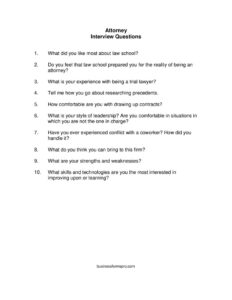
Attorney Interview Questions
Download free Attorney Interview Questions to screen legal candidates with structured, role-specific prompts — free template in PDF and DOCX, no signup.
PDF
DOCX
4 downloads
0
likes
Download Files
- DOCX
The Attorney Interview Questions template is a ready-made list of structured prompts used to evaluate candidates for a lawyer or associate position. Hiring managers, law firm partners, and HR teams most often use it to run consistent, fair interviews that surface real legal skill and cultural fit. It’s free to download in both PDF and DOCX with no signup required.
What Is an Attorney Interview Questions Template?
An Attorney Interview Questions template is a curated set of questions designed specifically for hiring legal professionals. Rather than relying on generic interview prompts, it focuses on the competencies that matter in legal practice — courtroom experience, legal research, contract drafting, judgment, and teamwork. The template is typically used by interviewers at law firms, in-house legal departments, government agencies, and recruiting firms. It documents what each candidate is asked so every applicant is measured against the same standard, which supports both better hiring decisions and defensible, consistent process records. Because it is editable, you can add firm-specific or practice-area questions before the interview begins.
When Do You Need Attorney Interview Questions?
This template is useful any time you need to evaluate legal talent in a focused, repeatable way. Common scenarios include:
- Hiring a new associate straight out of law school, where questions about their education and learning goals reveal potential and ambition.
- Filling a litigation role that demands courtroom poise — the trial experience and conflict-handling questions become central.
- Recruiting a transactional attorney for a corporate or real estate practice, where contract drafting comfort is the priority.
- Standardizing a panel interview so multiple partners ask the same core questions and can compare notes fairly afterward.
- Promoting from within, using the leadership and strengths questions to assess readiness for a senior or supervisory role.
- Screening lateral hires who already have experience, where research methods and self-identified weaknesses help gauge depth.
What an Attorney Interview Should Cover
A complete attorney interview balances several dimensions so you don’t over-index on one trait. The strongest interviews touch on:
- Background and education — what they took from law school and how it shaped them.
- Practical legal skill — trial work, legal research methodology, and contract drafting.
- Soft skills and temperament — leadership style, conflict resolution, and the ability to follow as well as lead.
- Fit and contribution — what the candidate believes they add to your firm specifically.
- Self-awareness and growth — honest strengths, weaknesses, and a desire to keep learning new skills and technologies.
Keeping a written record of responses against these categories makes post-interview scoring far easier.
How to Use These Attorney Interview Questions
Work through the template field by field, leaving space to note each answer:
- Open with “What did you like most about law school?” as an easy, rapport-building question that reveals motivation.
- Ask “Did law school prepare you for the reality of being an attorney?” to gauge self-awareness and realistic expectations.
- Probe trial experience with the litigation question, asking for specific cases and outcomes.
- Use “How do you research precedents?” to assess analytical rigor and familiarity with research tools.
- Cover transactional ability through the contract drafting comfort question.
- Explore leadership style and whether they can work under others’ direction.
- Ask about coworker conflict to evaluate emotional intelligence and professionalism.
- Have them describe what they bring to the firm to test how well they researched you.
- Request honest strengths and weaknesses.
- Close with the skills and technologies they want to improve, signaling growth mindset.
Tips for Getting Honest, Useful Answers
The value of these questions depends on how you deliver and follow up on them. Ask one question at a time and resist the urge to fill silences — give candidates room to think, especially on the research and contract questions where depth matters. When an answer is vague, use follow-ups like “Can you walk me through a specific matter?” The conflict and weakness questions are most revealing when you press gently for a concrete example rather than a rehearsed generality. Take notes verbatim where possible so you are comparing actual responses, not your later impressions.
Adapting the Questions to Your Practice Area
While these ten questions form a strong core, tailor them to the role. For a litigation hire, expand on trial strategy, deposition experience, and handling difficult judges or opposing counsel. For a corporate or transactional role, deepen the contract drafting line with questions about negotiation, due diligence, and managing client expectations. For a junior associate, lean into the law school and learning-goals questions, since track record is limited. Add any jurisdiction- or bar-admission-related questions your role requires, and keep employment-law-compliant practices in mind so every candidate is asked a consistent, job-related set.
Common Mistakes to Avoid
- Asking only one type of question — focusing entirely on trial skill while ignoring teamwork and fit.
- Accepting surface answers on research and contracts without asking for a concrete example.
- Talking more than the candidate, which prevents you from gathering real information.
- Skipping note-taking, making fair comparison impossible after a long day of interviews.
- Asking inconsistent questions across candidates, which undermines fairness and any defensible record.
- Treating the weakness question as a gotcha rather than an honest look at self-awareness.
Frequently Asked Questions
What is an Attorney Interview Questions template? It is a structured list of questions tailored to hiring lawyers, covering education, trial and research skill, contract drafting, leadership, and growth. It helps interviewers run consistent, focused interviews and compare candidates fairly. You can use it as-is or customize it for your practice area.
How do I use these questions in an interview? Ask them in order, leaving space to record each answer, and use follow-up prompts to get specific examples. Start with the easier law-school question to build rapport, then move into skills and behavioral questions. Keep your delivery consistent across candidates so your notes are comparable.
Can I edit or add my own questions? Yes. The DOCX version is fully editable, so you can add practice-area questions, bar-admission requirements, or firm-specific prompts. Many interviewers blend these core questions with a few of their own and a short skills exercise.
Are these questions appropriate for any attorney role? They work as a strong general foundation for associates, lateral hires, and senior candidates, but you should tailor the emphasis. A litigation role calls for more trial-focused questions, while a transactional role calls for deeper contract and negotiation prompts. Junior candidates benefit from more focus on education and learning goals.
How many questions should I ask? These ten cover the essentials and usually fit comfortably in a 45-to-60 minute interview with follow-ups. If time is short, prioritize the questions most relevant to the role’s core duties. If you have a panel, divide the questions among interviewers to avoid repetition.
How much does this template cost? Nothing — it is completely free to download here in both PDF and DOCX formats with no signup or account required. You can print it for a panel or edit it digitally before each interview. Use it as many times as you need.
This template is provided as a general example for informational purposes only and does not constitute legal, HR, or employment advice. Hiring and interview requirements vary by jurisdiction and employer, and equal-opportunity and anti-discrimination rules apply to your questions. Consult a qualified employment-law professional to ensure your interview process is compliant.
Official resource: for the rules that apply to your situation, see the U.S. Department of Labor.
Related Forms
- Flash Animator Interview Questions
- Call Center Operator Interview Questions
- Internet Marketing Director Interview Questions
- Hotel Front Desk Staff Interview Questions
- Computer Programmer Interview Questions
- Hostess Interview Questions
Browse more in Interview Questions.