
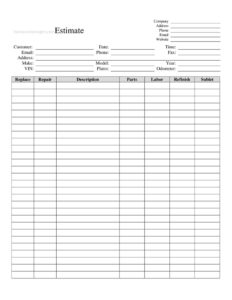
Auto Estimate Form
Download a free Auto Estimate Form template to give customers a clear, itemized repair or service estimate before work begins — free PDF and DOCX download.
PDF
DOCX
6 downloads
0
likes
Download Files
- DOCX
An Auto Estimate Form is a written document that itemizes the expected cost of vehicle repairs or services before any work is performed, giving both the shop and the customer a clear understanding of what will be done and what it will cost. People most often use it to get written approval for a repair so there are no billing surprises later. You can download this Auto Estimate Form for free in PDF and DOCX formats, with no signup required.
What Is an Auto Estimate Form?
An Auto Estimate Form is a pre-work cost summary issued by an auto repair shop, body shop, dealership service department, or mobile mechanic to a vehicle owner. It documents the diagnosed problem, the parts and labor needed to fix it, and the projected total before taxes and fees. The form serves as a transparent quote that the customer can review, compare, and approve. It protects the shop by creating a record of what was agreed upon, and it protects the customer by setting expectations in writing. While an estimate is not a final invoice, it is often the foundation for the work order and the eventual bill once the job is complete.
When Do You Need an Auto Estimate Form?
An estimate is appropriate any time a customer wants to know the cost before authorizing repairs. Common situations include:
- Collision and body work — providing a damage estimate after an accident, often required for insurance claims.
- Mechanical repairs — quoting a brake job, transmission service, engine diagnostics, or suspension work.
- Routine maintenance bundles — pricing out a multi-point service such as fluids, filters, belts, and tires.
- Used-car reconditioning — itemizing repairs a dealership plans before reselling a vehicle.
- Insurance and warranty claims — supplying the documented figures an adjuster or third party needs.
- Second opinions — letting a customer compare quotes from competing shops before deciding.
In many states, shops are required to provide a written estimate and obtain customer authorization before exceeding it by a set percentage, which makes a clear, standardized form essential to staying compliant.
What an Auto Estimate Form Should Have
A complete estimate leaves no ambiguity about scope or price. The strongest forms include:
- Shop name, address, phone number, and any license or registration number.
- Customer name and contact information.
- Vehicle details — year, make, model, VIN, license plate, mileage, and color.
- A description of the customer’s complaint or requested service.
- An itemized list of parts with quantities and unit prices.
- Labor lines showing the task, estimated hours, and hourly rate.
- Subtotals for parts and labor, applicable taxes, shop supplies, and disposal fees.
- A grand total and the estimate’s expiration date.
- A signature line for customer authorization and the date.
How to Fill Out an Auto Estimate Form
Work through the form top to bottom so nothing is missed:
- Enter shop information. Add your business name, address, phone, email, and any required repair license or registration number at the top.
- Add the date and estimate number. Assign a unique reference so the quote can be tracked and matched to a future work order.
- Record customer details. Write the customer’s full name, phone, and email so you can reach them for approval or questions.
- Describe the vehicle. Fill in year, make, model, VIN, plate, mileage, and color to identify the exact car.
- State the concern. Summarize the customer’s complaint or the requested service in the description field.
- List parts. Enter each part, its quantity, and its unit price, then extend the line totals.
- List labor. Add each labor operation, the estimated hours, and your hourly rate.
- Calculate totals. Sum parts and labor, add taxes, shop supplies, and fees, then enter the grand total.
- Set terms. Note the expiration date and any authorization language, then have the customer sign and date.
Estimate vs. Invoice vs. Work Order
These three documents are related but distinct, and confusing them causes billing disputes. An estimate is a projection of cost issued before work begins; figures may change if hidden damage is found. A work order is the authorized instruction to perform the work, usually signed after the estimate is accepted. An invoice is the final bill issued after the job is done, reflecting actual parts and labor. Many shops use the estimate as the starting point and convert it into a work order, then into an invoice, keeping the numbers consistent throughout. Clearly labeling this document as an estimate — not a final bill — helps the customer understand that the total is an informed projection rather than a guaranteed price.
Tips for Accurate, Professional Estimates
A well-prepared estimate builds trust and reduces callbacks. Inspect the vehicle thoroughly before quoting so you catch related issues early. Use realistic labor times from a recognized labor guide rather than guessing. Break out parts and labor separately so the customer sees exactly where the money goes. Always note when an estimate is preliminary and may rise if additional damage is discovered once disassembly begins, and explain that you will call for approval before exceeding the quoted amount. Finally, give the estimate an expiration date — parts prices and availability change, and an open-ended quote can become impossible to honor.
Common Mistakes to Avoid
- Leaving the VIN or mileage blank — these identify the vehicle and matter for insurance and parts sourcing.
- Lumping parts and labor together — customers and adjusters want to see each line itemized.
- Forgetting taxes, shop supplies, and disposal fees — omitting them makes the final bill look like an overcharge.
- Not setting an expiration date — prices and availability shift, leaving you bound to outdated figures.
- Skipping customer authorization — performing work without a signed estimate can violate state repair laws.
- Failing to flag preliminary findings — surprise costs after disassembly should never be the customer’s first surprise on the invoice.
Frequently Asked Questions
What is an Auto Estimate Form used for? It is used to give a vehicle owner a written, itemized projection of repair or service costs before any work begins. This lets the customer review the scope and price, compare shops, or submit the figures to an insurer. It also creates a record both parties can refer back to once the job is authorized.
Is an auto estimate legally binding? An estimate is generally a good-faith projection rather than a fixed contract, but many states limit how much a final bill can exceed the written estimate without new customer approval. Once the customer signs to authorize the work, the estimate often becomes the basis of a binding work order. Always check your local repair regulations for specific rules.
How is an estimate different from an invoice? An estimate is prepared before the work and shows projected costs, while an invoice is issued after the work and reflects the actual parts and labor used. The estimate is for planning and approval; the invoice is the final amount due. Keeping the two consistent reduces disputes.
Do I need the VIN to complete the form? The VIN is strongly recommended because it pinpoints the exact vehicle for accurate parts ordering, insurance claims, and warranty verification. If the VIN is unavailable, the year, make, model, and license plate still help identify the car. Including the VIN makes the estimate more credible and easier to convert into a work order.
How much does this Auto Estimate Form cost? The template is completely free to download from Business Forms Pro in both PDF and DOCX formats. There is no signup, subscription, or hidden fee. You can edit the DOCX version to add your shop logo, rates, and standard fees.
Can I change the estimate after the customer signs? Yes, but you should contact the customer for approval before doing additional work or exceeding the quoted total, especially if hidden damage is found after disassembly. Document the revised figures and obtain a new authorization. Many states require this re-approval step to remain compliant.
This Auto Estimate Form template is a general example provided for informational purposes only and does not constitute legal, financial, or tax advice. Auto repair disclosure and estimate-authorization requirements vary by state and locality. Consult a qualified professional or your local consumer-protection or automotive regulatory agency to confirm the rules that apply to your shop.
Official resource: for the rules that apply to your situation, see your state DMV.
Related Forms
- New Car Comparison
- Vehicle Loan Payment Calculator
- Odometer Statement
- Used Vehicle Appraisal
- Motorcycle Bill of Sale
- Truck Bill of Sale
Browse more in Auto Sales.