
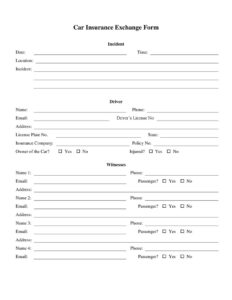
Car Insurance Exchange Form
Use our free Car Insurance Exchange Form template to record driver, vehicle, and insurance details after an accident — free download in PDF and DOCX.
PDF
DOC
2 downloads
0
likes
Download Files
- DOC
A Car Insurance Exchange Form is a simple document used to record and swap the driver, vehicle, and insurance details of everyone involved after a car accident. The most common reason people use it is to make sure no critical information is forgotten in the stressful minutes following a collision. You can download this template free in PDF and DOCX with no signup required.
What Is a Car Insurance Exchange Form?
A Car Insurance Exchange Form is a structured worksheet that drivers complete at the scene of an accident to collect the information each party needs to file an insurance claim. Rather than relying on memory or scribbling details on a phone, both drivers fill in the same fields so nothing is missed. It typically captures names, contact information, driver’s license numbers, vehicle descriptions, license plates, and insurance policy details. Anyone involved in a minor or major collision can use it, and it is equally helpful for individual drivers, fleet operators, and rideshare drivers. The form documents the facts of who was involved so that insurers, adjusters, and—if necessary—authorities have a clear, consistent record.
When Do You Need a Car Insurance Exchange Form?
This form is useful any time vehicles are involved in an incident and information needs to change hands. Common scenarios include:
- A fender bender in a parking lot where no police report is filed but both drivers still need each other’s insurance details.
- A multi-vehicle collision on a highway where capturing several parties’ information quickly matters.
- A rear-end accident at a stoplight where you want a clean record before memories fade.
- A company or fleet vehicle incident, where the driver must report standardized details back to the employer or insurer.
- A hit involving a parked car, where you leave or collect a note with full contact and insurance information.
- Minor damage with an uncooperative driver, where having a printed form encourages a complete, organized exchange.
Keeping a blank copy in your glovebox means you are never caught without a way to document what happened.
What a Car Insurance Exchange Form Should Have
To be genuinely useful, the form should cover three categories of information for each driver involved. First, personal and contact details: full name, address, phone number, email, and driver’s license number with issuing state. Second, vehicle details: make, model, year, color, license plate number, and the vehicle identification number (VIN). Third, insurance details: the insurance company name, policy number, and the policyholder’s name if it differs from the driver. A complete form also benefits from a section for the date, time, and location of the accident, a brief description of what happened, and space for the names and contact information of any witnesses. Optional fields for photos taken and weather conditions add helpful context.
How to Fill Out a Car Insurance Exchange Form
Work through the form calmly and confirm each detail against an official document where possible:
- Record the accident basics. Enter the date, time, and exact location of the incident, including the street, intersection, or landmark.
- Enter your information first. Write your full name, address, phone, email, and driver’s license number exactly as printed on your license.
- Add your vehicle details. Note the make, model, year, color, license plate, and VIN.
- Copy your insurance information. List your insurer’s name, policy number, and the policyholder’s name from your insurance card.
- Collect the other driver’s details. Repeat the same personal, vehicle, and insurance fields for each other party, checking their license and insurance card directly.
- Describe the incident. Write a short, factual summary of what happened without assigning blame.
- Note witnesses and evidence. Record any witness names and contacts, and check the box if you took photos.
- Review and exchange. Confirm everything is legible, then make sure both drivers leave with a copy.
Documenting the Scene Beyond the Form
The exchange form is your structured record, but pairing it with a few extra steps strengthens your eventual claim. Take clear photos of all vehicles, the damage, license plates, the surrounding area, and any road signs or signals. Note the position of the vehicles before they are moved, and capture the overall scene from a few angles. If anyone is injured or the damage is significant, call the appropriate authorities and request a police report number, which you can add to the form. Stick to facts when describing the event and avoid admitting fault at the scene, since liability is ultimately determined by the insurers and, if needed, the legal process. The more accurate and complete your documentation, the smoother the claims process tends to be.
Why Exchanging Information Promptly Matters
Insurance claims rely on accurate, timely details. If you discover later that a phone number was wrong or an insurance policy number was missing a digit, contacting the other party can become difficult or impossible. Completing the form on the spot—while both drivers are present—removes that risk. It also creates a shared, consistent version of events that reduces disputes about who was involved and what each party drove. For your own records, store the completed form with your photos and any correspondence so everything is in one place when your adjuster calls.
Common Mistakes to Avoid
- Skipping the VIN or plate number, which makes it harder to verify the vehicle later.
- Trusting a verbal policy number instead of copying it directly from the insurance card.
- Forgetting to record witnesses while they are still at the scene.
- Writing an unreadable or vague summary that confuses the adjuster.
- Admitting or assigning fault on the form, which should be left to the insurers.
- Failing to keep your own copy, leaving you without documentation when you file.
Frequently Asked Questions
What is a Car Insurance Exchange Form used for? It is used to collect and swap the key driver, vehicle, and insurance details of everyone involved in a car accident. Having all the information in one organized place makes filing an insurance claim faster and reduces the chance of missing something important.
How do I fill out a Car Insurance Exchange Form? Start with the date, time, and location, then enter your own personal, vehicle, and insurance details, followed by the same information for the other driver. Add a short factual description of the incident, note any witnesses, and make sure both parties leave with a copy.
Is a Car Insurance Exchange Form legally binding? The form itself is a record of information, not a contract, so it does not assign legal liability. However, the accurate details it captures are often used by insurers and, if necessary, in claims or legal proceedings, so completing it honestly is important.
Do I still need to call the police? Whether you must contact authorities depends on the severity of the accident and your local laws. Many jurisdictions require a report when there are injuries or damage above a certain amount; when in doubt, calling and obtaining a report number is the safer choice.
Should I admit fault on the form? No. Stick to documenting the facts—who was involved, what was driven, and what happened—and let the insurance companies determine fault. Avoid statements that accept blame, as liability is decided through the claims process.
Is this Car Insurance Exchange Form free to download? Yes. You can download the template free in both PDF and DOCX formats with no signup required, fill it out digitally, or print copies to keep in your vehicle for emergencies.
This template is provided as a general example for informational purposes only and does not constitute legal, financial, or insurance advice. Requirements and reporting obligations vary by jurisdiction and insurer—consult your insurance provider or a qualified professional for guidance specific to your situation.
Official resource: for the rules that apply to your situation, see the Consumer Financial Protection Bureau.
Related Forms
- Payment Calculator per $1000
- Theme Park Cash Envelope
- Credit Change Notice
- Daily Cash Sheet (3 shifts)
- Appraisal Worksheet
- Tip Jar Labels
Browse more in Money.