
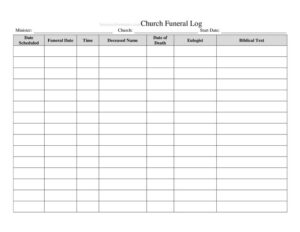
Church Funeral Log
Free church funeral log template in PDF & DOCX to record funeral and memorial services — names, dates, officiant, and details. Keep clear records. Download free.
PDF
DOCX
6 downloads
0
likes
Download Files
- DOCX
A church funeral log is a simple record used to document the funeral and memorial services a church holds — the name of the deceased, the date of the service, the officiant, and other key details. It helps a congregation keep careful, respectful records over the years. Download this free template in PDF or DOCX. No signup required.
What Is a Church Funeral Log?
A church funeral log is an ongoing record of the funeral, memorial, and graveside services a church conducts. Churches have long kept registers of the significant moments in their members’ lives — baptisms, marriages, and funerals — and a funeral log is the modern, easy-to-maintain version of that tradition. Each entry captures the essentials of a service so the church has an accurate history it can refer back to: for pastoral care of grieving families, for answering future inquiries from relatives or genealogists, and for the church’s own administrative and historical records. Whether kept by the pastor, a secretary, or a volunteer, a consistent log ensures these important services are never lost to memory.
When Do You Need a Church Funeral Log?
- Recording each funeral or memorial service the church holds, as it happens.
- Maintaining an accurate, ongoing register of services over months and years.
- Supporting pastoral follow-up and care for bereaved families.
- Answering future requests from relatives, members, or genealogists.
- Keeping orderly administrative and historical records for the congregation.
- Handing over to a new pastor or secretary a clear history of past services.
What the Log Should Record
A useful funeral log captures enough to identify and recall each service. Typical entries include the name of the deceased, the date of the service, the officiating minister or pastor, and details such as the type of service, the location, and any notes the church wishes to keep. Recording these consistently — in the same format each time — turns individual entries into a register that’s easy to search and a genuine part of the church’s history.
How to Fill Out the Funeral Log
- For each service, enter the name of the deceased.
- Record the date of the funeral or memorial service.
- Note the officiant — the minister, pastor, or clergy member who led the service.
- Add the type of service and the location (sanctuary, graveside, or elsewhere).
- Include any notes the church wishes to keep, such as the family contact or special requests.
- Keep the log in a consistent format and store it securely as part of the church’s records.
Keeping Records with Care
Funeral records touch families at their most vulnerable, so they deserve to be kept with both accuracy and discretion. Fill in each entry promptly while the details are fresh, and store the log somewhere secure where only those who need it can access it, since it contains personal information about families and the deceased. Consistency is what makes the log valuable over time: using the same fields for every service means the register can be searched and trusted years later. Many churches keep both a physical book and a digital copy so the record is protected against loss, and review the log periodically to ensure nothing has been missed. Treated this way, the funeral log becomes a quiet but meaningful part of how a congregation honors its members and cares for the families they leave behind.
Common Mistakes to Avoid
- Letting entries slip and recording services from memory weeks later.
- Using a different format each time, making the log hard to search.
- Leaving out the officiant or the exact date.
- Storing the only copy somewhere it could be lost or damaged.
- Treating sensitive family details carelessly rather than with discretion.
- Not reviewing the log periodically to confirm it’s complete.
Keeping Both Paper and Digital Records
Many congregations are moving their registers from a single bound book to a digital record, and a funeral log is well suited to both. A handwritten book has a permanence and a dignity that fit the occasion, and it doesn’t depend on technology to be read decades later. A digital log, by contrast, is easy to search, simple to back up, and straightforward to share with the people who need it. The strongest approach is usually to keep both: record each service in the register as it happens and maintain a digital copy that can be searched and safeguarded against fire, flood, or simple loss. Whichever form you favor, store the records securely, because they contain personal details about families and the deceased that deserve discretion. It also helps to connect the funeral log to the church’s other life-event records — baptisms, marriages, and memberships — so that, over time, the congregation holds a coherent history of the families it has served. When a relative or a researcher later asks about a service, a well-kept, cross-referenced log lets you answer with confidence and care. Assign one person clear responsibility for maintaining the record, review it periodically to confirm nothing has been missed, and pass it on intact when that role changes hands. Treated with this kind of steady attention, the funeral log becomes a lasting and quietly meaningful part of the church’s ministry to grieving families.
Frequently Asked Questions
What is a church funeral log? It’s a record of the funeral and memorial services a church holds, capturing the deceased’s name, the service date, the officiant, and other details to keep an accurate ongoing register.
Who keeps the funeral log? Usually the pastor, a church secretary, or a designated volunteer. What matters is that one consistent record is maintained so services are never lost track of.
Why keep a funeral register? For pastoral care of grieving families, to answer future inquiries from relatives or genealogists, and to maintain the church’s administrative and historical records over the years.
What details should each entry include? At minimum the name of the deceased, the date of the service, and the officiant, plus the service type, location, and any notes the church wishes to keep. The template above provides space for each.
How should the log be stored? Securely, given it contains personal information, and ideally in both a physical and a digital copy so the record is protected against loss or damage.
How much does this template cost? Nothing — it’s free to download in PDF and DOCX, with no signup required.
Related Forms
- Jesus Holy Card (2 per page)
- Virgin Of Guadalupe Holy Card (2 per page)
- My Holy Confirmation Card (2 per page)
- Prayer Of Saint Francis Funeral Card (2 per page)
- Church Petty Cash Reconciliation
- Baptism Holy Card (2 per page)
Browse more in Church.