
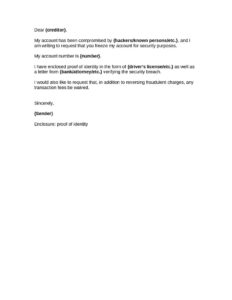
Credit Freeze Security Letter
Use a free Credit Freeze Security Letter template to request a security freeze on your credit file in writing — free PDF and DOCX download, no signup.
DOCX
2 downloads
0
likes
Download Files
- DOCX
A Credit Freeze Security Letter is a written request you send to a credit bureau asking it to place, temporarily lift, or permanently remove a security freeze on your credit file. People most often use it to lock down their credit after identity theft, a data breach, or simply as a proactive step to stop fraudsters from opening accounts in their name. You can download this letter free in PDF and DOCX formats, with no signup required.
What Is a Credit Freeze Security Letter?
A Credit Freeze Security Letter is a formal correspondence addressed to one of the major consumer credit reporting agencies that documents your intent to restrict access to your credit report. A security freeze prevents most lenders from viewing your file, which in turn stops new credit accounts from being opened without your authorization. The letter is issued by the consumer (or an authorized representative) and serves as a written, dated record of the request. Although many freezes can now be placed online or by phone, a mailed letter creates a paper trail, is useful when you must include copies of identification, and is sometimes the only option for certain freeze, thaw, or removal requests.
When Do You Need a Credit Freeze Security Letter?
This letter is helpful in several real-world situations where you want documented proof of your request:
- After identity theft — when someone has used or attempted to use your personal information and you want to block new fraudulent accounts immediately.
- Following a data breach — when a company that held your Social Security number, account numbers, or other sensitive data was hacked.
- As a preventive measure — when you rarely apply for new credit and want to keep your file locked by default.
- To temporarily lift (thaw) a freeze — when you are applying for a loan, mortgage, apartment, or new card and need to grant a lender brief access.
- To permanently remove a freeze — when you no longer want the restriction and prefer your file to be openly accessible again.
- On behalf of a minor or dependent — when a parent, guardian, or conservator manages credit protection for someone in their care.
What a Credit Freeze Security Letter Should Have
To be acted on quickly, the letter should clearly identify you, state exactly what you want, and include the verification details the bureau needs. Essential elements are your full legal name, current and recent former addresses, date of birth, and Social Security number (or the last four digits, depending on what the bureau requires). It should name the bureau you are writing to, state plainly whether you are placing, lifting, or removing a freeze, and reference any PIN or confirmation number you were previously issued. A dated signature and a list of enclosed identity documents round out a complete, actionable request.
How to Fill Out a Credit Freeze Security Letter
- Add the date and your contact block. Write your full legal name, mailing address, phone number, and email at the top so the bureau can reach you.
- Address the correct bureau. Enter the name and mailing address of the credit reporting agency you are contacting. Send a separate letter to each bureau you want frozen.
- State your request in the opening line. Clearly say whether you are requesting to place, temporarily lift, or permanently remove a security freeze.
- Provide your identifying details. Include your date of birth, Social Security number (or last four digits), and any previous addresses from the past two years so the bureau can match your file.
- Reference your PIN or confirmation number. If you are lifting or removing an existing freeze, include the PIN the bureau previously gave you.
- Specify dates for a temporary thaw. If lifting the freeze for an application, note the start and end dates or the creditor who needs access.
- List your enclosures. Note copies of your government ID and a recent utility bill or proof of address.
- Sign and date the letter by hand before mailing it.
How to Send It and What to Expect
Mail the letter to each bureau separately, because freezing your file with one agency does not freeze the others. Use certified mail with a return receipt so you have proof of delivery and a record of when the bureau received your request. Keep a photocopy of the signed letter and every enclosure for your own files. After processing, the bureau typically issues a confirmation and, for new freezes, a PIN or password you will need for any future lift or removal — store this somewhere safe and private. Processing times vary, so if you are timing a loan application, request your temporary thaw with a comfortable cushion before you expect a lender to pull your report.
Freeze vs. Fraud Alert vs. Credit Lock
It helps to know how a security freeze differs from related tools. A freeze restricts access to your report and generally must be lifted before new credit can be opened. A fraud alert does not block access but flags your file so lenders take extra steps to verify your identity. A credit lock is a similar product often offered through an app, but its terms are set by the bureau rather than by law. This letter is written for a formal security freeze request, which is the strongest of the document-based options.
Common Mistakes to Avoid
- Writing to only one bureau — a freeze must be requested with each agency separately to fully protect your file.
- Omitting identity documents — missing ID or proof of address can delay or stall the request.
- Losing your PIN — you will likely need it to lift or remove the freeze later, so keep it secure.
- Mailing without tracking — sending without certified mail leaves you no proof the letter arrived.
- Being vague about the request — failing to state clearly whether you want to place, lift, or remove the freeze causes confusion.
- Forgetting to sign — an unsigned letter may not be honored.
Frequently Asked Questions
What is a Credit Freeze Security Letter used for? It is a written request to a credit bureau to place, temporarily lift, or permanently remove a security freeze on your credit file. People use it to block fraudsters from opening accounts, to respond to identity theft or a data breach, or to thaw their file when applying for credit. The letter gives you a dated, documented record of exactly what you asked for.
Do I have to send a separate letter to each credit bureau? Yes. Each major credit reporting agency maintains its own file on you, and a freeze with one does not affect the others. To fully protect yourself, send a copy of the letter to each bureau you want frozen.
Does a credit freeze hurt my credit score? No. A security freeze does not lower your credit score and does not affect your existing accounts. It simply restricts new lenders from accessing your report to open new credit.
Is placing a credit freeze free? Under federal law, placing, lifting, and removing a security freeze is free of charge with the major bureaus. This letter template is also free to download here in PDF and DOCX with no signup.
How do I lift a freeze when I need to apply for a loan? Send a letter (or use the bureau’s online or phone option) requesting a temporary lift, include your PIN, and specify the dates or the creditor that needs access. Allow processing time before your lender pulls your report.
Do I need a PIN to remove the freeze later? Usually, yes. When the freeze is first placed, the bureau issues a PIN or password that you will need to verify your identity for future lifts or removals. Keep it stored securely so you are not locked out of managing your own file.
This template is a general example provided for informational purposes only and is not legal, financial, or credit advice. Procedures and requirements for security freezes vary by bureau and by jurisdiction. For guidance specific to your situation, consult a qualified professional or contact the credit reporting agency directly.
Related Forms
- Price Adjustment Request Letter
- Bank Fee Waiver Letter
- Bank Statement Request
- Letter Reporting Business To Regulatory Agency
- Payment on Specific Accounts
- Mortgage Assumption Letter
Browse more in Customer Letters.