
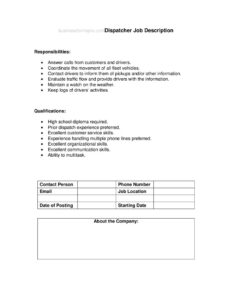
Dispatcher Job Description
Download a free Dispatcher job description template in PDF and DOCX to define responsibilities, qualifications, and hiring criteria — free download, no signup.
PDF
DOCX
0
likes
Download Files
- DOCX
A Dispatcher job description is a document employers use to define the duties, skills, and qualifications required for a dispatching role before posting a job opening or onboarding a new hire. The most common reason people use it is to write a clear, consistent job posting that attracts qualified candidates and sets expectations from day one. You can download this template free in both PDF and DOCX formats, with no signup required.
What Is a Dispatcher Job Description?
A Dispatcher job description is a structured outline of the responsibilities and qualifications associated with a dispatching position. It is typically issued by a hiring manager, HR department, or business owner in industries such as trucking, emergency services, taxi and rideshare fleets, courier companies, utilities, and field service operations. The document explains what the dispatcher will do day to day — coordinating drivers, routing assignments, tracking deliveries, and communicating with both staff and customers — and the skills, experience, and credentials needed to succeed. It serves as the foundation for job ads, interview scorecards, performance reviews, and internal role clarity. With clearly defined Responsibilities and Qualifications sections, the template makes it easy to capture exactly what a dispatcher role involves.
When Do You Need a Dispatcher Job Description?
A well-written job description is useful at several points in the employee lifecycle, not just during recruiting. Common situations include:
- Posting a new opening — when a transportation, logistics, or emergency-services company needs to advertise a dispatcher role on job boards or its careers page.
- Replacing a departing employee — to document an existing role accurately before backfilling the position.
- Onboarding new hires — to give a new dispatcher a clear written reference for their duties and reporting structure.
- Restructuring a team — when splitting dispatch responsibilities across multiple shifts or adding a lead dispatcher position.
- Conducting performance reviews — to measure an employee’s work against the agreed responsibilities and standards.
- Setting pay bands — HR can use the qualifications and scope to benchmark compensation against the market.
Types of Dispatcher Roles
Because dispatching exists across many industries, the same template can be adapted for different contexts. A truck/freight dispatcher coordinates long-haul drivers, loads, and delivery windows. A 911 or emergency dispatcher handles high-pressure calls and routes police, fire, or medical units. A taxi or transportation dispatcher assigns rides and tracks vehicle availability. A field service dispatcher schedules technicians for HVAC, plumbing, or utility work. Tailor the responsibilities and qualifications to match your specific industry.
What a Dispatcher Job Description Should Have
A complete and effective dispatcher job description usually includes the following elements:
- A clear job title and, where relevant, department or shift designation.
- A brief summary of the role’s purpose and how it fits the organization.
- A detailed Responsibilities section listing the recurring duties.
- A Qualifications section covering education, experience, licenses, and skills.
- Reporting relationships — who the dispatcher reports to and who they coordinate with.
- Work environment and schedule details, such as shift work, on-call hours, or weekend coverage.
- Physical or technical requirements, such as proficiency with dispatch software or radio systems.
How to Fill Out a Dispatcher Job Description
This template centers on two core sections. Use the steps below to complete it thoroughly:
- Add a job title and summary at the top — for example, “Fleet Dispatcher” — and write one or two sentences describing the role’s overall purpose.
- Complete the Responsibilities section. List each duty as its own bullet: receiving and prioritizing service requests, assigning drivers or technicians, monitoring routes and delivery status, maintaining logs and records, communicating delays to customers, and ensuring compliance with safety regulations. Aim for 6–10 concrete, action-driven statements.
- Complete the Qualifications section. Specify required education (such as a high school diploma or GED), years of relevant experience, software or system proficiency, communication skills, and any certifications or licenses your industry requires.
- Separate required from preferred qualifications so candidates know what is essential versus a bonus.
- Note the work schedule and reporting line so applicants understand shift expectations.
- Review and finalize the document, then save or export it as a PDF for posting or a DOCX for further editing.
Tips for Writing an Effective Description
Strong job descriptions attract better candidates and reduce mismatched applications. Keep responsibility bullets short and start each with an action verb like “coordinate,” “monitor,” or “resolve.” Be realistic about the qualifications — listing too many requirements can discourage capable applicants. Highlight what makes the role appealing, such as steady scheduling, a supportive team, or growth into a lead dispatcher position. Use language that reflects your actual workplace rather than generic boilerplate, and make sure the tone matches your company culture.
Common Mistakes to Avoid
- Being too vague — “handle dispatch duties” tells candidates nothing; spell out the actual tasks.
- Overloading qualifications — demanding excessive experience or unrelated skills shrinks your applicant pool.
- Ignoring the work schedule — failing to mention night shifts, weekends, or on-call duty leads to early turnover.
- Copying a generic template without editing — a 911 dispatcher and a freight dispatcher need very different descriptions.
- Mixing must-haves with nice-to-haves — blurring required and preferred qualifications confuses applicants.
- Forgetting key tools — omitting required software, GPS, or radio systems can lead to a poor skills match.
Frequently Asked Questions
What does a dispatcher job description include? It includes the job title, a summary of the role, a list of responsibilities, and the qualifications needed to perform the work. Many also note the reporting structure, work schedule, and any required licenses or software skills.
How do I fill out this Dispatcher job description template? Start by adding a job title and short summary, then list the day-to-day duties under Responsibilities and the required education, experience, and skills under Qualifications. Customize each section to match your industry and the specific position you are hiring for.
Is a job description legally binding? A job description is generally not a contract on its own, though some employers attach it to an offer letter or employment agreement. Employment laws and at-will rules vary by jurisdiction, so check your local requirements if you have concerns.
Can I use this template for any type of dispatcher? Yes. The structure works for freight, emergency, taxi, courier, utility, and field-service dispatchers — simply tailor the responsibilities and qualifications to the industry and tools your role involves.
How much does this template cost? It is completely free to download here in PDF and DOCX formats, with no signup or payment required. You can edit the DOCX version freely to fit your organization.
What qualifications should a dispatcher have? Common qualifications include a high school diploma or equivalent, strong communication and multitasking skills, proficiency with dispatch or scheduling software, and the ability to stay calm under pressure. Some roles also require specific certifications, especially in emergency services.
This template is provided as a general example for informational purposes only and does not constitute legal, HR, or employment advice. Employment requirements and regulations vary by jurisdiction and industry — consult a qualified professional before finalizing or relying on any job description.
Official resource: for the rules that apply to your situation, see the U.S. Department of Labor.
Related Forms
- System Administrator Job Description
- Dental Hygienist Job Description
- Personal Assistant Job Description
- Landscaper Job Description
- Pet Sitter Job Description
- Hotel Front Desk Staff Job Description
Browse more in Job Descriptions.