
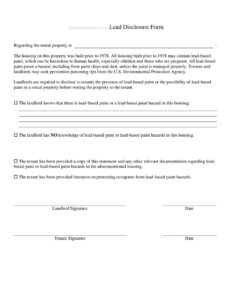
Landlord Lead Disclosure Form
Download a free Landlord Lead Disclosure Form template in PDF and DOCX to disclose lead-based paint hazards to tenants quickly and compliantly. Free download.
PDF
DOCX
1 downloads
0
likes
Download Files
- DOCX
A Landlord Lead Disclosure Form is a document that landlords give to tenants before a lease is signed to disclose any known lead-based paint or lead hazards in a rental property. It is most commonly used to satisfy federal disclosure rules for housing built before 1978, and you can download it here for free in both PDF and DOCX formats with no signup required.
What Is a Landlord Lead Disclosure Form?
A Landlord Lead Disclosure Form is a written statement that records what a landlord knows about lead-based paint and lead-based paint hazards in a dwelling, and confirms that the tenant has received that information. In the United States, federal law requires owners of most housing built before 1978 to disclose known lead hazards and to provide an EPA-approved pamphlet before a tenant becomes obligated under a lease. The form is typically signed by both the landlord (and any agent involved) and the tenant. It creates a paper trail proving the disclosure took place, protecting both parties and helping families—especially those with young children—make informed housing decisions.
When Do You Need a Landlord Lead Disclosure Form?
This form is required or recommended in a range of common rental situations involving older housing. Typical scenarios include:
- Renting out a single-family home, apartment, or condo that was built before 1978.
- Renewing or signing a new lease with an existing tenant in a pre-1978 building.
- Leasing to a family with young children or a pregnant tenant, where lead exposure risk is a heightened concern.
- Using a property management company that needs documented proof of disclosure to limit liability.
- Converting a property to a rental for the first time and preparing a compliant leasing packet.
- Responding to a tenant who asks directly about paint condition or past lead inspections.
Even when a property has been repainted or partially renovated, the underlying layers may still contain lead-based paint, so disclosure obligations generally still apply unless the structure is exempt.
What a Landlord Lead Disclosure Form Should Have
A complete lead disclosure form ties together the landlord’s knowledge, the supporting records, and signed acknowledgments. The key elements are:
- The property address and identification of the dwelling unit being rented.
- The landlord’s disclosure of known lead-based paint or lead hazards, or a statement that they have no knowledge of any.
- A list of any records or reports about lead in the property that the landlord has provided, or a statement that none are available.
- A tenant acknowledgment confirming receipt of the disclosure and the EPA lead-hazard pamphlet.
- An agent’s statement confirming they informed the landlord of their obligations (when an agent is involved).
- Dated signatures from the landlord, any agent, and each tenant certifying the information is accurate.
How to Fill Out a Landlord Lead Disclosure Form
Complete the form carefully before the lease is signed so the dates line up correctly. Work through it in this order:
- Enter the full property address, including unit number, at the top of the form.
- In the landlord’s disclosure section, check the box that reflects your actual knowledge—either that lead-based paint or hazards are present (and describe them) or that you have no knowledge.
- Indicate whether you are providing any records or reports about lead in the property; if so, list each document by title or attach copies.
- Have the tenant review and initial the acknowledgment confirming they received the disclosure information.
- Confirm the tenant has received the EPA-approved pamphlet on lead hazards and check the related box.
- If an agent or property manager is involved, have them sign the statement confirming they informed you of your disclosure duties.
- Each party—landlord, agent, and tenant—signs and dates the form, and everyone keeps a copy.
Federal Background and Recordkeeping
The disclosure requirement comes from federal law that applies to most housing built before 1978, with limited exemptions such as housing for the elderly or disabled (with no children expected to reside there), zero-bedroom units, and certain short-term rentals. Landlords are generally expected to keep the signed disclosure on file for several years as evidence of compliance. Some states and cities add their own lead-related rules, inspection requirements, or additional forms, so it is wise to confirm what applies in your area. Keeping organized, dated copies protects you if a dispute or inquiry arises later.
Tips for Staying Compliant
Disclosure is about timing and proof as much as content. Give the tenant the form and the EPA pamphlet before they sign the lease—not after—so the acknowledgment is genuine. Attach the lead disclosure as part of your standard leasing packet so it is never overlooked. If you have had a lead inspection or risk assessment, include the report rather than summarizing it. Use the same form for every adult tenant on the lease so each person acknowledges receipt individually. Finally, never guess: if you genuinely do not know whether lead is present, say so honestly rather than overstating or understating the risk.
Common Mistakes to Avoid
- Providing the disclosure after the lease is already signed instead of before the tenant is obligated.
- Forgetting to give the tenant the required EPA lead-hazard pamphlet along with the form.
- Leaving the knowledge checkboxes blank, which makes the disclosure incomplete and unclear.
- Failing to attach available inspection reports or records that you referenced on the form.
- Not collecting signatures and dates from every adult tenant, the agent, and the landlord.
- Discarding the signed form too soon instead of keeping it on file as proof of compliance.
Frequently Asked Questions
What is a Landlord Lead Disclosure Form used for? It is used to tell tenants what a landlord knows about lead-based paint and lead hazards in a rental property and to document that the tenant received that information. It is most often required for housing built before 1978. The signed form serves as proof that the disclosure happened before the lease was signed.
Is a lead disclosure legally required for every rental? No. Federal disclosure rules generally apply to housing built before 1978, with exemptions for certain units such as zero-bedroom dwellings and some senior or disabled housing where children are not expected to live. Newer properties built in 1978 or later are typically exempt. Check your local rules, since some areas impose extra requirements.
Do I need to give the tenant anything besides this form? Yes—federal rules generally require you to provide an EPA-approved pamphlet about protecting your family from lead hazards. If you have any lead inspection reports or risk assessments, you should also provide those. The form includes acknowledgments confirming the tenant received these materials.
Does the Landlord Lead Disclosure Form need to be notarized? Notarization is generally not required. The form is validated by the dated signatures of the landlord, any agent, and the tenant rather than by a notary. Keep a signed copy for your records as evidence of compliance.
How long should I keep the signed disclosure? Landlords are commonly advised to retain the signed disclosure for at least several years after the tenancy begins, in case a question or dispute arises later. Storing it with the lease and other tenant documents keeps everything together. Digital copies are a good backup to physical files.
Is this template free to download? Yes. You can download the Landlord Lead Disclosure Form here for free in both PDF and DOCX formats, with no signup required. The DOCX version lets you add your property details and branding before printing it for signatures.
This template is a general example provided for informational purposes only and is not legal advice. Lead disclosure requirements vary by federal, state, and local law, and individual situations differ. Consult a qualified attorney or housing professional to confirm your obligations before relying on this form.
Official resource: for the rules that apply to your situation, see HUD.
Related Forms
- Notice of Lease Termination
- Tenant Lease Breaking Request Letter
- Notice of Overdue Rent
- Security Deposit Return Letter
- Landlord Non-Renewal Letter
- Request for Tenant Repairs
Browse more in Landlord Documents.