
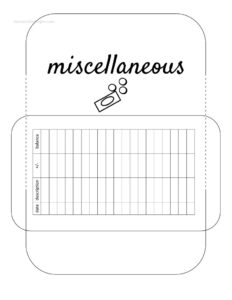
Miscellaneous Cash Envelope
Download a free Miscellaneous Cash Envelope template to organize spare cash, track spending, and stick to your budget — free PDF and DOCX download.
PDF
DOCX
0
likes
Download Files
- DOCX
A Miscellaneous Cash Envelope is a simple printable pouch used to hold and track cash set aside for unplanned or irregular expenses that don’t fit neatly into your other budget categories. People most often use it as part of the cash envelope budgeting system to keep small, random spending under control. It’s free to download here in both PDF and DOCX formats — no signup required.
What Is a Miscellaneous Cash Envelope?
A Miscellaneous Cash Envelope is a labeled paper envelope that holds physical cash for the catch-all category of your budget — the small, occasional purchases that don’t belong to groceries, gas, rent, or other fixed lines. It’s typically used by individuals and households who follow the envelope budgeting method, where each spending category gets its own envelope funded at the start of a pay period. The “miscellaneous” envelope absorbs odds-and-ends expenses: a birthday card, a parking meter, a last-minute school fee. The envelope often includes a printed area to log the category, the amount loaded, the date, and a running record of withdrawals so you always know how much is left.
When Do You Need a Miscellaneous Cash Envelope?
This envelope is most useful whenever you want a dedicated, visible place for the small spending that tends to slip through the cracks. Common situations include:
- Following a zero-based budget where every dollar is assigned a job and the leftovers need a home.
- Curbing impulse purchases by limiting yourself to the physical cash in the envelope rather than swiping a card.
- Covering irregular costs such as vending machines, tips, small repairs, or a coworker’s collection envelope.
- Teaching kids or teens about budgeting with a tangible, hands-on tool.
- Traveling or attending events where you want a set amount of spending money and a way to track it.
- Resetting your finances after overspending, when a strict cash-only approach helps rebuild discipline.
What a Miscellaneous Cash Envelope Should Have
A complete and useful cash envelope is more than a place to stash bills — it should help you stay accountable. The key elements include a clear category label so it’s not confused with other envelopes, a starting balance or amount loaded, the date the envelope was funded, and a transaction log with columns for the date, description, amount spent, and remaining balance. A space for the budget period (weekly, biweekly, or monthly) keeps the tracking consistent. Many people also add a target or budgeted amount at the top so they can see at a glance whether they are on pace or overspending in the miscellaneous category.
How to Fill Out a Miscellaneous Cash Envelope
Because this is a flexible budgeting tool, fill it out in a way that matches how you manage your money:
- Label the category. Write “Miscellaneous” (or a more specific name like “Misc / Extras”) clearly on the front so it’s easy to grab.
- Set the budget period. Note whether this envelope covers a week, two weeks, or a month so your tracking stays consistent.
- Record the amount loaded. Write the starting cash you placed inside, along with the date you funded it.
- Enter your budgeted target. If you have a planned limit for miscellaneous spending, note it at the top to compare against actual spending.
- Log each withdrawal. Every time you take cash out, write the date, a short description of the purchase, and the amount.
- Update the running balance. Subtract each expense from the previous balance so the remaining total is always accurate.
- Reconcile at the end. When the period closes, compare the cash left to your log and decide whether to roll it over or reset.
How to Use the Envelope System Effectively
The miscellaneous envelope works best as one piece of a larger envelope system. Start by listing all of your spending categories, then fund each envelope with cash at the beginning of your pay period. The miscellaneous envelope should be intentionally small — it’s a buffer, not a free-for-all. If you find yourself constantly emptying it, that’s a signal that a recurring expense deserves its own category. Some budgeters let leftover miscellaneous cash roll into savings at month’s end, turning unused buffer money into progress toward a goal. Others zero it out and start fresh. Keep the envelope somewhere secure but accessible, and always log a withdrawal the moment you take cash so the balance never drifts out of sync with reality.
Tips for Tracking Miscellaneous Spending
Miscellaneous spending is the hardest to control precisely because it has no clear pattern. A few habits help: round your entries to the nearest dollar for speed, keep small receipts tucked in the envelope until you log them, and review the log weekly to spot any expense that keeps reappearing. If your miscellaneous envelope routinely runs dry before the period ends, consider whether you’ve underfunded it or whether some “random” purchases are actually predictable. Pairing the envelope with a quick monthly review gives you a clearer picture of where your spare cash really goes.
Common Mistakes to Avoid
- Treating it as unlimited. Letting the miscellaneous envelope become a dumping ground defeats the purpose of budgeting.
- Forgetting to log withdrawals. Cash spent but never recorded makes the running balance meaningless.
- Overfunding the category. A bloated miscellaneous envelope hides where money is actually going.
- Mixing categories. Pulling grocery or gas money from this envelope blurs your tracking.
- Skipping the period reset. Failing to reconcile or roll over at the end makes the next period inaccurate.
- Leaving large amounts of cash unsecured. Keep only what you need and store the envelope safely.
Frequently Asked Questions
What is a Miscellaneous Cash Envelope used for? It’s a printable envelope for holding and tracking cash assigned to your budget’s catch-all category. It captures small, irregular expenses — tips, parking, small gifts, or one-off purchases — that don’t belong to a dedicated category. Using physical cash makes overspending harder and your limit visible.
How do I fill out the envelope? Label it “Miscellaneous,” note the budget period, and record the cash you load along with the date. Each time you spend, log the date, a short description, and the amount, then update the running balance. At the end of the period, reconcile the remaining cash with your log.
Is this template free to download? Yes. The Miscellaneous Cash Envelope template is completely free to download in both PDF and DOCX formats, with no signup or payment required. You can print it as often as you like for personal budgeting.
How much should I put in my miscellaneous envelope? There’s no fixed amount — it depends on your income and how much truly irregular spending you have. Many budgeters keep it intentionally small as a buffer. If it empties too quickly, that’s a sign a recurring expense should get its own category instead.
Can I customize the template? Yes. The DOCX version can be edited to change the category name, add or remove log columns, or adjust the budget period. The PDF is ready to print as-is if you prefer to fill it out by hand.
Does leftover cash roll over to the next period? That’s your choice. Some people roll unused miscellaneous cash into savings, while others reset the envelope to a fixed starting amount each period. Decide on one approach and apply it consistently so your tracking stays accurate.
This template is provided as a general example for informational purposes only and does not constitute financial, tax, or budgeting advice. Personal finance needs vary by individual and circumstance — consult a qualified financial professional for guidance tailored to your situation.
Official resource: for the rules that apply to your situation, see the Consumer Financial Protection Bureau.
Related Forms
- Profit And Loss Statement
- Side Hustle Income Tracker
- Gas Cash Envelope
- Clothing Cash Envelope
- Business Checking Record
- Budget Revision Request
Browse more in Money.