
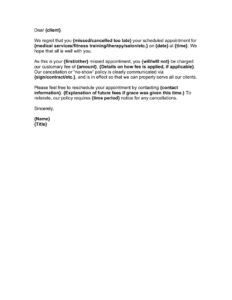
Missed Appointment Letter
Use our free Missed Appointment Letter template to professionally follow up with clients who skipped a scheduled visit and reschedule — free download.
PDF
1 downloads
0
likes
Download Files
A Missed Appointment Letter is a brief written notice sent to a client, patient, or customer after they fail to attend a scheduled appointment without canceling in advance. The single most common reason people use it is to professionally document the no-show, encourage the person to reschedule, and gently remind them of any cancellation policy. It is free to download here in both PDF and DOCX formats — no signup required.
What Is a Missed Appointment Letter?
A Missed Appointment Letter is a formal communication issued by a business, clinic, office, or service provider to acknowledge that a client did not appear for a confirmed appointment. It documents the date and time of the missed visit, expresses the provider’s continued willingness to serve the client, and outlines the next steps for rescheduling. Medical practices, dental offices, salons, law firms, financial advisors, and repair services all use these letters to keep their calendars accurate and to protect themselves if repeated no-shows become a pattern. The tone is typically courteous rather than accusatory, because the goal is to retain the relationship while reinforcing that appointments carry real value and reserved time.
When Do You Need a Missed Appointment Letter?
This letter is useful in many service-based situations where time slots are reserved in advance. Common scenarios include:
- A patient skips a medical or dental appointment without calling to cancel.
- A client misses a consultation with a lawyer, accountant, or financial advisor.
- A customer fails to show for a salon, spa, or grooming booking that held a stylist’s time.
- A homeowner is not present when a technician arrives for a scheduled repair or installation.
- A student or tutoring client does not attend a reserved session.
- A repeated no-show needs formal documentation before a practice considers a late-cancellation fee or discharge from service.
What a Missed Appointment Letter Should Have
An effective letter is short, clear, and respectful. It should identify the recipient, state the date and time of the missed appointment, and reference the type of service that was scheduled. It should invite the client to reschedule and provide a direct phone number, email, or booking link to make that easy. If your business has a cancellation or no-show policy, the letter should briefly restate it so the client understands future expectations. Finally, it should close with the sender’s name, title, organization, and contact details so the recipient knows exactly who reached out and how to respond.
How to Fill Out a Missed Appointment Letter
- Add your business name, address, phone number, and the date at the top so the letter looks official and is easy to act on.
- Enter the recipient’s full name and mailing address in the inside address block.
- Open with a polite greeting, such as “Dear [Client Name].”
- State the purpose clearly: note that the client missed an appointment scheduled for a specific date and time.
- Identify the type of appointment or service that was reserved, so there is no confusion about which visit was missed.
- Express understanding that schedules change, and avoid a scolding tone.
- Invite the client to reschedule and provide the exact phone number, email, or online booking link to use.
- If applicable, restate your cancellation or no-show policy and any associated fee in one or two sentences.
- Close with a courteous sign-off, then add your full name, title, and direct contact information.
Setting the Right Tone
The tone you choose has a real impact on whether a client comes back. For a first missed appointment, keep the letter warm and assume the best — most no-shows are honest mistakes caused by forgotten reminders, scheduling mix-ups, or emergencies. Phrases like “we missed seeing you” land better than “you failed to attend.” For a second or third occurrence, the same template can be adjusted to be more firm, clearly referencing the pattern and the policy consequences. Many businesses keep two or three versions of this letter on file — a friendly first notice, a firmer reminder, and a final notice — all built from the same base template so the formatting stays consistent.
Reducing Future No-Shows
A Missed Appointment Letter works best as part of a larger system rather than a one-off reaction. Pair it with automated text or email reminders sent 24 to 48 hours before each appointment, confirm bookings at the time they are made, and make rescheduling effortless with a clear link or phone line. Tracking which clients repeatedly miss appointments helps you decide when a written notice is warranted and whether a deposit or cancellation fee is appropriate going forward. The letter itself becomes a paper trail that supports those decisions and shows you communicated expectations clearly.
Common Mistakes to Avoid
- Using an accusatory or angry tone that drives the client away instead of bringing them back.
- Forgetting to include the specific missed date and time, which weakens the documentation.
- Omitting clear rescheduling instructions, leaving the client unsure how to respond.
- Referencing a cancellation fee that was never disclosed to the client beforehand.
- Sending the letter so late that the client has forgotten the appointment entirely.
- Leaving out the sender’s name, title, or contact details, making the letter feel impersonal or hard to act on.
Frequently Asked Questions
What is a Missed Appointment Letter? It is a short written notice a business sends after a client does not show up for a scheduled appointment. It documents the missed visit, invites the client to reschedule, and may restate the cancellation policy. It helps maintain professional records while keeping the relationship intact.
How do I fill out a Missed Appointment Letter? Add your business details and the date, enter the recipient’s name and address, state the date and time of the missed appointment, identify the service, and invite the client to reschedule with clear contact information. Keep the tone polite and close with your name and title. Our free template provides a ready-made structure you can complete in minutes.
Is a Missed Appointment Letter legally binding? The letter itself is generally a courtesy communication rather than a binding contract. However, it can serve as documentation if a practice later enforces a no-show fee or discharges a client for repeated absences. Any fees must usually have been disclosed to the client in advance to be enforceable, and rules vary by jurisdiction and industry.
Should I charge a fee for a missed appointment? That depends on your policy and what the client agreed to when booking. Many businesses charge a no-show or late-cancellation fee only if the policy was clearly communicated beforehand. If you intend to charge, the letter should reference the previously disclosed policy rather than introduce a surprise charge.
How soon should I send the letter? Send it promptly — ideally within a day or two of the missed appointment — so the visit is still fresh in the client’s mind. A quick follow-up improves the chance the client reschedules and shows that your time is valued. Delaying the letter weakens both its documentation value and its rescheduling impact.
Is this Missed Appointment Letter template really free? Yes. You can download it free in PDF and DOCX formats with no signup required. Edit it in your word processor to match your business name, branding, policy, and contact details before sending.
This template is a general example provided for informational purposes only and is not legal, financial, or professional advice. Cancellation and no-show policies, fee enforcement, and patient or client communication requirements vary by jurisdiction and industry — consult a qualified professional before relying on this document.
Related Forms
- Out Of Stock Notice
- Congratulations on Promotion
- Auto Insurance Verification Letter
- Introducing New Salesperson
- Disputed Invoice
- Employee Termination For Gross Misconduct
Browse more in Business Letters.