
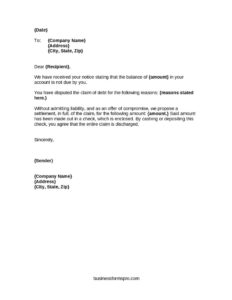
Offer To Settle Disputed Account
Download a free Offer to Settle Disputed Account letter template to resolve a contested balance with an accord and satisfaction check — free download in PDF and DOCX.
DOCX
4 downloads
0
likes
Download Files
- DOCX
An Offer to Settle Disputed Account is a business letter sent to a party who disputes that they owe a stated balance, proposing to resolve the entire claim for a specific compromise amount. People most often use it to close out a contested invoice or account quickly — frequently by enclosing a settlement check that, once cashed, discharges the full claim. You can download this template free in PDF and DOCX, with no signup required.
What Is an Offer to Settle Disputed Account?
An Offer to Settle Disputed Account is a written proposal from a debtor (or a paying party) to a creditor or claimant who has demanded payment that the debtor believes is wrong, excessive, or not owed. Rather than litigating or letting the dispute fester, the sender offers a defined sum as a complete and final settlement of the contested balance. The letter typically states the offer is made without admitting liability and is intended as an offer of compromise. When a check is enclosed and accepted, the letter may operate as an “accord and satisfaction” — meaning the dispute is treated as fully resolved once the funds are deposited or cashed.
When Do You Need an Offer to Settle Disputed Account?
This letter fits situations where a balance is genuinely in dispute and you want a clean, documented resolution. Common scenarios include:
- Billing disagreements: A vendor claims you owe the full invoice, but you believe part of the work was incomplete or overcharged, and you offer a reduced figure to close it out.
- Service quality disputes: A contractor or supplier delivered goods or services you found deficient, and you propose paying a portion to settle.
- Account reconciliation conflicts: Two businesses disagree over the running balance of an open account, and you want to cut off further dispute with a single payment.
- Avoiding collections or litigation: You want to resolve a contested debt before it escalates to a collection agency or a lawsuit.
- Damaged or returned goods: A buyer disputes a charge for products that arrived damaged and offers a compromise amount.
- Final demand responses: You received a demand notice and want to respond with a good-faith settlement offer rather than ignore it.
What an Offer to Settle Disputed Account Should Have
A complete settlement letter is short but precise. It should clearly identify the parties, reference the disputed balance and the reasons given for the dispute, state the proposed settlement amount, and make plain that the offer is a compromise made without admitting liability. If a check is enclosed, the letter should spell out that cashing or depositing it constitutes acceptance and full discharge of the claim. Including the date, addresses, and an authorized signature ensures both sides have a clear paper trail of what was offered and on what terms.
How to Fill Out an Offer to Settle Disputed Account
- Date: Enter the date you are sending the letter at the top.
- Recipient block: Fill in the Company Name, Address, and City, State, Zip of the creditor or claimant you are responding to.
- Salutation: Replace Dear {Recipient} with the name of the specific person handling the account, if known.
- Disputed balance: In the line referencing the notice, insert the amount the other party claims is due.
- Reasons for dispute: In the reasons stated here field, summarize why the balance is contested — for example, incomplete delivery, billing errors, or quality issues.
- Settlement amount: Enter the amount you are offering as full and final settlement. Make sure it matches the enclosed check exactly.
- Enclose the check: Confirm a check for the settlement amount is attached, since the letter states cashing or depositing it discharges the entire claim.
- Signature block: Add the Sender name, Company Name, Address, and City, State, Zip, then sign.
Understanding Accord and Satisfaction
The core mechanism behind this letter is a legal concept called accord and satisfaction. In a genuine dispute, when a debtor offers a smaller sum as full payment and the creditor accepts it — often by cashing the enclosed check — the original claim can be considered satisfied. For this to work, three elements generally matter: there must be a bona fide dispute over the amount owed, the offer must be clearly conditioned as full and final settlement, and the creditor must knowingly accept the payment on those terms. The phrasing in this template — “By cashing or depositing this check, you agree that the entire claim is discharged” — is designed to make that condition explicit. Because the rules and enforceability vary by jurisdiction, it is wise to confirm how accord and satisfaction is treated where you do business.
Tips for a Stronger Settlement Offer
Keep the tone professional and free of blame; the goal is resolution, not argument. State the dispute reasons factually and briefly rather than rehashing the entire history. Send the letter and check together by a trackable method, and keep a copy of both for your records. Some senders also write “payment in full of disputed account” or similar wording in the check memo line to reinforce the settlement intent — though wording alone does not guarantee enforceability. If the stakes are high, consider having a professional review the letter before you send it.
Common Mistakes to Avoid
- Mismatched amounts: Listing one settlement figure in the letter and a different amount on the check creates confusion and weakens the offer.
- Admitting liability: Adding language that concedes you owe the full debt undermines the “without admitting liability” compromise stance.
- Vague dispute reasons: Leaving the reasons section blank or generic makes it harder to show there was a genuine dispute.
- No proof of delivery: Sending without tracking leaves you unable to prove the offer and check were received.
- Forgetting the check: The letter references an enclosed check; sending the letter alone breaks the accord and satisfaction logic.
- Skipping records: Failing to keep copies of the signed letter and the cleared check removes your evidence the claim was settled.
Frequently Asked Questions
What is an Offer to Settle Disputed Account? It is a business letter proposing to resolve a contested account balance for a specific compromise amount, usually with a settlement check enclosed. It states the offer is made without admitting liability and that cashing the check discharges the full claim. It is used to close out disputes without litigation.
How do I fill out the Offer to Settle Disputed Account? Add the date, the recipient’s company name and address, the disputed amount, the reasons for the dispute, and your proposed settlement amount. Enclose a check for that exact amount and complete your signature block. Make sure the letter and check figures match precisely.
Is this letter legally binding? If there is a genuine dispute and the creditor accepts the check on the stated terms, it may create an enforceable accord and satisfaction in many jurisdictions. However, the rules differ by state and circumstance, so enforceability is not automatic. Consult a qualified professional for high-value or contentious disputes.
Do I have to enclose a check? This template is written around an enclosed settlement check, which is what triggers the discharge upon cashing. You can adapt it to propose payment by another method, but the accord and satisfaction effect typically depends on the creditor accepting a clearly conditioned payment.
Does this letter need to be notarized or witnessed? A settlement offer letter of this kind generally does not require notarization or witnesses to be valid. The key is clear written terms and the creditor’s acceptance of the payment. Keep copies and proof of delivery for your records.
How much does this template cost? It is completely free to download from Business Forms Pro in both PDF and DOCX formats, with no signup or payment required. You can edit the DOCX version to fit your specific account and dispute details. Use it as many times as you need.
This template is a general example provided for informational purposes only and is not legal, financial, or tax advice. Laws governing disputed accounts and accord and satisfaction vary by jurisdiction, and enforceability depends on your specific facts. Consult a qualified attorney or professional before relying on this letter to settle a disputed claim.
Related Forms
- New Product Announcement
- Payment Location Change
- Promotion Letter
- Follow Up Letter
- Cease and Desist Copyright
- Partial Shipment Notification
Browse more in Business Letters.