
Offering Count Sheet
Download a free Offering Count Sheet template to record and verify tithes, offerings, cash, and checks — available as a free PDF and DOCX download.
PDF
DOC
27 downloads
0
likes
Download Files
- DOC
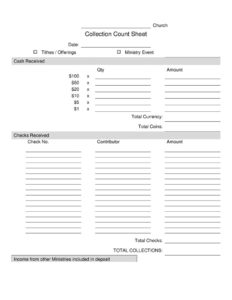
An Offering Count Sheet is a simple form your church uses to record and verify every dollar collected during a service, recording cash by denomination, individual checks, and other ministry income before a deposit is made. It’s the most common tool counting teams use to keep collections transparent and accountable, and you can download it free here in both PDF and DOCX formats — no signup required.
What Is an Offering Count Sheet?
An Offering Count Sheet is a record used by a church counting team or finance committee to tally money received from tithes, offerings, and ministry events. It documents exactly how much cash was received broken down by bill denomination and coins, lists each check by number, contributor, and amount, and notes any income from other ministries included in the same deposit. The form is typically completed by two or more counters immediately after a service, signed by the person who counted, and matched against the bank deposit slip. It creates a clear paper trail so the totals on the sheet, the deposit, and the church’s accounting records all agree.
When Do You Need an Offering Count Sheet?
Almost any congregation that receives money benefits from a consistent counting record. Common situations include:
- Weekly Sunday services — recording the regular tithes and offerings collected in the plate or basket.
- Special services or holidays — counting larger collections at Christmas, Easter, or revival events.
- Ministry events — tracking funds from a youth fundraiser, missions drive, or building campaign as a separate line.
- Mid-week and evening services — documenting smaller offerings that still need to be logged and deposited.
- Designated giving — when checks are marked for a specific purpose, such as benevolence or a capital fund.
- Audit and review — providing finance committees and outside auditors with a verifiable count for each deposit.
What an Offering Count Sheet Should Have
A complete count sheet captures every category of money and ties it to a specific date and a named counter. The essential elements are the service or collection date, a breakdown of cash by denomination with quantity and amount columns, a total for currency and a separate total for coins, an itemized list of checks showing check number, contributor, and amount, a checks total, and a grand total of all collections. It should also include a line for income from other ministries with the amount and purpose, and a signature line for the person or team who counted. Together these fields let the church reconcile the count against the actual bank deposit.
How to Fill Out an Offering Count Sheet
- Date: Enter the date of the service or collection being counted.
- Tithes / Offerings and Ministry Event: Indicate the source — mark whether this is general tithes and offerings or tie it to a specific ministry event.
- Cash Received — by denomination: For each bill ($100, $50, $20, $10, $5, $1), count the bills and write the Qty (quantity), then multiply to get the Amount for that row.
- Total Currency: Add all the bill amounts together and record the total currency.
- Total Coins: Count and total any coins separately, then enter the coin total.
- Checks Received: List each check on its own line — record the Check No., the Contributor name, and the Amount.
- Total Checks: Add all check amounts and enter the total.
- Income from other Ministries: If another ministry’s funds are included in the deposit, enter the Amount and a brief Purpose.
- Total Collections: Add total currency, total coins, total checks, and any other ministry income for the grand total.
- Counted By: Have each counter sign to verify the totals.
Best Practices for Counting Teams
The integrity of an offering count rests as much on procedure as on the form itself. Most churches use a two-person rule, meaning at least two unrelated people count together and both sign the Counted By line, so no single individual ever handles money alone. Count in a secure, low-traffic room and keep the collection sealed until the team is ready. Record checks exactly as written, copying the check number and contributor name precisely, since these details feed individual giving statements at year-end. When the count is finished, compare your Total Collections directly to the bank deposit slip — the two figures should match to the penny before anyone leaves the room.
Reconciling the Sheet With Your Records
The count sheet is the bridge between the offering plate and your accounting system. After counting, the treasurer or bookkeeper enters the totals into the church’s financial software, posting cash and checks against the correct funds or designations. Keep the completed sheets on file in date order, along with copies of deposit slips, so they can be cross-referenced during a review. Designated checks — those a contributor earmarks for missions, building, or benevolence — should be flagged in the Purpose column or in a note so they are posted to the right account rather than to the general fund.
Common Mistakes to Avoid
- Counting alone: Letting one person count and sign undermines accountability — always use two or more counters.
- Skipping the denomination breakdown: Writing one lump cash figure makes errors impossible to trace; fill in the Qty and Amount for each bill.
- Omitting check details: Leaving out the check number or contributor name causes problems when issuing giving statements.
- Not separating coins: Lumping coins into currency throws off the totals; use the Total Coins line.
- Forgetting other ministry income: Failing to log and label funds from another ministry creates posting errors later.
- Not reconciling to the deposit: Skipping the comparison between Total Collections and the actual deposit slip lets mistakes slip through.
Frequently Asked Questions
What is an Offering Count Sheet used for? It is used to record and verify all money collected at a church service or event before it is deposited. The sheet documents cash by denomination, individual checks, and other ministry income, then totals everything so the count can be matched against the bank deposit.
How do I fill out the cash section? Count the bills for each denomination — $100, $50, $20, $10, $5, and $1 — and write the quantity in the Qty column, then enter the dollar Amount for that row. Add all the rows to get Total Currency, and total any coins separately on the Total Coins line.
How many people should count the offering? Best practice is at least two unrelated people counting together, with both signing the Counted By line. This two-person rule protects volunteers from suspicion and reduces the chance of errors going unnoticed.
Why do I need to record the check number and contributor? Recording each check’s number, contributor name, and amount creates an accurate record for issuing year-end giving statements and for tracing any deposit discrepancy. It also helps you post designated gifts to the correct fund.
Is an Offering Count Sheet a legal or tax document? The sheet itself is an internal control record, not a tax filing, but it supports your church’s bookkeeping and any contribution records used for donor statements. Keep completed sheets on file so they are available during a financial review or audit.
Is this Offering Count Sheet free to download? Yes. You can download this template free in both PDF and DOCX formats with no signup required, and you can customize the fields to fit your church’s funds, services, and counting procedures.
This Offering Count Sheet template is provided as a general example for informational purposes only and does not constitute legal, financial, accounting, or tax advice. Recordkeeping and reporting requirements vary by jurisdiction and by organization — consult a qualified accountant or financial professional to ensure your church’s procedures meet applicable rules.
Related Forms
- Wedding Reception Fees
- Prayer To St Joseph Holy Card (2 per page)
- My Holy Confirmation Card (2 per page)
- Ordination Anniversary Card (2 per page)
- Prayer Of Saint Francis Funeral Card (2 per page)
- My First Holy Communion Card (2 per page)
Browse more in Church.