
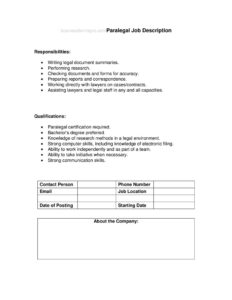
Paralegal Job Description
Download a free Paralegal job description template in PDF and DOCX to clearly define responsibilities, qualifications, and hiring expectations.
PDF
DOCX
0
likes
Download Files
- DOCX
A Paralegal Job Description is a document that defines the duties, qualifications, and expectations for a paralegal role within a law firm, corporate legal department, or government agency. The most common reason people use it is to attract qualified candidates and set clear performance standards before posting a job opening. You can download this template for free in both PDF and DOCX formats, with no signup required.
What Is a Paralegal Job Description?
A Paralegal Job Description is a structured outline that communicates what a paralegal will do on the job and what skills, education, and experience are required to perform the role. It is typically issued by a hiring manager, HR department, attorney, or office administrator and serves as the foundation for a job posting, an interview rubric, and an eventual performance review. The document documents core responsibilities — such as legal research, drafting documents, and case management — alongside the qualifications that distinguish a strong applicant. By putting these expectations in writing, employers reduce confusion, standardize hiring, and give candidates a transparent picture of the position before they apply.
When Do You Need a Paralegal Job Description?
This template is useful any time you need to formalize or communicate the paralegal role. Common scenarios include:
- Opening a new position: When a law firm or legal department is hiring its first or an additional paralegal and needs a clear posting.
- Replacing a departing employee: To update and re-advertise the role after a paralegal resigns or is promoted.
- Setting performance expectations: Managers use it during onboarding and reviews to clarify what success looks like.
- Restructuring a legal team: When duties shift between paralegals, legal assistants, and attorneys, written descriptions prevent overlap.
- Working with recruiters or staffing agencies: A precise description helps third parties screen candidates accurately.
- Justifying a job classification: HR may need the document to set salary bands, FLSA status, or comply with internal policy.
Types of Paralegal Roles
Paralegal positions vary widely, and your description should reflect the specialty. A litigation paralegal focuses on discovery, trial preparation, and court filings. A corporate paralegal handles contracts, compliance, and entity formation. Real estate, immigration, family law, and intellectual property paralegals each carry distinct duties. Tailoring the responsibilities and qualifications to the practice area produces a more accurate and effective posting.
What a Paralegal Job Description Should Have
A complete description gives candidates and managers everything they need to evaluate fit. The key elements include:
- A clear job title and, if relevant, the practice area or department.
- A short summary of the role’s purpose and who it reports to.
- A detailed Responsibilities section listing the day-to-day and ongoing duties.
- A Qualifications section covering education, certification, experience, and skills.
- Any required software proficiency, such as case management or e-discovery platforms.
- Soft skills like attention to detail, organization, and written communication.
- Work conditions, location, and whether the role is remote, hybrid, or on-site.
How to Fill Out a Paralegal Job Description
This template centers on two core sections — Responsibilities and Qualifications. Follow these steps to complete it:
- Add a job title and summary: Above the template fields, label the role (e.g., “Litigation Paralegal”) and write one or two sentences describing its purpose and reporting line.
- Complete the Responsibilities section: List specific, action-oriented duties such as conducting legal research, drafting pleadings and correspondence, managing case files, preparing discovery responses, scheduling depositions, and assisting attorneys at trial. Use bullet points and start each with a verb.
- Prioritize the duties: Place the most important or time-consuming tasks first so candidates immediately understand the role’s focus.
- Complete the Qualifications section: Specify required education (associate’s degree, paralegal certificate, or bachelor’s), certifications (such as CP or RP), years of experience, and software skills.
- Separate required from preferred: Distinguish must-have qualifications from those that are nice to have to widen your candidate pool.
- Review for accuracy: Confirm the duties match the actual role and remove anything outdated or inflated before posting.
Tips for Writing an Effective Paralegal Description
Strong job descriptions are specific and honest. Avoid vague phrases like “handles legal work” in favor of concrete tasks such as “drafts subpoenas and trial exhibits.” Quantify where you can — for example, “manages a caseload of 40+ active matters.” Keep the language inclusive and free of unnecessary jargon so a broad range of qualified applicants can see themselves in the role. If your jurisdiction or bar association regulates how paralegal work is described or supervised, ensure your language reflects that paralegals work under attorney supervision and do not provide legal advice or represent clients.
Job Description vs. Job Posting
A job description and a job posting are related but distinct. The description is an internal reference document that defines the role’s duties and requirements over time, often used for HR classification and performance management. A posting is the public-facing advertisement that draws from the description but adds marketing language, company culture, benefits, and an application call to action. Using this template as your foundation lets you produce a consistent description and then adapt it into one or more postings as needed.
Common Mistakes to Avoid
- Listing too many requirements: Overloading the qualifications can discourage strong applicants who meet most criteria.
- Being vague about duties: Generic responsibilities make it hard to screen candidates and set expectations.
- Ignoring the practice area: A one-size-fits-all description fails to reflect specialized litigation or corporate work.
- Confusing paralegals with legal assistants: Clarify the role so duties and pay align with the correct classification.
- Forgetting supervision language: Failing to note that paralegals work under attorney supervision can create compliance issues.
- Never updating the document: Roles evolve, so review the description periodically to keep it current.
Frequently Asked Questions
What is a Paralegal Job Description? It is a written document that outlines the responsibilities and qualifications for a paralegal position. Employers use it to attract candidates, guide interviews, and set clear performance expectations once someone is hired.
How do I fill out this template? Start by adding a job title and brief summary, then complete the Responsibilities section with specific duties and the Qualifications section with required education, certifications, experience, and skills. Separate required qualifications from preferred ones and review everything for accuracy before posting.
What qualifications should a paralegal have? Most roles require an associate’s degree or paralegal certificate, though some employers prefer a bachelor’s degree, and many value professional certifications such as CP or RP. Practical skills like legal research, document drafting, organization, and familiarity with case management software are also commonly listed.
Is this job description a legally binding contract? No, a job description is generally not an employment contract by itself; it describes the role rather than guaranteeing terms of employment. Employers often include at-will language and consult HR or counsel to ensure the document aligns with their policies and local employment laws.
How much does this template cost? It is completely free to download from Business Forms Pro in both PDF and DOCX formats, with no account or signup required. You can edit it freely to match your firm, practice area, and specific hiring needs.
Can I customize the responsibilities and qualifications? Yes, the template is designed to be edited. Add, remove, or reorder duties to reflect your litigation, corporate, immigration, or other specialty, and adjust the qualifications to match your firm’s standards and budget.
This template is provided as a general example for informational purposes only and does not constitute legal, employment, or HR advice. Employment requirements and job classification rules vary by jurisdiction and employer — consult a qualified attorney or HR professional before finalizing or posting a job description.
Official resource: for the rules that apply to your situation, see the U.S. Department of Labor.
Related Forms
- Teacher Job Description
- Pet Sitter Job Description
- Store Manager Job Description
- Delivery Driver Job Description
- Janitor Job Description
- Catering Assistant Job Description
Browse more in Job Descriptions.