
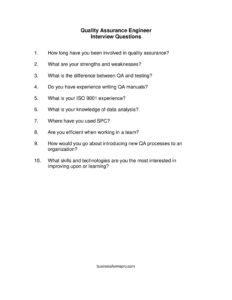
Quality Assurance Engineer Interview Questions
Download a free Quality Assurance Engineer interview questions template to screen QA candidates fairly and thoroughly — free PDF and DOCX download.
PDF
DOCX
0
likes
Download Files
- DOCX
The Quality Assurance Engineer Interview Questions template is a ready-made list of focused questions for evaluating candidates who test products, build QA processes, and protect quality standards. Hiring managers most often use it to run consistent, structured interviews that compare applicants on the same criteria. It is free to download in both PDF and DOCX, with no signup required.
What Is a Quality Assurance Engineer Interview Questions Template?
A Quality Assurance Engineer Interview Questions template is a prepared set of questions a hiring team asks each QA candidate during a screening or panel interview. It is typically used by recruiters, engineering managers, QA leads, and HR coordinators to document a fair, repeatable conversation. The template covers experience, technical knowledge, process skills, and teamwork — the core areas that determine whether someone can find defects, write documentation, and improve quality systems. Rather than improvising on the spot, interviewers work from a shared list so every applicant answers comparable questions, which makes scoring and side-by-side comparison far easier and reduces unconscious bias in hiring decisions.
When Do You Need a Quality Assurance Engineer Interview Questions Template?
This template is useful any time you are evaluating QA talent and want structure and consistency. Common situations include:
- Filling a new or backfilled QA engineer, QA analyst, or test engineer position on a software or manufacturing team.
- Building a hiring panel where several interviewers each cover different topic areas and need to coordinate their questions.
- Screening a high volume of applicants and needing a quick, repeatable way to compare technical depth.
- Training a junior recruiter or hiring manager who is new to evaluating quality assurance skills.
- Standardizing your interview process to support fair, defensible hiring records.
- Promoting internally and assessing whether a candidate is ready to lead QA process improvement.
What a Strong QA Interview Question Set Should Have
An effective set balances breadth and depth. It should probe years and type of QA experience, distinguish conceptual understanding from hands-on practice, and surface both technical and soft skills. The best lists mix open-ended behavioral questions (“How would you introduce a new process?”) with specific knowledge checks (“What is your ISO 9001 experience?”). It should also leave room to follow up, capture notes, and rate each answer. Crucially, it should connect to the actual role: a QA engineer who writes manuals, analyzes data, and applies statistical process control needs different questions than a manual tester, so tailor emphasis accordingly.
How to Use This Quality Assurance Engineer Interview Questions Template
Work through the questions in a logical order and take notes against each one:
- Open with “How long have you been involved in quality assurance?” to establish experience level and set a baseline for the rest of the conversation.
- Ask “What are your strengths and weaknesses?” to gauge self-awareness and honesty.
- Use “What is the difference between QA and testing?” as a knowledge check — strong candidates explain QA as prevention and testing as detection.
- Explore documentation skills with “Do you have experience writing QA manuals?” and ask for examples.
- Probe standards knowledge through “What is your ISO 9001 experience?” to see if they understand quality management systems.
- Assess analytical ability with “What is your knowledge of data analysis?”
- Dig into practical application by asking “Where have you used SPC?” (statistical process control).
- Evaluate collaboration with “Are you efficient when working in a team?”
- Test leadership thinking via “How would you go about introducing new QA processes to an organization?”
- Close with “What skills and technologies are you most interested in improving or learning?” to measure growth mindset.
What to Listen For in Each Answer
The questions only do half the work — your interpretation does the rest. When candidates describe their QA tenure, listen for the type of environment (software, manufacturing, regulated industry) rather than just the number of years. On the QA-versus-testing question, a thoughtful answer frames QA as a process-focused discipline that builds quality in, while testing verifies a product after it is built. For ISO 9001 and SPC, ask candidates to walk you through a real example — an audit they prepared for, a control chart they maintained, or a corrective action they led. When discussing how they would introduce new processes, strong applicants mention stakeholder buy-in, pilot programs, and measuring results rather than imposing change top-down. These follow-ups separate memorized definitions from genuine experience.
Adapting the Questions to the Role
QA engineering spans several specialties, so adjust emphasis to the job you are filling. For a software QA role, you might layer in questions about test automation frameworks, defect tracking tools, and regression strategy. For a manufacturing or operations QA role, lean harder on the ISO 9001 and SPC questions and add items about inspection, sampling plans, and audit readiness. For a senior or lead position, weight the process-improvement and teamwork questions more heavily, since those reveal leadership capacity. Keep the core list intact so you preserve consistency across candidates, but feel free to append a few role-specific items in the DOCX version before each interview.
Common Mistakes to Avoid
- Asking questions in a different order or with different wording for each candidate, which undermines fair comparison.
- Accepting textbook definitions without asking for a concrete, real-world example.
- Skipping note-taking, then relying on memory when you compare applicants later.
- Over-indexing on technical knowledge while ignoring teamwork and communication — QA is highly collaborative.
- Treating “weaknesses” as a trick question instead of an honest gauge of self-awareness.
- Failing to tailor the SPC and ISO 9001 questions to whether the role actually requires them.
Frequently Asked Questions
What is this Quality Assurance Engineer Interview Questions template? It is a curated list of ten interview questions designed to help you evaluate QA candidates on experience, technical knowledge, process skills, and teamwork. You can use it as-is or customize it for your specific role and industry. It is free to download in PDF and DOCX.
How do I use the questions in an interview? Print or open the template, ask each candidate the same questions in the same order, and record their answers and your impressions beside each item. Use follow-up prompts to ask for specific examples, then score answers consistently so you can compare applicants fairly afterward.
Can I edit or add my own questions? Yes. The DOCX version is fully editable, so you can reorder items, reword them, or add role-specific questions about automation tools, test frameworks, or regulatory requirements. Many teams keep the core list and append a few custom questions for each opening.
What is the difference between QA and testing, and why is it asked? QA (quality assurance) is a broad, process-oriented discipline focused on preventing defects, while testing is a specific activity that detects defects in a finished product. The question is included because a candidate’s answer quickly reveals whether they understand the strategic side of quality, not just the hands-on side.
Are SPC and ISO 9001 questions relevant for software QA roles? They are most relevant for manufacturing, hardware, and regulated environments, but understanding ISO 9001 quality management principles and statistical process control can still signal a disciplined mindset. If your role does not require them, you can remove or replace those questions in the template.
How much does this template cost? Nothing — it is completely free to download in both PDF and DOCX formats with no signup or account required. You can reuse it for as many interviews and candidates as you need.
This template is a general example provided for informational purposes only and does not constitute legal, HR, or hiring-compliance advice. Interview and employment requirements vary by jurisdiction and industry; consult a qualified HR or legal professional to ensure your hiring process meets applicable laws and regulations.
Official resource: for the rules that apply to your situation, see the U.S. Department of Labor.
Related Forms
- Computer Programmer Interview Questions
- Website Designer Interview Questions
- Home Healthcare Assistant Interview Questions
- Dispatcher Interview Questions
- Secretary Interview Questions
- Controller Interview Questions
Browse more in Interview Questions.