
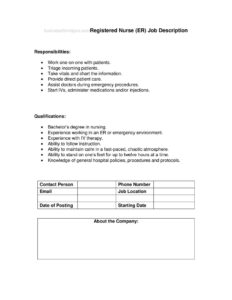
Registered Nurse ER Job Description
Download a free Registered Nurse ER job description template in PDF and DOCX to define ER nursing responsibilities, qualifications, and hiring criteria fast.
PDF
DOCX
0
likes
Download Files
- DOCX
A Registered Nurse ER job description is a hiring document that outlines the duties, skills, and credentials required for a registered nurse working in a hospital emergency room. Employers most often use it to post a job opening, screen applicants, and set clear expectations for fast-paced emergency care. You can download this template free in both PDF and DOCX formats with no signup required.
What Is a Registered Nurse ER Job Description?
A Registered Nurse ER job description is a structured summary of what an emergency room nurse does and the qualifications needed to perform the role. It is typically issued by a hospital’s human resources team, nurse manager, or recruiter and shared with candidates, staffing agencies, and credentialing departments. The document captures core responsibilities — such as triage, patient assessment, and rapid intervention — alongside the qualifications required, including licensure, certifications, and clinical experience. It serves both as a recruiting tool and an internal reference that helps align expectations between the nurse, supervisors, and the broader care team. A well-written version reduces hiring confusion and supports fair, consistent evaluation of applicants.
When Do You Need a Registered Nurse ER Job Description?
This document is useful any time you are defining, advertising, or evaluating an emergency room nursing role. Common situations include:
- Posting a new or replacement ER nurse opening on job boards or a hospital careers page.
- Working with a staffing or travel-nurse agency that needs precise role requirements.
- Standardizing duties across multiple emergency department shifts or units.
- Conducting performance reviews and clarifying what success looks like in the role.
- Onboarding a newly hired RN who needs a clear summary of expectations.
- Restructuring an emergency department and redefining how responsibilities are divided.
Types of ER Nursing Roles This Template Can Cover
The same framework can be adapted for several variations of the position. A general staff ER nurse focuses on direct patient care across all incoming cases. A charge nurse role adds shift coordination and staff oversight. A trauma-focused position emphasizes advanced certifications and high-acuity intervention. Pediatric ER and triage-specialized roles can also use this template with adjusted responsibilities and qualifications. Tailor the two core sections to match the exact scope you are hiring for.
What a Registered Nurse ER Job Description Should Have
To be complete and genuinely useful, the document should clearly separate what the nurse will do from what the nurse must bring to the role. The two anchoring sections are:
- Responsibilities — the day-to-day clinical and operational duties, such as triaging patients by severity, performing assessments, administering medications, monitoring vital signs, documenting care, and collaborating with physicians.
- Qualifications — the required credentials and competencies, such as an active RN license, BLS/ACLS certification, relevant emergency or trauma experience, and the soft skills needed for high-pressure environments.
Strong job descriptions also state the job title clearly, indicate the department and reporting line, and note any physical or scheduling demands like rotating shifts, weekends, or the ability to stand and move for extended periods.
How to Fill Out a Registered Nurse ER Job Description
This template centers on two editable sections — Responsibilities and Qualifications — so the focus is on filling them with accurate, role-specific detail. Follow these steps:
- Add the exact job title at the top, such as “Registered Nurse – Emergency Room” or “ER Staff RN.”
- Note the department, facility, and who the role reports to (for example, the ER Nurse Manager).
- Under Responsibilities, list each core duty as a separate line: triage and prioritize incoming patients, perform rapid assessments, start IVs and administer medications, monitor and document vitals, assist with procedures, communicate with physicians and families, and maintain accurate records.
- Order responsibilities from most frequent or critical to least, so candidates grasp the role’s true focus.
- Under Qualifications, list required items first — active RN license, BLS and ACLS certification, and minimum years of ER or acute-care experience.
- Then add preferred qualifications, such as TNCC, PALS, or CEN certification and prior trauma-center experience.
- Include essential soft skills: composure under pressure, strong communication, and teamwork.
- Review for accuracy, remove anything not truly required, and save as PDF for posting or DOCX for further editing.
Tips for Writing Responsibilities and Qualifications That Attract the Right Nurses
The strength of an ER nurse job description lies in its specificity. Vague phrases like “provide patient care” tell candidates little; “triage and stabilize high-acuity patients during peak emergency volume” tells them exactly what they’re signing up for. Use active verbs to begin each responsibility line and quantify experience requirements where you can, such as “minimum two years of emergency department experience.” Separate true requirements from nice-to-haves so you don’t accidentally discourage qualified applicants. Keep the language consistent with your facility’s actual workflow, since mismatched expectations are a leading cause of early turnover in emergency nursing.
Keeping the Description Compliant and Inclusive
Focus on the genuine functions of the role rather than personal characteristics, and describe physical demands in terms of essential job tasks. Employment and accommodation requirements vary by jurisdiction and employer policy, so coordinate with your HR or compliance team before posting. Avoid wording that could unintentionally narrow your candidate pool, and ensure certification and licensure requirements reflect what is genuinely necessary for the position.
Common Mistakes to Avoid
- Listing generic nursing duties without reflecting the fast-paced, high-acuity reality of emergency care.
- Mixing required and preferred qualifications so candidates can’t tell what is mandatory.
- Omitting essential certifications like BLS or ACLS, or listing certifications you don’t actually require.
- Forgetting to mention shift patterns, weekend rotations, or on-call expectations.
- Overloading the responsibilities section so it becomes unreadable — keep each line focused.
- Failing to update the description when the role’s actual duties or department structure changes.
Frequently Asked Questions
What is a Registered Nurse ER job description used for? It is used to define and advertise an emergency room nursing role, screen applicants, and set clear expectations for both the employer and the hired nurse. It typically guides recruiting, onboarding, and performance discussions. Having one consistent document keeps everyone aligned on duties and required credentials.
What should go in the Responsibilities section? Include the day-to-day clinical and operational duties an ER nurse performs, such as triage, patient assessment, medication administration, monitoring vitals, assisting with procedures, and documenting care. List each duty on its own line and order them by importance. Be specific enough that a candidate immediately understands the role’s real demands.
What qualifications should I list for an ER nurse? Start with the non-negotiables: an active RN license and required certifications like BLS and ACLS, plus a minimum amount of emergency or acute-care experience. Then add preferred items such as TNCC, PALS, or CEN. Clearly labeling required versus preferred helps you attract qualified applicants without screening out strong candidates.
Is this job description legally binding? A job description is generally a descriptive hiring and management tool, not a contract by itself, though it can be referenced in employment discussions. Whether and how it carries legal weight depends on your employer policies and local employment law. Consult your HR or legal team to confirm how it fits your hiring process.
Can I edit the template for a charge nurse or travel role? Yes. The template’s Responsibilities and Qualifications sections are fully editable, so you can adapt them for charge nurse, trauma, pediatric ER, triage, or travel-nurse positions. Adjust the duties and required certifications to match the specific scope and reporting structure of the role.
How much does this template cost? It is completely free to download from Business Forms Pro in both PDF and DOCX formats, with no signup required. You can use the PDF for immediate posting or the DOCX to customize the wording for your facility. There are no hidden fees or registration steps.
This template is a general example provided for informational purposes only and does not constitute legal, employment, or human resources advice. Hiring, licensure, and accommodation requirements vary by jurisdiction and employer. Consult a qualified HR or legal professional before using it in your hiring process.
Official resource: for the rules that apply to your situation, see the U.S. Department of Labor.
Related Forms
- Barista Job Description
- Delivery Driver Job Description
- Personal Assistant Job Description
- Handyman Job Description
- HR Specialist Job Description
- Restaurant Manager Job Description
Browse more in Job Descriptions.