
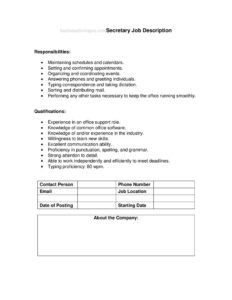
Secretary Job Description
Create a clear secretary job description with our free template, including responsibilities and qualifications sections, in PDF and DOCX free download.
PDF
DOCX
1 downloads
0
likes
Download Files
- DOCX
A secretary job description is a document that outlines the duties, responsibilities, and qualifications required for a secretary or administrative support role. Employers use it most often when posting a vacancy or clarifying expectations for an existing position, and you can download this template free in both PDF and DOCX formats with no signup required.
What Is a Secretary Job Description?
A secretary job description is a structured summary that explains what a secretary does and what skills, experience, and credentials are needed to perform the role well. It is typically issued by a hiring manager, business owner, or human resources department and used to recruit, evaluate, and onboard administrative staff. The document defines the scope of clerical and office-support work — answering phones, managing schedules, handling correspondence, and maintaining records — so both the employer and the candidate share a common understanding of the job. This particular template centers on two essential sections, Responsibilities and Qualifications, giving you a clean framework to describe duties and required attributes for any secretarial position.
When Do You Need a Secretary Job Description?
This document is useful any time you need to define, advertise, or formalize an administrative support role. Common situations include:
- Posting a job opening on job boards, your company website, or social media to attract qualified applicants.
- Hiring your first secretary as a growing small business that needs help with phones, filing, and scheduling.
- Replacing a departing employee and wanting to clarify the role before reposting it.
- Restructuring duties when a secretary’s responsibilities have grown or shifted over time.
- Conducting performance reviews, where a written description provides a fair benchmark against the actual job.
- Onboarding new staff, so a new hire understands exactly what is expected from day one.
Types of Secretary Roles to Adapt This For
The word “secretary” covers a range of administrative positions, and this template can be tailored to each. An executive secretary supports senior leadership with complex scheduling and confidential correspondence. A legal secretary prepares documents and manages case files in a law office. A medical secretary handles patient scheduling and records in a clinic. A school secretary manages front-office tasks in an educational setting. Adjust the responsibilities and qualifications to match the industry, seniority, and specialized software or knowledge your role demands.
What a Secretary Job Description Should Have
A complete, effective secretary job description usually includes the following elements:
- A clear job title and a brief summary of the position’s purpose.
- A detailed Responsibilities section listing day-to-day and periodic duties.
- A Qualifications section covering education, experience, and skills.
- Required technical proficiencies, such as word processing, spreadsheets, or scheduling software.
- Soft skills like communication, organization, discretion, and attention to detail.
- Reporting relationships — who the secretary supports and reports to.
- Any physical, scheduling, or location requirements relevant to the role.
How to Fill Out a Secretary Job Description
This template keeps things simple with two core sections. Follow these steps to complete it:
- Add a job title at the top, such as “Administrative Secretary” or “Executive Secretary,” and a one- or two-sentence overview of the role’s purpose.
- Under Responsibilities, list each task the secretary will perform. Begin every line with an action verb — answer, schedule, prepare, file, coordinate, draft. Include phone and email handling, calendar management, document preparation, record keeping, and meeting support.
- Be specific about frequency or scope where it helps, such as “maintain filing systems for client records” rather than a vague “do filing.”
- Under Qualifications, list the education, experience, and skills required. Note minimum education, years of administrative experience, software proficiency, and key soft skills like communication and confidentiality.
- Separate “required” from “preferred” qualifications so candidates can self-assess accurately.
- Review the final document for tone and clarity, then save and export it as a PDF for posting or a DOCX for further editing.
Tips for Writing a Strong Job Description
The best job descriptions are both honest and inviting. Use plain language and avoid internal jargon that outside applicants won’t recognize. Keep the responsibilities list focused on the eight to twelve most important duties rather than every conceivable task, which can overwhelm readers. In the qualifications section, distinguish between non-negotiable requirements and nice-to-haves; over-listing requirements can discourage capable candidates from applying. Where relevant, mention the tools and systems your office uses so applicants know whether their skills match. Finally, reflect your actual workplace culture and expectations so the people who apply are a genuine fit for the role.
How a Job Description Differs From a Job Posting
A job description is the underlying definition of a role — its duties and requirements — while a job posting is the public advertisement built around it. A posting often adds salary range, benefits, company background, application instructions, and a marketing tone designed to attract candidates. You can use this secretary job description as the foundation, then layer those extra promotional details on top when you advertise the opening. Keeping the description separate also makes it easy to reuse for performance reviews and onboarding long after the posting has expired.
Common Mistakes to Avoid
- Being too vague — listing “general office duties” without explaining what they actually involve.
- Overloading qualifications — demanding years of experience and degrees for an entry-level support role.
- Mixing requirements with preferences, so candidates can’t tell what is essential.
- Copying a generic description that doesn’t reflect your industry or specific tasks.
- Forgetting reporting lines, leaving applicants unsure who they would support.
- Neglecting to update the description as the role evolves, leading to mismatched expectations.
Frequently Asked Questions
What is a secretary job description? It is a document that outlines the responsibilities and qualifications for a secretary or administrative support role. Employers use it to recruit candidates, set clear expectations, and evaluate performance. This template provides ready-made Responsibilities and Qualifications sections you can customize.
How do I fill out this template? Add a job title and brief overview, then list duties in the Responsibilities section using action verbs. Next, fill in the Qualifications section with the education, experience, and skills you require. Keep both sections specific to your workplace and the type of secretary you need.
Is this secretary job description free to download? Yes. You can download it free in PDF and DOCX formats with no signup or payment required. The DOCX version is fully editable so you can tailor every section to your organization.
What should I include in the Responsibilities section? Include the core daily and periodic tasks such as answering phones, scheduling appointments, managing correspondence, preparing documents, and maintaining files. Focus on the most important duties and start each with an action verb. Add any role-specific duties unique to your industry.
What qualifications should a secretary have? Common qualifications include a high school diploma or higher, administrative experience, strong organizational and communication skills, and proficiency with office software. Specialized roles like legal or medical secretaries may require additional knowledge or certifications. Adjust the list to match your specific needs.
Is a job description a legal contract? No, a job description on its own is generally not a binding employment contract; it describes a role rather than setting legal terms of employment. Employment terms are typically covered by an offer letter or contract. Always confirm your obligations with the appropriate guidance for your situation.
This template is provided as a general example for informational purposes only and does not constitute legal, HR, or professional advice. Employment laws and requirements vary by jurisdiction — consult a qualified human resources or legal professional before finalizing hiring documents.
Official resource: for the rules that apply to your situation, see the U.S. Department of Labor.
Related Forms
- Account Development Manager Job Description
- Catering Assistant Job Description
- Web Developer Job Description
- Line Cook Job Description
- Sales Manager Job Description
- Canvasser Job Description
Browse more in Job Descriptions.