
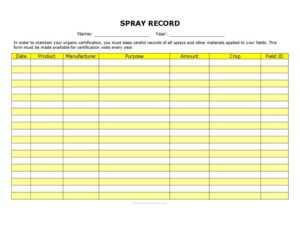
Spray Record
Track every product applied to your fields with this free Spray Record template, built for organic certification and farm compliance — free download.
PDF
DOC
9 downloads
0
likes
Download Files
- DOC
A Spray Record is a farm document used to log every spray, treatment, or material applied to your fields throughout the growing season. The most common reason people use it is to maintain organic certification, which requires careful, ongoing documentation of what was applied, where, and why. You can download this Spray Record template free as a PDF or DOCX — no signup required.
What Is a Spray Record?
A Spray Record is a structured log kept by a grower, farm manager, or crop adviser that documents each material applied to a field or crop. It captures the product name, manufacturer, the amount used, the date of application, the field where it was applied, the crop being treated, and the purpose of the treatment. For organic operations, this record is more than a convenience — it is a compliance requirement that certifiers review during their annual inspection. The form creates a transparent, season-by-season paper trail showing that only approved inputs were used, helping you demonstrate that your fields meet the standards your certification depends on.
When Do You Need a Spray Record?
This document is relevant any time something is applied to a crop or field that needs to be tracked. Common situations include:
- Organic certification audits — certifiers expect a complete record available at every annual visit showing all materials used on certified fields.
- Applying pest or disease treatments — recording each fungicide, insecticide, or biological control so you can show what was used and when.
- Fertilizer and soil amendment tracking — logging foliar feeds, compost teas, or approved nutrients applied across different fields.
- Multi-field operations — keeping separate entries per Field ID so you can prove which inputs touched which parcels.
- Reviewing the season for planning — looking back at what worked, how much product was used, and adjusting your inputs for next year.
- Buyer or supply-chain verification — providing documentation when a buyer, packer, or processor asks for proof of spray history.
What a Spray Record Should Have
A complete Spray Record ties each application to a specific field, crop, and date so it can be verified later. At the top, it identifies the grower by Name and the Year the record covers. Each line entry then captures the essentials of a single application: the Date it occurred, the Field ID where it was applied, the Crop being treated, the Product name, the Manufacturer of that product, the Amount applied, and the Purpose of the treatment. Together these fields answer the core questions a certifier or auditor will ask: who applied it, what was used, where, when, how much, and why. A consistent, legible format makes the record easy to scan and defend during an inspection.
How to Fill Out a Spray Record
- Name: Enter the name of the grower, farm, or operation responsible for the record at the top of the form.
- Year: Write the calendar year this sheet covers so each season’s records stay clearly separated.
- Date: For each application, record the exact date the material was applied. Fill this in the day of the spray, not from memory weeks later.
- Field ID: Enter the identifier for the specific field, block, or parcel that received the application, matching the names you use on your farm map.
- Crop: Note the crop growing in that field at the time of treatment.
- Product: Write the full product or material name exactly as it appears on the label.
- Manufacturer: Record the company that produces the product, which helps verify the input against approved-materials lists.
- Amount: Enter how much was applied, including the unit (gallons, ounces, pounds, or rate per acre).
- Purpose: Briefly describe why you applied it — for example, aphid control, mildew prevention, or nutrient supplement.
Keeping Your Records Audit-Ready
The value of a Spray Record comes from consistency. Fill in each entry at the time of application rather than reconstructing it later, and keep the form in a predictable place — a binder, clipboard, or digital folder — so it is genuinely available at every certification visit, as your certifier requires. Save the original product labels and purchase receipts alongside the record; they back up the manufacturer and product details and confirm that the input was an approved material. Many growers keep a separate sheet for each year and retain past years for the period their certifier specifies. If you spray multiple fields in one day, log each as its own line so the Field ID, crop, and amount stay accurate.
Spray Record vs. Other Farm Logs
A Spray Record focuses specifically on materials applied to crops and fields. It is distinct from broader farm activity logs, harvest records, or seed and planting records, though they all support certification together. Where a seed log proves your planting stock and a harvest record tracks output, the Spray Record proves your input practices. Keeping them as separate, focused documents makes each one easier to complete and faster for an inspector to review. Use this template purely for application data and pair it with your other recordkeeping for a complete picture of your operation.
Common Mistakes to Avoid
- Filling in dates from memory — record the date the day of application so it is accurate and credible.
- Vague product names — write the exact label name and manufacturer rather than a nickname or abbreviation.
- Leaving out the amount or unit — an amount without a unit is hard to verify and may raise questions at inspection.
- Mixing multiple fields on one line — give each Field ID its own entry to keep the record clear.
- Skipping the purpose — noting why a material was applied shows intent and helps justify the input.
- Discarding old sheets — keep prior years’ records available for the retention period your certifier requires.
Frequently Asked Questions
What is a Spray Record used for? It is used to document every product or material applied to your fields, including the date, field, crop, amount, and purpose. The most common reason growers keep one is to maintain organic certification, since certifiers require these records to be available at each annual visit.
How do I fill out a Spray Record? Start with your name and the year, then add one line for each application listing the date, Field ID, crop, product, manufacturer, amount, and purpose. Complete each entry at the time of the spray so the details stay accurate and audit-ready.
Is a Spray Record required for organic certification? Most certification programs require growers to document all materials applied to certified fields and to make those records available during inspections. Requirements vary by certifier and region, so confirm the exact format and retention period your program expects.
How long should I keep my Spray Records? Many growers keep several years of records on file, and certifiers often specify a minimum retention period. Check with your certifying body for the exact length and store past years where they remain easy to retrieve.
What should I write in the Purpose field? Note the reason for the application in a few words, such as aphid control, disease prevention, or nutrient supplement. A clear purpose shows your intent and helps explain each input during a review.
Is this Spray Record template free to download? Yes. You can download this Spray Record template free in PDF or DOCX format with no signup required, then print it for the field or fill it in digitally.
This Spray Record template is a general example provided for informational purposes only and is not legal, agricultural, or certification advice. Recordkeeping requirements vary by certifier, jurisdiction, and program — consult your certifying body or a qualified professional to confirm what your operation must document.
Related Forms
- Dairy Record Keeping Form
- Farm Inventory Record
- Sheep Birthing Records
- Farm Equipment Record
- Apiary Record Form
- Animal Healthcare Record
Browse more in Agriculture.