
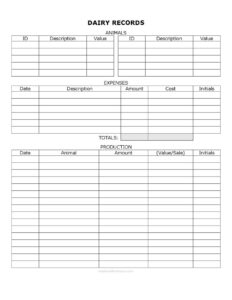
Dairy Record Keeping Form
Track milk production, herd costs, and animal values with this free Dairy Record Keeping Form template, available as a free download in PDF and DOCX.
PDF
DOC
12 downloads
0
likes
Download Files
- DOC
A Dairy Record Keeping Form is a simple worksheet for tracking your herd’s milk production, animal details, expenses, and values in one organized place. Most dairy operators use it to keep a clean daily and monthly record so they can monitor productivity, manage costs, and prepare for tax season. This template is free to download in both PDF and DOCX formats, with no signup required.
What Is a Dairy Record Keeping Form?
A Dairy Record Keeping Form is a structured log used by dairy farmers, herd managers, and farm bookkeepers to document the day-to-day activity of a dairy operation. It captures key information about each animal, the milk it produces, the expenses tied to running the dairy, and the value or sale price of livestock and products. Rather than relying on scattered notes, the form brings production figures, identification numbers, dates, costs, and totals together in a single, repeatable layout. It serves as both a working management tool and a paper trail you can reference when reviewing profitability, planning breeding, or supporting financial and tax records.
When Do You Need a Dairy Record Keeping Form?
This form is useful any time you need to document the activity and economics of a dairy herd. Common situations include:
- Daily and monthly milk tracking — logging production by animal and totaling output to spot rising or falling yields.
- Managing herd expenses — recording feed, veterinary, equipment, and supply costs so you can see what each animal or the whole operation truly costs to run.
- Tracking animal values and sales — noting the value of each animal and the sale price when livestock is sold or culled.
- Tax and accounting preparation — organizing dated expenses and income figures so your accountant has accurate, itemized records.
- Breeding and culling decisions — comparing production records across animals to decide which to keep, breed, or remove.
- Farm transitions or loan applications — providing a clear history of production and costs when applying for financing or transferring management.
What a Dairy Record Keeping Form Should Have
A complete dairy record links each animal to its production, cost, and value so the numbers add up at the end of the period. The essential elements are an animal identification column (ID), the date of each entry, a production figure, an expenses or cost column with descriptions, a value or sale column, and a totals row that summarizes the page. Including initials or a sign-off helps confirm who recorded the data, which is valuable on farms with multiple workers. The strongest records are consistent: the same units, the same recording schedule, and the same person-or-process behind each entry, so trends are real and not an artifact of inconsistent logging.
How to Fill Out a Dairy Record Keeping Form
- Enter the Date. Record the day each entry applies to, whether you log daily, weekly, or monthly.
- Identify the Animal and ID. Write the animal’s name or type in the Animal field and its tag or registration number in the ID field so every figure ties back to a specific cow.
- Record Production. In the Production column, note the milk yield for that animal and period using a consistent unit (pounds, gallons, or liters).
- Log Expenses. Use the Description field to name the cost (feed, vet, supplies) and the Amount or Cost field to enter the dollar figure under Expenses.
- Note Value and Sales. Enter each animal’s worth in the Value column and any sale price in Value/Sale when livestock or product is sold.
- Add Initials. The person recording the entry signs the Initials field to confirm accuracy.
- Calculate Totals. Sum production, expenses, and values in the Totals row to close out the period.
Types of Dairy Records You Can Track
Although this is a single flexible form, you can adapt it to several record types. A production record focuses on the Animal, ID, Date, and Production columns to monitor milk output per cow over time. An expense record leans on the Description, Amount, Cost, and Expenses fields to capture the running cost of feed, medicine, and supplies. An inventory or sales record uses the Animal, Value, and Value/Sale columns to track the worth of your herd and document livestock sales. Many operators keep one form per category, while smaller farms combine all three on a single sheet and rely on the Totals row to keep everything reconciled.
Tips for Reliable Dairy Records
Set a fixed recording schedule and stick to it — milk yields lose meaning if some entries are daily and others are monthly. Keep your units uniform across every row so totals are comparable. Store completed forms by month or year so you can pull historical data quickly, and consider transferring the figures into a spreadsheet periodically to chart trends. If multiple workers handle milking, the Initials field helps you trace any unusual numbers back to a shift or person. Above all, record as you go; recreating figures from memory at the end of the month introduces errors that undermine the value of the whole record.
Common Mistakes to Avoid
- Mixing units — switching between gallons and pounds makes production totals meaningless.
- Leaving the ID blank — without an animal identifier, you can’t compare performance cow by cow.
- Skipping dates — undated entries cannot be placed in a timeline or matched to expenses.
- Lumping expenses together — vague descriptions hide where money actually goes.
- Forgetting to total — an unbalanced Totals row defeats the purpose of the record at tax time.
- Recording from memory — delayed entries are the leading source of inaccurate figures.
Frequently Asked Questions
What is a Dairy Record Keeping Form used for? It is used to track milk production, animal details, expenses, and values for a dairy herd in one organized worksheet. Farmers rely on it to monitor productivity, control costs, and keep accurate records for management and tax purposes. The form turns scattered notes into a consistent, reviewable history.
How do I fill out the production and expense columns? Enter each animal’s milk yield in the Production column using a consistent unit, and record costs in the Expenses section with a clear Description and an Amount or Cost figure. Tie every entry to a Date and the animal’s ID so the numbers can be traced and totaled accurately at the end of the period.
Is this form legally binding? A dairy record is generally a management and accounting document rather than a binding contract. However, accurate records can support tax filings, loan applications, and farm valuations, so they should be kept truthfully and consistently. Treat them as official business records of your operation.
Do I need to keep dairy records for taxes? Many farm operations are expected to maintain records of income and expenses for tax reporting, and a dairy record helps organize that information. Specific requirements vary by jurisdiction and the size of your operation, so check your local rules or consult an accountant familiar with agricultural taxes.
How often should I record entries? Set a fixed schedule — daily for milking and production, and at least monthly for expenses and values. Consistent timing makes your totals comparable across periods and helps you spot trends or problems early. Recording as activity happens is far more accurate than reconstructing it later.
Is this Dairy Record Keeping Form really free? Yes. You can download it for free in both PDF and DOCX formats with no signup required. Use the editable DOCX version if you want to add columns or adjust the layout to match your herd and recording habits.
This template is provided as a general example for informational purposes only and does not constitute legal, financial, or tax advice. Recordkeeping and reporting requirements vary by jurisdiction and operation type — consult a qualified accountant or agricultural advisor for guidance specific to your situation.
Related Forms
- Monthly Farm Store Sales Record
- Farmers Market Sales Record
- Field Planning Worksheet
- Animal Healthcare Record
- Farm Store Price Sheet
- Sheep Birthing Records
Browse more in Agriculture.