
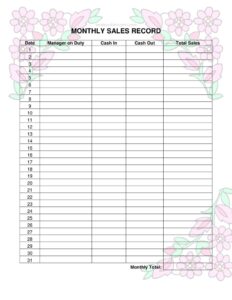
Monthly Farm Store Sales Record
Track daily cash in, cash out, and total sales with this free Monthly Farm Store Sales Record template — download in PDF or DOCX, no signup required.
PDF
DOCX
6 downloads
0
likes
Download Files
- DOCX
A Monthly Farm Store Sales Record is a simple ledger that captures daily cash in, cash out, and total sales for a farm stand, market booth, or on-farm retail shop across a full month. Farmers and store managers use it most often to keep an accurate running tally of revenue so they know exactly what the farm store earned. It is free to download here in both PDF and DOCX formats, with no signup required.
What Is a Monthly Farm Store Sales Record?
A Monthly Farm Store Sales Record is a single-page tracking sheet that documents the money flowing through a farm retail operation each day, then totals it for the month. It is typically maintained by the farm owner, store manager, or whoever closes out the register at the end of a shift. The record notes the date, the manager on duty, the amount of cash taken in, any cash paid out, and the total sales for that day, building toward a monthly total at the bottom. It serves as a working financial diary that supports bookkeeping, tax preparation, and day-to-day decisions about pricing, staffing, and inventory.
When Do You Need a Monthly Farm Store Sales Record?
Almost any farm that sells directly to the public benefits from keeping a consistent monthly record. Common situations include:
- Running an on-farm store or farm stand where customers pay cash for produce, eggs, honey, or value-added goods.
- Selling at a weekly farmers market and needing to reconcile each market day’s cash drawer against recorded sales.
- Tracking seasonal swings — comparing a busy harvest month against a slow winter to plan staffing and stock.
- Preparing for tax season by giving your accountant a clean, dated summary of gross sales and cash disbursements.
- Managing multiple shift workers so you can see which manager was on duty for any given day’s totals.
- Spotting cash shortages or errors when the recorded total sales don’t match the cash in minus cash out.
What a Monthly Farm Store Sales Record Should Have
A complete record is more than a list of numbers — it ties each figure to a specific day and a responsible person. The essentials are a clearly labeled month and year, a row for each operating day, a column for cash in and cash out, a daily total sales figure, the name of the manager on duty, and a monthly total that sums every day. Including the manager’s name creates accountability and makes it easy to follow up on any discrepancy. A clean monthly total at the bottom turns dozens of daily entries into one figure you can drop straight into your accounting or tax worksheet.
How to Fill Out a Monthly Farm Store Sales Record
- Label the month and year at the top so the sheet is unmistakable when filed alongside other months.
- Enter the Date for each operating day, one row per day the store is open. Skip or leave blank any days you don’t trade.
- Record Cash In — the total money received that day from sales, including the opening float if your method counts it, or strictly customer payments if you prefer.
- Record Cash Out — any money paid out of the drawer that day, such as petty-cash purchases, change runs, refunds, or supplier payments.
- Write the Total Sales for the day, your actual revenue figure for goods sold, separate from cash movements.
- Note the Manager on Duty who closed the register and recorded the figures, so each row has an accountable name.
- Calculate the Monthly Total by summing the daily Total Sales column once the month ends, and double-check it against your cash records.
Cash In vs. Cash Out vs. Total Sales
These three figures are related but distinct, and confusing them is the fastest way to muddle a month’s books. Cash In is the money physically entering the drawer or till; Cash Out is money leaving it for purchases, change, or refunds; and Total Sales is the value of goods you actually sold, regardless of how customers paid. On a cash-only farm stand these numbers often align closely, but the moment you accept cards, vouchers, or pay a supplier from the drawer, they diverge. Keeping each in its own column lets you reconcile at the end of the day: your expected cash should roughly equal opening float plus cash in minus cash out.
Tips for Keeping a Reliable Record
Fill in the sheet at the same time every day — ideally at close — while the numbers are fresh and the drawer is being counted. Use a single, consistent method for what counts as cash in (with or without float) so monthly comparisons stay meaningful. Keep the completed sheets in a dated folder or binder, and consider photographing or scanning each month as a backup. If you use the DOCX version, set up a formula or simply tally in a calculator the same way each time. Consistency, not complexity, is what makes this record trustworthy come tax time.
Common Mistakes to Avoid
- Mixing up cash out and sales — recording a supplier payment as a sale inflates your revenue and distorts the monthly total.
- Leaving the Manager on Duty blank, which removes accountability when a day’s numbers don’t add up.
- Filling in days from memory at the end of the week instead of recording at each close.
- Forgetting to label the month and year, making filed sheets hard to identify later.
- Not reconciling the drawer against cash in minus cash out, so shortages go unnoticed.
- Skipping the monthly total or adding it incorrectly, which defeats the purpose of the whole sheet.
Frequently Asked Questions
What is a Monthly Farm Store Sales Record used for? It is used to log daily cash in, cash out, and total sales for a farm store or stand and to roll those daily figures into one monthly total. Farmers rely on it for bookkeeping, reconciling the register, and preparing gross-sales figures for tax season.
How do I fill out the Monthly Farm Store Sales Record? Enter the date for each trading day, then record cash in, cash out, total sales, and the manager on duty for that day. At month end, add up the daily total sales column to produce the monthly total and check it against your cash counts.
What’s the difference between Cash In and Total Sales? Cash In is the actual money that entered the drawer, while Total Sales is the value of goods sold regardless of payment method. On a cash-only stand they are usually close, but accepting cards or making cash payouts will cause them to differ.
Is this record legally binding or official? The sheet itself is an internal business record, not a legal contract, but it can serve as supporting documentation for your accounts and tax filings. Keep it accurate and consistent, since tax authorities may ask to see records of your gross sales.
How long should I keep my sales records? Many businesses retain financial records for several years, but the exact period depends on your jurisdiction’s tax rules. Check your local requirements and, when in doubt, keep records longer rather than discarding them early.
How much does this template cost? Nothing — the Monthly Farm Store Sales Record is completely free to download here in both PDF and DOCX formats, with no signup required. You can print the PDF for the counter or edit the DOCX to match your own columns and store name.
This template is a general example provided for informational purposes only and is not legal, financial, or tax advice. Recordkeeping and tax requirements vary by jurisdiction, so consult a qualified accountant or tax professional about your specific situation.
Related Forms
- Field Planning Worksheet
- Farm Inventory Record
- Detailed Egg Production Record
- Field Activity Log
- Spray Record
- Dairy Record Keeping Form
Browse more in Agriculture.