
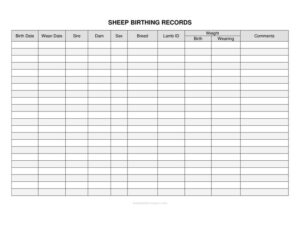
Sheep Birthing Records
Track every lambing event with this free Sheep Birthing Records template, recording dam, sire, lamb ID, weight and weaning — free download in PDF and DOCX.
PDF
DOC
5 downloads
0
likes
Download Files
- DOC
A Sheep Birthing Records form is a simple worksheet shepherds use to document every lambing event — capturing which ewe gave birth, when, to how many lambs, and how those lambs perform from birth through weaning. Most flock owners reach for it during lambing season to keep an accurate, organized history of each animal. It’s free to download here in both PDF and DOCX, with no signup required.
What Is a Sheep Birthing Records Form?
A Sheep Birthing Records form is a flock-management document that logs the key details of each lambing. It is typically filled out by the shepherd, farm owner, or barn staff at or shortly after birth, then updated again at weaning. The form ties each lamb to its parents (the dam and sire), records its sex, weight, and an individual identification number, and leaves room for notes on the delivery. Over a season it becomes a written breeding and performance history — the foundation for culling decisions, selecting replacement ewes, tracking genetics, and meeting any registration or recordkeeping requirements your operation follows.
When Do You Need a Sheep Birthing Records Form?
Any operation that breeds sheep benefits from consistent birthing records. Common situations include:
- Lambing season tracking — recording each birth in real time so no lamb or ewe is overlooked during a busy stretch.
- Breeding evaluation — comparing how different dam and sire pairings perform in litter size, birth weight, and survival.
- Selecting replacement ewes — using birth and weaning data to identify the most productive bloodlines to keep.
- Registration and pedigree — supplying breed associations with accurate parentage and birth dates for registered stock.
- Veterinary and health history — noting difficult births or weak lambs so a vet can spot patterns across the flock.
- Sales and showing — providing buyers or show committees with verifiable birth dates, breed, and weights.
Even small hobby flocks find the form valuable: memory fades fast when several ewes lamb in the same week, and a written record removes the guesswork.
What a Sheep Birthing Records Form Should Have
A complete birthing record connects the lamb to its parents and tracks its early performance. The essential elements are a unique Lamb ID, the birth date, the identities of the dam and sire, the lamb’s sex and breed, a birth weight, and details about the birth itself. To measure growth, the form also needs a wean date and weaning information. A free-text comments area rounds it out, giving you space to note anything unusual — assisted deliveries, multiples, or health concerns. Together these fields turn scattered observations into a usable, comparable dataset.
How to Fill Out a Sheep Birthing Records Form
- Birth: Note the type of birth — single, twin, triplet, or quad — so litter size is recorded for the ewe.
- Birth Date: Enter the exact date the lamb was born; this anchors age, weaning, and registration timelines.
- Breed: Record the lamb’s breed or crossbreed designation (for example, Suffolk, Dorset, or a documented cross).
- Dam: Write the ewe’s ID number or name. Accuracy here is critical for pedigree and culling decisions.
- Sire: Enter the ram’s ID or name. If the ram is unknown in a group breeding, note that honestly.
- Lamb ID: Assign and record a unique identifier — an ear tag number, tattoo, or scrapie tag — for the new lamb.
- Sex: Mark the lamb as ram (male), ewe (female), or wether if later castrated.
- Weight: Record the birth weight, ideally taken soon after birth for consistency.
- Wean Date / Weaning: When the lamb is weaned, fill in the date and weaning weight or notes.
- Comments: Add anything notable — birthing difficulty, fostering, illness, or vigor at birth.
Tips for Reliable Flock Records
Birthing records are only as good as the habits behind them. Keep a clipboard, notebook, or printed form in the lambing barn so entries happen at the moment of birth rather than from memory hours later. Use a consistent ID system — many producers tie the lamb’s tag to its dam and birth year — so the records stay searchable as the flock grows. Weigh lambs on the same scale at the same time of day to make birth and weaning weights truly comparable. If you keep digital spreadsheets, transcribe the paper form promptly and store the originals as a backup. Over several seasons, this discipline lets you calculate average daily gain, compare sires, and spot ewes that consistently raise heavy, healthy lambs.
Birth Records vs. General Flock Health Logs
It helps to keep birthing records separate from day-to-day health and treatment logs. A birthing record is a one-time-per-lambing snapshot focused on parentage, birth details, and weaning outcome — a genetic and performance document. A health log, by contrast, tracks ongoing events like vaccinations, deworming, hoof trimming, and illness across an animal’s whole life. Using the Lamb ID as the common key, you can link the two without cluttering either. This keeps your birthing data clean for breeding analysis while still letting you trace a lamb’s full story when needed.
Common Mistakes to Avoid
- Delaying entries: Waiting until evening to write down morning births leads to mixed-up dams and missing weights.
- Duplicate or vague Lamb IDs: Reusing tag numbers or leaving the ID blank makes records impossible to track later.
- Guessing the sire: In group breeding, record uncertainty honestly rather than assuming, which corrupts pedigree data.
- Skipping birth weights: Without a birth weight, you can’t measure growth or compare lambs fairly.
- Forgetting the weaning update: A birth record with no wean date or weight tells only half the performance story.
- Illegible handwriting: Smudged or rushed notes in the barn defeat the purpose; transfer to a clean copy if needed.
Frequently Asked Questions
What is a Sheep Birthing Records form used for? It is used to document each lambing event in a flock, including the lamb’s ID, birth date, parents, sex, breed, and weight. Producers rely on it to track breeding performance, support registration, and make culling and selection decisions over time.
How do I fill out the dam and sire fields? Enter the ewe’s identification (the dam) and the ram’s identification (the sire) using whatever tag numbers or names your flock system uses. If you breed in a group and cannot be certain of the ram, note the breeding group or mark the sire as unknown rather than guessing.
What should the Lamb ID be? The Lamb ID is a unique identifier for the individual animal, commonly an ear tag, tattoo, or official scrapie tag number. Pick a consistent system and never reuse a number, so each lamb can be traced throughout its life.
When do I record the weaning information? The weaning fields are filled in later, when the lamb is separated from the ewe — typically recording the wean date and weaning weight. Comparing birth weight to weaning weight helps you measure growth and the ewe’s mothering ability.
Is this form legally required? Routine birthing records are generally for your own management rather than a legal mandate, though some breed associations and identification or disease-tracking programs do require specific records. Requirements vary by region and program, so check the rules that apply to your operation.
How much does this template cost? Nothing — the Sheep Birthing Records template is completely free to download here in PDF and DOCX formats, with no signup required. You can print it for the barn or edit the DOCX version to match your own tagging and breed conventions.
This template is a general example provided for informational purposes only and does not constitute legal, veterinary, or business advice. Recordkeeping and animal identification requirements vary by jurisdiction and by breed or program. Consult a qualified professional or your relevant agricultural authority to ensure your records meet applicable requirements.
Related Forms
- Three Year History Form
- Field Productivity Record
- Spray Record
- Apiary Record Form
- Detailed Egg Production Record
- Dairy Record Keeping Form
Browse more in Agriculture.