
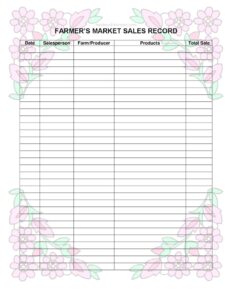
Farmers Market Sales Record
Track every market day with this free Farmers Market Sales Record template—log products, sales, and totals fast. Free PDF and DOCX download, no signup.
PDF
DOCX
7 downloads
0
likes
Download Files
- DOCX
A Farmers Market Sales Record is a simple log used by growers and vendors to track what they sold, when, and for how much at a market or farm stand. The most common reason people use it is to keep clean, day-by-day sales numbers for bookkeeping, taxes, and inventory planning. You can download it free in both PDF and DOCX formats, with no signup required.
What Is a Farmers Market Sales Record?
A Farmers Market Sales Record is a worksheet that documents the produce, baked goods, eggs, honey, flowers, or other items a farm sells at a given market. It is typically filled out by the farm owner, a market manager, or the person staffing the booth. Each entry captures the market date, the farm or producer name, the products moved, the salesperson on duty, and the total sale amount. Over a season these records add up to a full picture of which crops perform, which market days are strongest, and how much revenue the operation generates. It is an internal recordkeeping tool rather than a customer receipt, though it pairs naturally with one.
When Do You Need a Farmers Market Sales Record?
Small farms, homesteaders, and market vendors reach for this form whenever money changes hands at a stall. Common situations include:
- Weekly market days — logging totals at the close of each Saturday or Sunday market so the booth’s performance is captured before the cash box is counted.
- Tax preparation — building a running record of gross sales that supports a Schedule F or small-business return at year end.
- Multiple sellers or shifts — when more than one salesperson works a booth and you need to know who handled which transactions.
- Comparing products — tracking whether tomatoes, eggs, or cut flowers bring in the most revenue across the season.
- CSA and wholesale add-ons — recording one-off bulk sales to restaurants or neighbors alongside regular market income.
- Grant or program reporting — providing documented sales figures when applying for agricultural grants, cottage-food permits, or beginning-farmer programs.
What a Farmers Market Sales Record Should Have
A useful sales record stays simple but complete. At minimum it should capture the date of the market or sale, the farm or producer name so records from different vendors don’t get mixed, a clear list of the products sold, the salesperson responsible for the entry, and the total sale figure. Adding a running total at the bottom of each page helps you reconcile against the cash box. Many growers also note the market location or weather in the margin, since both affect turnout. The goal is a record clean enough that you can read it weeks later and reconstruct exactly what happened on that market day.
How to Fill Out a Farmers Market Sales Record
- Date: Enter the calendar date of the market or sale. Use a consistent format such as MM/DD/YYYY so entries sort correctly when you total the season.
- Farm/Producer: Write the name of your farm or business as it appears on permits and invoices. If you sell under a brand, use that name consistently across every record.
- Products: List the items sold for that entry—for example “heirloom tomatoes, salad greens, dozen eggs.” If you want item-level detail, create a new line per product; if you want a day summary, group them.
- Salesperson: Note who recorded or handled the sale. This is essential when family members, employees, or volunteers share the booth.
- Total Sale: Record the dollar amount collected for that line. At the end of the day, add the column to get your gross take and compare it to the cash and card totals in your till.
Tips for Keeping Accurate Market Records
Fill the record out as you go or immediately at close, not days later from memory. Keep one sheet per market day so totals stay tidy, then file the completed pages in a folder or scan them into a spreadsheet each week. If you accept both cash and cards, jot the payment type next to the total so reconciliation is painless. Round consistently—either to the penny or to the dollar—rather than switching mid-day. Storing these sheets in date order makes your season review and tax prep dramatically faster.
How This Differs From a Sales Receipt
A Farmers Market Sales Record is an internal log of all your transactions, while a receipt is given to an individual customer as proof of purchase. The record summarizes your booth’s activity for your own books; a receipt documents a single buyer’s purchase. Many vendors use both: handwritten receipts for customers who ask, and this running record to capture the full day’s sales for accounting. Because it consolidates everything in one place, the sales record is what you’ll lean on at tax time and when reviewing seasonal performance.
Common Mistakes to Avoid
- Skipping slow days — even a $20 morning belongs in the record; gaps make your season totals inaccurate.
- Vague product entries — writing “produce” instead of specific items makes it impossible to see what actually sells.
- Leaving out the salesperson — without it, you can’t trace a discrepancy back to a shift or person.
- Mixing farms on one sheet — if you sell for multiple producers, keep separate records so revenue isn’t blended.
- Not reconciling against the till — failing to compare the logged total to actual cash and card receipts hides shortages and math errors.
- Storing loose sheets — unfiled pages get lost; keep them organized by date from the first market on.
Frequently Asked Questions
What is a Farmers Market Sales Record used for? It is used to log the products, dates, and dollar amounts of items sold at a farmers market or farm stand. Growers rely on it for bookkeeping, tax preparation, and tracking which products and market days perform best over a season.
How do I fill out the Farmers Market Sales Record? Enter the market date, your farm or producer name, the products sold, the salesperson on duty, and the total sale amount for each line. Add up the totals at the end of each day and compare them to the cash and card receipts in your till.
Is this form legally binding? No, it is an internal recordkeeping document, not a contract. However, accurate sales records can serve as supporting documentation for tax filings and grant or permit applications, so keeping them complete and honest matters.
Does it need to be notarized or witnessed? No. A sales record requires no notarization or witnesses—it is a private business log you maintain for your own books and tax purposes.
How much does the template cost? It is completely free to download here in both PDF and DOCX formats, with no signup or payment required. You can print copies for the booth or edit the DOCX version to add columns that fit your operation.
Can I use one sheet for multiple market days? You can, but it’s cleaner to use one sheet per market day so totals and reconciliation stay simple. Keeping days separate makes it much easier to review which markets are most profitable across the season.
This template is a general example provided for informational purposes only and does not constitute legal, financial, or tax advice. Recordkeeping and reporting requirements vary by state and locality—consult a qualified accountant or local agricultural authority for guidance specific to your situation.
Related Forms
- Apiary Record Form
- Animal Profile Record
- Farm Store Price Sheet
- Farm Inventory Record
- Farm Store Order Form
- Dairy Animal ID List
Browse more in Agriculture.