
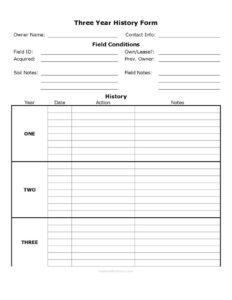
Three Year History Form
Document three years of field land use, crops, and inputs with this free Three Year History Form template, available as a free PDF and DOCX download.
PDF
DOC
8 downloads
0
likes
Download Files
- DOC
A Three Year History Form is an agricultural record that documents how a parcel of land has been used, treated, and managed over the past three growing seasons. Farmers, organic certifiers, and crop insurers most often use it to verify field history when applying for certification, conservation programs, or leases. You can download it free here in both PDF and DOCX formats with no signup required.
What Is a Three Year History Form?
A Three Year History Form is a structured worksheet that captures a field’s land-use record across three consecutive years. It is typically prepared by the grower, farm manager, or landowner and reviewed by a certifying agency, agronomist, or program administrator. The form documents which crops were planted, what inputs or treatments were applied, how ownership or lease status changed, and the general condition of the soil and field over time. Because many agricultural programs — especially organic certification — require proof that no prohibited substances were applied for a set period, this document provides a clear, verifiable timeline. It turns scattered memory and paperwork into a single, organized history that supports eligibility decisions.
When Do You Need a Three Year History Form?
This form comes up whenever a third party needs proof of how land has been managed before they act on it. Common situations include:
- Applying for organic certification, where many programs require evidence that no prohibited inputs were used on the field for the prior three years.
- Enrolling land in a conservation or cost-share program that asks for prior cropping and treatment history.
- Buying or leasing farmland and needing the previous owner’s account of crop rotation, chemical use, and soil treatment.
- Transitioning a conventional field to organic production and tracking the required transition window.
- Filing crop insurance or disaster aid claims that rely on documented planting and yield history.
- Renewing certification or program enrollment, where an updated rolling three-year record must be submitted.
What a Three Year History Form Should Have
A complete form ties every entry to a specific field and a specific year. At minimum it should include the field’s identifying details, the owner or operator information, and a year-by-year breakdown covering three full seasons. Each year’s record should note what was grown, what was applied or done to the land (the action), the condition of the field, and any soil observations. It should also capture whether the land is owned or leased, when it was acquired, and who the previous owner was, since program reviewers often need that chain of custody. Space for general notes and contact information rounds out a record that an outside reviewer can trust and follow.
How to Fill Out a Three Year History Form
Work field by field and year by year so nothing is left to memory later:
- Date: Enter the date you complete the form so reviewers know how current the record is.
- Field ID: Write the parcel name or number you use to identify this specific field.
- Owner Name and Contact Info: List the current owner or operator and a phone number or email for follow-up.
- Own/Lease: Indicate whether the land is owned or leased.
- Acquired: Note the date or year you took possession of the field.
- Prev. Owner: Record the previous owner’s name to establish the chain of management.
- Year (One, Two, Three): For each of the three years, enter the calendar year.
- History and Action: Describe the crop grown and every action taken — tillage, planting, sprays, amendments — for that year.
- Field Conditions and Field Notes: Record drainage, weed pressure, cover, or other observations.
- Soil Notes: Add soil test results, amendments, or fertility observations.
- Notes: Use the general notes area for anything that doesn’t fit elsewhere.
Tips for Building an Accurate Record
Pull from your existing records rather than relying on recall. Spray logs, seed receipts, soil test reports, equipment records, and field maps all help you reconstruct an accurate three-year picture. If you bought or leased the land mid-period, ask the previous owner to fill in the years before your tenure and have them confirm in writing. Be specific in the action and history fields — list product names, application dates, and rates where you have them, because vague entries like “sprayed” can trigger questions from a certifier. Keep a copy with your other farm records and update it annually so your rolling three-year window is always ready when a program asks for it.
How It Differs From Other Field Records
A Three Year History Form is a summary document, not a substitute for your detailed day-to-day logs. Your spray records, planting logs, and harvest records capture single events in fine detail; this form rolls those events up into a three-season overview that a reviewer can scan quickly. It is also distinct from a soil test report, which measures chemistry at one moment, and from a lease agreement, which governs the legal relationship rather than the management history. Think of it as the connective tissue that ties those individual records into one coherent narrative of how the land has been farmed.
Common Mistakes to Avoid
- Leaving years blank because the field was fallow — note fallow or cover-crop status explicitly instead.
- Listing only crops and forgetting to record the inputs and actions applied each year.
- Guessing at dates for acquisition or applications rather than checking your receipts and logs.
- Omitting the previous owner when you didn’t manage the land for all three years.
- Mixing several fields on one form instead of keeping a separate history per field ID.
- Using vague descriptions that a certifier or insurer cannot verify against supporting documents.
Frequently Asked Questions
What is a Three Year History Form used for? It documents how a field was managed over three consecutive years, including crops, inputs, ownership, and soil treatment. Programs such as organic certification, crop insurance, and conservation enrollment commonly require it to verify a field’s eligibility and management history.
How do I fill out a Three Year History Form? Start with the field ID, owner and contact information, and the own/lease and acquisition details, then complete a year-by-year record of crops, actions, field conditions, and soil notes for years one, two, and three. Pull dates and product details from your existing spray, seed, and soil records for accuracy.
Do I need to fill in years before I owned the land? Yes, the three-year window usually covers the land regardless of who managed it, so record the previous owner and ask them to confirm what was done before your tenure. Reviewers often require the full period to be documented.
Is a Three Year History Form legally binding? It is primarily a record-keeping and verification document rather than a contract, but submitting it to a certifier or program may carry an attestation that the information is accurate. Treat it as a truthful statement, since false entries can jeopardize certification or program eligibility.
How much does this form cost? The template on this page is completely free to download in PDF and DOCX formats, with no signup or account required. You can edit the DOCX version to match your farm’s field names and program requirements.
Does the form need to be notarized? Notarization is generally not required for a field history record, though some programs ask for a signature attesting to its accuracy. Always check the specific instructions of the certifier or agency you are submitting it to.
This template is a general example provided for informational purposes only and is not legal, financial, agronomic, or certification advice. Program and certification requirements vary by jurisdiction and certifying body — consult the relevant agency or a qualified professional before relying on this form.
Related Forms
- Farm Store Order Form
- Spray Record
- Monthly Farm Expenses Form
- Sheep Birthing Records
- Farm Equipment Record
- Field Planning Worksheet
Browse more in Agriculture.