
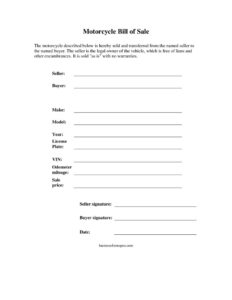
Motorcycle Bill of Sale
Download a free Motorcycle Bill of Sale template to document the sale of a bike, record the VIN and price, and transfer ownership — free download in PDF or DOCX.
PDF
DOCX
2 downloads
0
likes
Download Files
- DOCX
A Motorcycle Bill of Sale is a written record that documents the sale and transfer of a motorcycle from a seller to a buyer. People use it most often to prove a private bike sale actually happened — capturing the price, the VIN, the odometer reading, and both signatures so each party has protection. You can download this template free in PDF or DOCX, with no signup required.
What Is a Motorcycle Bill of Sale?
A Motorcycle Bill of Sale is a short legal document that records the details of a motorcycle changing hands. It is typically created by the seller and signed by both the seller and the buyer at the time money is exchanged. The form identifies the specific bike by make, model, year, license plate, and VIN, states the agreed sale price, and confirms that the seller is the legal owner with a clear title. It also notes the condition of the sale — in this template, the motorcycle is sold “as is” with no warranties. The document serves as a receipt and as evidence of the ownership transfer for both parties.
When Do You Need a Motorcycle Bill of Sale?
A bill of sale is useful any time a motorcycle moves between owners outside of a dealership. Common situations include:
- Selling a used motorcycle to a private buyer and needing a written receipt of the transaction.
- Buying a bike from an individual and wanting proof of purchase to register or title it.
- Documenting a sale between family members or friends where money still changes hands.
- Establishing the purchase price for sales tax, registration, or insurance purposes.
- Selling a project or non-running motorcycle “as is” and recording that no warranties were given.
- Removing your liability as the seller by proving the date you transferred ownership.
What a Motorcycle Bill of Sale Should Have
A complete bill of sale leaves no doubt about who sold what, to whom, and for how much. The essentials are the full legal names of the seller and buyer, a precise description of the motorcycle (make, model, year), the unique identifiers (VIN and license plate), the odometer mileage at the time of sale, and the agreed sale price. It should also include a statement that the seller is the legal owner and that the bike is free of liens, the “as is” condition language, the date of the transaction, and the signatures of both parties. These elements turn a casual handshake into a documented transfer.
How to Fill Out a Motorcycle Bill of Sale
- Seller: Enter the full legal name (and address, if you add one) of the person selling the motorcycle.
- Buyer: Write the full legal name of the person purchasing the bike.
- Make: Record the manufacturer, such as Harley-Davidson, Honda, or Yamaha.
- Model: Add the specific model name or number of the motorcycle.
- Year: Enter the model year of the bike.
- License Plate: Note the current plate number assigned to the motorcycle.
- VIN: Copy the full Vehicle Identification Number exactly as it appears on the frame and title — double-check every character.
- Odometer mileage: Write the mileage shown on the odometer at the moment of sale.
- Sale price: Enter the agreed dollar amount the buyer is paying.
- Signatures and date: Have both the seller and buyer sign, and fill in the date the sale took place.
Complete two copies so the buyer and seller each keep a signed original.
“As Is” Sales and Lien Disclosure
This template states the motorcycle is sold “as is” with no warranties. That phrase means the buyer accepts the bike in its current condition and the seller is not responsible for repairs or defects discovered after the sale. For private sales, “as is” is common and generally protects the seller — but it does not excuse fraud or knowingly hiding a serious problem. The form also confirms the seller is the legal owner and the motorcycle is free of liens. If there is still a loan against the bike, that lien typically must be paid off and released before clear ownership can transfer, so be honest about any outstanding financing.
After the Sale: Title and Registration
The bill of sale documents the transaction, but in most places it does not replace the title transfer. The seller usually signs over the motorcycle title to the buyer, and the buyer takes the signed title plus the bill of sale to the local motor vehicle agency to register the bike and apply for a new title. Many states use the sale price on the bill of sale to calculate sales tax owed at registration. The seller may also need to notify their DMV that the vehicle was sold and cancel or transfer insurance. Keep your signed copy in case any registration or liability question comes up later.
Common Mistakes to Avoid
- Recording the VIN incorrectly — a single wrong digit can stall registration, so verify it against the title and the frame.
- Leaving the odometer mileage blank, which can raise questions about the bike’s actual use and history.
- Forgetting to sign and date the form, or only one party signing instead of both.
- Selling a motorcycle that still has an unpaid loan without disclosing the lien.
- Not making two copies, leaving one party without proof of the transaction.
- Writing a sale price lower than the real amount to reduce taxes, which is illegal and can backfire.
Frequently Asked Questions
Does a motorcycle bill of sale need to be notarized? In many states a motorcycle bill of sale does not require notarization to be valid, but some states or counties do require it for title transfer. Notarizing the document adds an extra layer of proof that both signatures are genuine. Check your local motor vehicle agency’s rules before finalizing the sale.
Is a bill of sale the same as a title? No. The bill of sale is a receipt that documents the transaction and price, while the title is the official document proving legal ownership. You generally need both — the signed title to transfer ownership and the bill of sale to record the sale terms.
Is a motorcycle bill of sale legally binding? Once both the seller and buyer sign and date it, the document is a binding record of the transaction. It can be used as evidence of the sale, the price, and the transfer of ownership. To be enforceable, the information should be accurate and both parties should sign voluntarily.
What does selling “as is” mean? Selling “as is” means the buyer accepts the motorcycle in its present condition with no guarantees about its quality or future performance. The seller is not obligated to make repairs after the sale. This language protects the seller but does not permit knowingly concealing defects or misrepresenting the bike.
How much does this template cost? This Motorcycle Bill of Sale template is completely free to download from Business Forms Pro in PDF or DOCX format. There is no signup, subscription, or hidden fee. You can fill it out on your computer or print it and complete it by hand.
Do I need the odometer reading on a motorcycle? Recording the odometer mileage is good practice and is often required for vehicle sales to document accurate usage. It helps the buyer understand the bike’s wear and may be needed for registration. Always enter the exact figure shown at the time of sale.
This Motorcycle Bill of Sale template is a general example provided for informational purposes only and is not legal, financial, or tax advice. Requirements for vehicle sales, title transfers, and notarization vary by state and locality — consult your local motor vehicle agency or a qualified professional to confirm what applies to your situation.
Official resource: for the rules that apply to your situation, see your state DMV.
Related Forms
- Fuel Tracker
- Motor Vehicle Bill of Sale
- Truck Bill of Sale
- Vehicle Invoice
- Used Car Mechanic Checklist
- Used Car Comparison
Browse more in Auto Sales.