
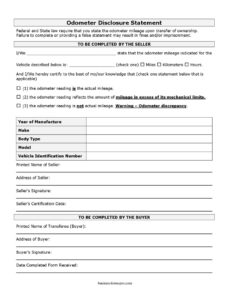
Odometer Statement
Download a free Odometer Statement template to legally disclose vehicle mileage at sale; fill in seller and buyer details and get a free PDF download.
PDF
DOCX
9 downloads
0
likes
Download Files
- DOCX
An Odometer Statement is the document a vehicle seller uses to officially disclose the mileage shown on a car’s odometer at the moment ownership transfers to a buyer. People most often need one because federal and state law require an accurate mileage disclosure during a private or dealer sale, and this form creates the written record. You can download this Odometer Statement free in both PDF and DOCX formats — no signup required.
What Is an Odometer Statement?
An Odometer Statement, also called an Odometer Disclosure Statement, is a signed declaration in which the seller of a vehicle certifies the mileage reading at the time of transfer. It is issued by the seller and acknowledged by the buyer, documenting both the recorded number and whether that number represents the vehicle’s true mileage. The statement protects buyers from odometer fraud and gives sellers a documented good-faith record of what they disclosed. Because federal law (and most state titling agencies) require this disclosure when transferring ownership, the form typically accompanies the title assignment or sale paperwork. Providing a false statement can carry serious penalties, including fines and possible imprisonment, which is why accuracy matters.
When Do You Need an Odometer Statement?
Almost any change of vehicle ownership can trigger the need for a mileage disclosure. Common situations include:
- Private vehicle sales — when one individual sells a car, truck, or motorcycle to another and the title is reassigned.
- Dealer transactions — when a dealership buys, sells, or trades a vehicle and must document mileage for its records and the new owner.
- Gifting or transferring a vehicle to a family member, where the titling agency still expects a disclosure.
- Title replacements or duplicate title processing, where the agency requires the current mileage on file.
- Lease buyouts, when a lessee purchases the vehicle at the end of a lease and ownership formally transfers.
- Estate or probate transfers, where a vehicle passes to an heir or is sold from an estate.
Note that some older or heavy vehicles may be exempt from federal disclosure requirements depending on age and weight, but when in doubt it is safer to complete the statement.
What an Odometer Statement Should Have
A complete and valid Odometer Statement contains several core elements. It must clearly identify the vehicle by year, make, body type, model, and Vehicle Identification Number (VIN). It must show the exact mileage reading and specify the unit of measure — miles, kilometers, or hours. Crucially, it must include one of three certified statements: that the reading is the actual mileage, that the reading has exceeded the odometer’s mechanical limits (rolled over), or that the reading is not the actual mileage and a discrepancy exists. Finally, it requires the printed names, addresses, and signatures of both the seller and the buyer, along with the certification and receipt dates. Without these signed certifications, the disclosure is incomplete.
How to Fill Out an Odometer Statement
- Read the legal notice at the top reminding both parties that federal and state law require an accurate disclosure and that false statements carry penalties.
- In the seller section, enter the seller’s name where indicated, then write the number shown on the odometer and circle or note whether it is in miles, kilometers, or hours.
- Check exactly one of the three certification statements: (1) the reading is the actual mileage; (2) the reading reflects mileage in excess of the odometer’s mechanical limits; or (3) the reading is not the actual mileage — a discrepancy warning.
- Fill in the vehicle details: Year of Manufacture, Make, Body Type, Model, and the full Vehicle Identification Number.
- Enter the Printed Name of Seller and Address of Seller, then have the seller sign and date the Seller’s Certification Date line.
- In the buyer section, record the Printed name of transferee (buyer) and Address of Buyer, have the buyer sign, and note the Date Completed Form Received.
Choosing the Correct Certification Box
The three certification options exist because not every odometer reading tells the full story. Box one is the most common — use it when you believe the displayed number is accurate. Box two applies when the odometer has physically rolled past its maximum digits (for example, a five-digit odometer that has passed 99,999 miles and started over). Box three is the warning box, used when the seller knows or suspects the reading does not reflect true mileage — perhaps because the odometer was replaced, repaired, or tampered with by a previous owner. Selecting the right box honestly is essential; choosing box one to mask a known discrepancy is exactly the kind of false statement the law penalizes.
Recordkeeping and Next Steps
Once both parties have signed, the buyer should keep the original or a copy with the bill of sale and title paperwork, and the seller should retain a copy for their records. Many states require the odometer disclosure to be submitted alongside the title when the buyer registers the vehicle, and some incorporate the disclosure directly into the title document itself. Keep your copy somewhere safe, because it can be important evidence if a mileage dispute arises later. If your state uses an official titling form for disclosure, follow that agency’s instructions for where the statement must be filed.
Common Mistakes to Avoid
- Leaving the certification boxes unchecked — failing to select one of the three statements makes the disclosure incomplete.
- Recording the wrong unit — confusing miles with kilometers can drastically misstate the vehicle’s history.
- Copying the VIN incorrectly — a single wrong digit can invalidate the document or mismatch the title.
- Using correction fluid or scribbling over errors — alterations raise fraud concerns; start a fresh form instead.
- Forgetting the buyer’s signature or the date received, which leaves the transfer record one-sided.
- Rounding or estimating the mileage instead of writing the exact number displayed at transfer.
Frequently Asked Questions
What is an Odometer Statement used for? It is used to legally disclose a vehicle’s mileage when ownership transfers from a seller to a buyer. The statement protects the buyer from odometer fraud and gives both parties a signed record of the reading at the time of sale.
Is an Odometer Statement legally required? In most cases, yes — federal law and many state titling agencies require a mileage disclosure when a vehicle changes hands. Certain older or very heavy vehicles may be exempt, but completing the form is the safest approach when you are unsure.
Does an Odometer Statement need to be notarized? Notarization is generally not required for a basic odometer disclosure, since the form relies on the signed certifications of the seller and buyer. However, some states or transaction types may request notarization, so check your local titling agency’s rules.
What does it mean if the reading is “not actual mileage”? It means the seller knows or believes the odometer reading does not reflect the vehicle’s true mileage, often because the odometer was replaced, broken, or tampered with. Checking this box places a discrepancy warning on record so the buyer is fully informed.
Can I correct a mistake on the form? It is best to avoid corrections on a mileage disclosure because alterations can look like tampering. If you make an error, fill out a fresh copy rather than crossing out or using correction fluid.
How much does this Odometer Statement template cost? Nothing — you can download this Odometer Statement template free from Business Forms Pro in both PDF and DOCX formats, with no signup required. You only pay any fees your state charges when filing titling paperwork.
This Odometer Statement template is a general example provided for informational purposes only and is not legal, financial, or tax advice. Odometer disclosure requirements vary by jurisdiction and may change over time; consult a qualified professional or your local motor vehicle agency to confirm what applies to your transaction.
Official resource: for the rules that apply to your situation, see your state DMV.
Related Forms
- Auto Transport Bill of Lading
- Used Car Comparison
- Vehicle Invoice
- Used Vehicle Appraisal
- Deal Recap
- Fuel Tracker
Browse more in Auto Sales.