
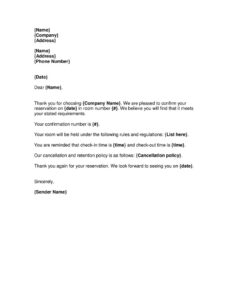
Reservation Confirmation Letter
Use this free Reservation Confirmation Letter template to confirm bookings, room details, check-in times, and cancellation policy. Free download in PDF and DOCX.
PDF
DOCX
6 downloads
0
likes
Download Files
- DOCX
A Reservation Confirmation Letter is a formal note a business sends to a customer to confirm that their booking has been received and secured. Hotels, venues, and service providers most often use it to put booking details in writing so the guest knows exactly what to expect. You can download this template free in PDF and DOCX formats with no signup required.
What Is a Reservation Confirmation Letter?
A Reservation Confirmation Letter is a written acknowledgment issued by a company to a customer after a booking is made. It is typically sent by a hotel front desk, reservations department, event venue, or hospitality manager, and it documents the key details of the reservation: the date, the room or space assigned, the confirmation number, and the rules that apply to the stay. The letter serves two purposes at once. First, it reassures the guest that their request was accepted and recorded. Second, it creates a clear record that both parties can refer back to, reducing disputes about times, terms, or cancellation charges later on.
When Do You Need a Reservation Confirmation Letter?
This letter is useful any time a business needs to formally lock in a booking and communicate the terms in writing. Common situations include:
- Hotel room bookings — confirming a guest’s room number, arrival date, and nightly rules before they travel.
- Event and banquet halls — verifying a reserved space, time slot, and deposit or cancellation policy.
- Vacation rentals and lodges — sending a written confirmation with check-in and check-out windows.
- Conference and meeting rooms — confirming a corporate booking with a reference number for billing.
- Restaurants holding large-party reservations — putting a guaranteed table and any hold policy in writing.
- Spa, tour, or appointment-based services — confirming a date and time alongside terms for rescheduling.
In each case, the letter turns a verbal or online booking into a documented agreement the guest can present at arrival.
What a Reservation Confirmation Letter Should Have
A complete confirmation letter leaves no important detail to memory. It should clearly identify both the business and the guest by name and address, and include a phone number so the guest can reach the property. The body must state the reservation date, the specific room or space assigned, and a unique confirmation number for tracking. Crucially, it should spell out the house rules, the exact check-in and check-out times, and the cancellation and retention policy so there are no surprises. Finally, a warm closing and the sender’s name personalize the message and signal professionalism. Together these elements make the letter both welcoming and functional.
How to Fill Out a Reservation Confirmation Letter
- Enter your business {Company} and {Address} at the top, followed by the guest’s {Name}, {Address}, and {Phone Number} for the recipient block.
- Add the {Date} the letter is written.
- Open with the salutation, addressing the guest by {Name}.
- In the thank-you line, insert your {Company Name} so the guest knows who is confirming.
- Fill in the reservation {date} and the assigned room number {#}.
- Provide the unique confirmation number {#} the guest will reference at check-in or for any inquiry.
- Under the rules and regulations, replace {List here} with the specific house rules — quiet hours, occupancy limits, pet policy, or smoking rules.
- State the check-in {time} and check-out {time} clearly.
- Detail your {Cancellation policy}, including deadlines and any retention or no-show charges.
- Close by repeating the arrival {date}, then sign with the {Sender Name}.
Tips for a Clear, Professional Confirmation
The most effective confirmation letters are specific and easy to scan. Use exact times in a consistent format — for example, “3:00 PM” for check-in and “11:00 AM” for check-out — rather than vague phrases like “afternoon.” Spell out the cancellation policy in plain numbers and dates so a guest knows precisely when a deposit becomes non-refundable. Keep the confirmation number prominent, since it is the single piece of information the guest will quote when calling or emailing. A friendly tone matters too: this letter is often a guest’s first formal contact with your business, so the welcome you set here shapes their expectations for the whole stay.
How It Differs From a Booking Receipt
A confirmation letter is not the same as a payment receipt or an invoice. A receipt documents money that has changed hands, while a confirmation letter documents the terms of the reservation — what is reserved, when, and under what conditions. Many businesses send both: a receipt for the deposit and a confirmation letter outlining the rules. Because the confirmation letter restates the cancellation and retention policy, it also functions as a reference if a billing dispute arises later. Keeping a copy of every confirmation letter you send, organized by confirmation number, makes it easy to resolve questions and keep your records consistent.
Common Mistakes to Avoid
- Leaving the confirmation number blank — without it, the guest cannot easily verify their booking.
- Using vague times — always state exact check-in and check-out times to prevent early-arrival or late-departure confusion.
- Omitting the cancellation policy — guests need to know deadlines and fees before they commit, not after.
- Forgetting to confirm the date twice — the template repeats the date intentionally; make sure both mentions match.
- Misspelling the guest’s name — a small error undermines the professional impression of the letter.
- Skipping a contact phone number — guests often need to call about late arrivals or special requests.
Frequently Asked Questions
What is a Reservation Confirmation Letter used for? It is used to formally confirm a customer’s booking and put the key details in writing. The letter records the reservation date, room or space, confirmation number, check-in and check-out times, and the cancellation policy. This gives both the business and the guest a clear, shared reference.
How do I fill out the confirmation number? Use whatever unique reference your booking system generates, or create a simple sequential code if you track reservations manually. Place it prominently in the letter so the guest can quote it when they arrive or have a question. Keep your own copy filed under the same number for easy lookup.
Does a Reservation Confirmation Letter need to be signed or notarized? It does not require notarization, since it is a business courtesy and record rather than a sworn legal document. A signature or the sender’s name at the bottom is standard practice and adds professionalism. Notarization is generally unnecessary for routine reservation confirmations.
Is a Reservation Confirmation Letter legally binding? The letter can support the terms of an agreement, especially the cancellation and retention policy stated in it, but its enforceability depends on your booking terms and local rules. It is best treated as documentation of what both parties agreed to. For high-value bookings, consult a professional about your specific terms.
What should the cancellation policy include? State the deadline by which a guest can cancel without penalty, any deposit that is forfeited after that point, and any charge for a no-show. Use clear dates and amounts rather than general language. Being specific protects your business and helps the guest plan responsibly.
How much does this template cost? This Reservation Confirmation Letter template is completely free to download from Business Forms Pro. It is available in both PDF and DOCX formats, with no signup or payment required. You can edit the DOCX version to match your business branding and policies.
This template is a general example provided for informational purposes only and does not constitute legal, financial, or tax advice. Hospitality and contract requirements vary by jurisdiction, so consult a qualified professional before relying on any reservation terms.
Related Forms
- 30 Days Past Due Letter
- Recall To Work Letter
- Price Increase Announcement
- Withheld Delivery Notice
- Notice of Breach of Option
- Notice Of Approval Of New Credit Account
Browse more in Business Letters.