
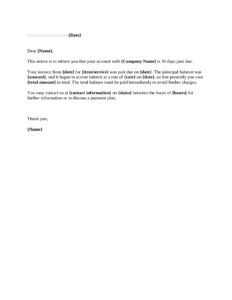
30 Days Past Due Letter
Use this free 30 Days Past Due Letter template to professionally remind customers of overdue invoices and request prompt payment — free download in PDF and DOCX.
DOCX
6 downloads
0
likes
Download Files
- DOCX
A 30 Days Past Due Letter is a written notice sent to a customer or client whose invoice has gone unpaid for roughly a month, reminding them of the outstanding balance and requesting prompt payment. It is the most common first formal step businesses take when a friendly invoice has slipped through the cracks. You can download this template free in both PDF and DOCX formats, with no signup required.
What Is a 30 Days Past Due Letter?
A 30 Days Past Due Letter is a polite but firm collection notice issued by a business, freelancer, or accounts receivable department to a customer who has not paid an invoice within 30 days of its due date. It documents the original invoice details, the amount owed, and the date payment was expected, while clearly asking the recipient to settle the balance. The tone is usually courteous because a one-month delay is often an oversight rather than a refusal to pay. The letter serves both as a genuine reminder and as a written record showing you made a good-faith effort to collect, which can matter later if the debt escalates.
When Do You Need a 30 Days Past Due Letter?
This letter fits any situation where an invoice has crossed the 30-day mark without payment. Common scenarios include:
- A regular client missed paying a monthly retainer or service invoice and may simply have forgotten.
- A wholesale or B2B customer is past the net-30 terms printed on the original invoice.
- A contractor or freelancer completed a project and the final payment has not arrived a month after delivery.
- A subscription or membership renewal charge failed and the balance is now overdue.
- A previous emailed reminder went unanswered and you want a more formal paper trail.
- You are following an internal collections schedule that sends letters at 30, 60, and 90 days past due.
What a 30 Days Past Due Letter Should Have
A complete and effective letter is clear, specific, and easy to act on. It should include your business name and contact details, the customer’s name and address, the date, and a reference to the specific invoice that is overdue. State the original invoice number, the invoice date, the due date, and the exact outstanding amount. Include any late fees or interest that apply under your terms, a firm request for payment, the accepted payment methods, and a deadline by which you expect the balance settled. Closing the letter with a courteous note and your signature keeps the relationship intact while making the expectation unmistakable.
How to Fill Out a 30 Days Past Due Letter
- Enter the current date at the top so the 30-day timeline is documented.
- Add your business name, address, phone number, and email as the sender.
- Fill in the recipient’s name, company, and mailing address.
- Open with a courteous greeting addressed to the responsible contact or accounts payable.
- Reference the overdue invoice by its invoice number and invoice date.
- State the original due date and note that the balance is now 30 days past due.
- List the amount due, including any applicable late fees or interest spelled out in your terms.
- Request payment clearly and provide a specific payment deadline.
- List accepted payment methods — check, bank transfer, card, or online portal — with any links or account details.
- Add a polite closing offering to help if the invoice was already paid or if there is a question.
- Sign with your name, title, and the best number to call.
Keeping the Right Tone at 30 Days
At the 30-day mark, most overdue balances are accidental — a misplaced invoice, an out-of-office approver, or a payment scheduled for the wrong cycle. Because of this, your first past due letter should assume good faith. A friendly, professional tone protects the customer relationship and often produces faster results than an aggressive demand. Acknowledge the possibility that payment may have already been sent, give clear instructions for resolving the balance, and make it easy to reach you. Save firmer language for the 60- and 90-day stages if the account remains unpaid. A well-worded 30-day letter frequently resolves the matter without further escalation.
What Happens After You Send It
Keep a copy of every past due letter you send, along with the date and method of delivery, in the customer’s account file. If you mailed it, note whether you used regular or certified mail; certified mail provides proof of delivery that can be useful if the debt is later disputed. Allow a reasonable window — often one to two weeks — for the payment to arrive before following up. If the deadline passes without response, the next step is typically a 60 Days Past Due Letter with firmer language, a phone call, or a final demand before involving a collections agency. Consistent documentation at each stage strengthens your position throughout.
Common Mistakes to Avoid
- Leaving out the invoice number or original due date, which makes it hard for the customer to identify the charge.
- Stating the wrong outstanding balance — always reconcile against your records first.
- Adding late fees or interest that were never disclosed in your original terms.
- Using a hostile tone too early, which can damage an otherwise good relationship.
- Failing to give a clear payment deadline or specific instructions for how to pay.
- Forgetting to keep a dated copy of the letter for your own records.
Frequently Asked Questions
What is a 30 Days Past Due Letter? It is a formal written reminder sent to a customer whose invoice has been unpaid for about 30 days past its due date. It restates the invoice details and amount owed and requests prompt payment. It also creates a documented record of your collection effort.
How do I fill out a 30 Days Past Due Letter? Add the date, your business details, and the customer’s information, then reference the specific overdue invoice by number, date, and amount. Set a clear payment deadline and list how the customer can pay. Close politely and sign with your name and title.
Is a 30 Days Past Due Letter legally binding? The letter itself is a reminder, not a contract, but it documents that you requested payment in good faith. The underlying debt remains governed by your original invoice and agreed terms. Keeping copies of these letters can support you if the matter ever goes to collections or court.
Should I charge late fees in this letter? You can only include late fees or interest if they were disclosed in your original agreement or invoice terms. If they were, state the amount clearly and show how it was calculated. If they were not previously disclosed, it is best to omit them at this stage.
How should I deliver the letter? Email works for speed and a digital record, while certified mail provides proof of delivery for higher-value or disputed balances. Many businesses send both. Always keep a dated copy in the customer’s file regardless of the method.
How much does this template cost? Nothing — this 30 Days Past Due Letter template is completely free to download in PDF and DOCX, with no signup required. You can edit the DOCX version to match your branding and payment terms. Reuse it for any overdue account as needed.
This template is a general example provided for informational purposes only and is not legal, financial, or tax advice. Debt collection rules and disclosure requirements vary by jurisdiction. Consult a qualified professional for guidance on your specific situation.
Related Forms
- Confirming a Speaker
- Acknowledging a Contribution
- Employee Termination For Poor Performance
- Vehicle Appraisal Verification Letter
- Recognizing a Suggestion
- Cease and Desist Copyright
Browse more in Business Letters.