
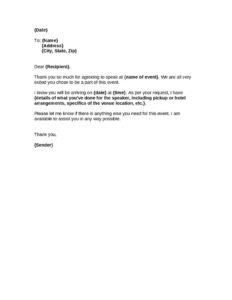
Confirming a Speaker
Download a free Confirming a Speaker letter template to confirm event details, arrival times, and arrangements with your guest speaker — free download in PDF and DOCX.
DOCX
3 downloads
0
likes
Download Files
- DOCX
A Confirming a Speaker letter is a short, professional note an event organizer sends to a guest speaker to lock in the details after they’ve agreed to participate. People most often use it to put arrival times, venue logistics, and promised arrangements in writing so nothing is left to memory. You can download this template free in both PDF and DOCX formats, with no signup required.
What Is a Confirming a Speaker Letter?
A Confirming a Speaker letter is a courtesy and logistics document issued by the host, organizer, or coordinator of an event to a speaker who has accepted an invitation. It restates the speaker’s agreement to participate, expresses appreciation, and confirms the practical details surrounding their appearance — arrival date and time, transportation, lodging, and venue specifics. While it isn’t a binding contract, it serves as a written record that both sides share the same understanding. The tone is warm but professional, and the letter doubles as a reassurance that the host is organized and ready to support the speaker. For many conferences, seminars, fundraisers, and corporate events, it is the final touchpoint before the engagement itself.
When Do You Need a Confirming a Speaker Letter?
This letter is useful any time a speaker has verbally or informally agreed to appear and you want to formalize the arrangements. Common situations include:
- Confirming a keynote or breakout speaker for a conference or industry summit.
- Following up with a guest lecturer invited to a university, school, or training session.
- Coordinating a featured speaker for a nonprofit gala, awards night, or fundraiser.
- Finalizing details with a panelist or workshop leader at a corporate retreat.
- Confirming a community speaker for a club meeting, association event, or local seminar.
- Reassuring an out-of-town speaker that travel pickup and hotel arrangements are handled.
What a Confirming a Speaker Letter Should Have
A complete confirmation letter is brief but covers every essential. It should clearly identify the event by name, state the speaker’s confirmed arrival date and time, and spell out any arrangements the host has made on the speaker’s behalf — transportation, accommodations, and exact venue location. It should thank the speaker sincerely, invite them to raise any outstanding needs, and provide a way to reach the sender. Including specifics rather than vague promises is what gives the letter real value: “a car will collect you from the airport at 3:00 p.m.” is far more useful than “we’ll handle travel.” A clear signature from the organizer closes the letter on a personal, accountable note.
How to Fill Out a Confirming a Speaker Letter
- Enter the {Date} you are sending the letter at the top.
- Address the speaker by completing the {Name}, {Address}, and {City, State, Zip} fields so the letter reaches the right person.
- Open with a personal greeting using the {Recipient} field — use the name the speaker prefers.
- In the opening line, insert the {name of event} to thank them for agreeing to speak and confirm what they are participating in.
- Fill in the {date} and {time} of their expected arrival so expectations are aligned.
- Complete the {details of what you’ve done for the speaker} section — list pickup or hotel arrangements, the specific venue location, parking, room or stage details, and anything they requested.
- Reaffirm your availability to help and invite further questions.
- Sign off with the {Sender} field, adding your name, title, and contact information.
Tips for Writing a Confirmation That Speakers Appreciate
Speakers are often busy professionals juggling multiple engagements, so clarity is a kindness. Be precise with times and addresses, and include the full street address of the venue rather than just a building name. If you arranged a hotel, note the confirmation number, check-in date, and whether the room is prepaid. If a driver is collecting them, include the pickup point and a phone number for the day-of contact. Mention the duration of their talk, the audience size, and any technical setup such as a projector, microphone, or laptop connection. A speaker who knows exactly what to expect arrives relaxed and prepared — which reflects well on your event.
How This Differs From a Speaker Agreement
It’s worth distinguishing this letter from a formal speaker agreement or contract. A confirmation letter is a friendly logistics summary; it documents details and signals readiness, but it usually does not address legal terms such as fees, cancellation policies, intellectual property, or liability. If your event involves an honorarium, expense reimbursement, recording rights, or other binding commitments, those belong in a separate signed agreement. Many organizers use both: a contract handles the legal relationship, and the confirmation letter — sent closer to the event — reiterates the practical arrangements. Sending the confirmation a week or two before the event keeps the details fresh for everyone.
Common Mistakes to Avoid
- Leaving the {details} section vague — “we’ll take care of everything” gives the speaker nothing concrete to rely on.
- Omitting the exact venue address, room, or stage location, which causes day-of confusion.
- Forgetting to confirm the arrival {date} and {time}, the very details the letter exists to pin down.
- Not including a direct contact number, so the speaker has no one to reach if plans change.
- Sending it too late, after the speaker has already made their own travel assumptions.
- Misspelling the speaker’s name or event name — a careless error that undermines an otherwise warm letter.
Frequently Asked Questions
What is a Confirming a Speaker letter used for? It is used by an event organizer to confirm, in writing, that a speaker has agreed to appear and to summarize the logistics around their visit. It records arrival times, transportation, lodging, and venue details so both parties share the same expectations. It also serves as a polite, professional touchpoint before the event.
How do I fill out the Confirming a Speaker template? Add the date and the speaker’s mailing details, greet them by name, and insert the event name. Then confirm the arrival date and time, describe the arrangements you’ve made in the details section, and close with your signature and contact information. Replace every placeholder in braces with your specific information.
Is a confirmation letter the same as a speaker contract? No. A confirmation letter documents logistics and shows you’re organized, but it generally does not cover legal terms like fees, cancellation, or recording rights. If money or binding obligations are involved, use a separate signed speaker agreement alongside this letter.
When should I send the confirmation letter? Send it once the speaker has agreed to participate and arrangements are settled — typically one to three weeks before the event. This gives the speaker time to review the details and ask questions while leaving room to adjust if anything changes. Sending too early or too late reduces its usefulness.
Does this letter need to be signed or notarized? No notarization is required, as it is a courtesy and logistics letter rather than a legal instrument. It should include a clear sign-off with your name, title, and contact details so the speaker knows who to reach. A simple signature or email signature is sufficient.
Is this Confirming a Speaker template free to download? Yes. You can download it free from Business Forms Pro in both PDF and DOCX formats, with no signup or payment required. Edit the DOCX version to match your event and speaker details, then send it by email or post.
This template is provided as a general example for informational purposes only and does not constitute legal, financial, or professional advice. Requirements and best practices for speaker engagements vary by organization and jurisdiction; for binding agreements or specific concerns, consult a qualified professional.
Related Forms
- Invitation to Bid
- Notice of Breach of Option
- Offer to a Potential Client
- Promotion Letter
- Payment Location Change
- Request for Partial Shipment
Browse more in Business Letters.