
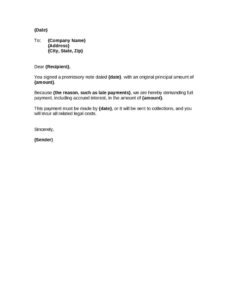
Demand Payment on Promissory Note
Use our free Demand Payment on Promissory Note template to formally request overdue repayment; clear, professional, and ready as a free download in PDF and DOCX.
DOCX
3 downloads
0
likes
Download Files
- DOCX
A Demand Payment on Promissory Note letter is a formal written notice sent by a lender to a borrower requesting repayment of money owed under a promissory note that is past due or has been accelerated. People most often use it as a firm but professional first step before pursuing collection or legal action. You can download it free in PDF and DOCX, with no signup required.
What Is a Demand Payment on Promissory Note Letter?
A Demand Payment on Promissory Note is a written communication from the holder of a promissory note (the lender or payee) to the maker (the borrower) demanding payment of an outstanding balance. It documents that the lender has formally requested payment, identifies the note in question, states the amount due, and sets a deadline for the borrower to respond. Because promissory notes are legally binding repayment agreements, a demand letter often serves as a required or expected precondition before a lender escalates to a lawsuit, collection agency, or note acceleration. It creates a clear paper trail showing the lender acted in good faith and gave the borrower notice and an opportunity to cure the default.
When Do You Need a Demand Payment on Promissory Note Letter?
This letter is appropriate any time a borrower has fallen behind on the terms of a signed note. Common situations include:
- A borrower has missed one or more scheduled installment payments on the note.
- The note has reached its maturity date and the full balance remains unpaid.
- The borrower has defaulted on a term that triggers an acceleration clause, making the entire balance immediately due.
- You loaned money to a business partner, family member, or friend and informal reminders have gone unanswered.
- You are a company carrying a promissory note from a customer or vendor who has stopped paying.
- You need to preserve your legal rights and document a demand before referring the matter to an attorney or collection agency.
What a Demand Payment Letter Should Have
An effective demand letter is specific, professional, and unambiguous. At minimum it should clearly identify the parties, reference the original promissory note by date and amount, state the exact sum now owed (including principal, accrued interest, and any late fees), and give a firm deadline for payment. It should specify acceptable payment methods and where to send funds. Many lenders also include a brief statement of consequences if the deadline passes — such as referral to legal counsel or acceleration of the note. Keep the tone factual rather than threatening; the goal is to prompt payment while protecting your position.
How to Fill Out a Demand Payment on Promissory Note Letter
- Enter the date at the top, then the borrower’s full legal name and mailing address as the recipient.
- Add a clear subject or reference line, such as “Demand for Payment — Promissory Note dated [date].”
- Open by identifying yourself as the holder of the note and referencing the original promissory note, including its execution date and original principal amount.
- State the current amount due, breaking out the unpaid principal, any accrued interest, and applicable late charges so the total is transparent.
- Specify the payment deadline — for example, within ten days of the letter’s date — and how payment should be delivered (check, wire, or other method) and to what address.
- Describe the consequences of non-payment, such as acceleration of the full balance or referral for legal collection, in a measured, factual way.
- Close with your name, signature, and contact information so the borrower can reach you to arrange payment.
- Keep a dated copy of the letter and proof of mailing for your records.
How to Deliver the Letter and Document It
How you send a demand letter can matter as much as what it says. Many lenders send the letter by certified mail with return receipt requested so they have proof the borrower received it. Sending a copy by regular mail and email as well can increase the odds it reaches the borrower and is seen promptly. Retain the original signed copy, the certified mail receipt, and the green return card if you receive one. If the note specifies a particular notice method or address, follow it exactly, because failing to give notice the way the contract requires can weaken your position later. Good documentation turns a single letter into a defensible record of the steps you took.
Demand Letter vs. the Promissory Note Itself
It is important not to confuse the demand letter with the promissory note. The promissory note is the underlying contract — the signed promise to repay money under specific terms. The demand letter does not create or change that obligation; it simply asserts that the borrower has failed to meet it and requests payment. Because the note governs the relationship, your demand should track its actual terms, including the interest rate, payment schedule, default definitions, and any cure period the note grants the borrower. Quoting the note accurately makes your demand credible and harder to dispute.
Common Mistakes to Avoid
- Stating an incorrect balance — always recalculate principal, interest, and fees against the note’s actual terms before sending.
- Using threatening or abusive language, which can backfire and may violate debt collection rules in some situations.
- Forgetting to reference the specific promissory note by date and amount, leaving the demand vague.
- Giving an unreasonable or unstated deadline, or failing to ignore any cure period the note requires.
- Sending the letter informally with no proof of delivery, leaving you unable to show the borrower received notice.
- Failing to keep a signed, dated copy of the letter for your own records.
Frequently Asked Questions
What is a Demand Payment on Promissory Note letter? It is a formal written notice from a lender to a borrower demanding repayment of money owed under a signed promissory note. It identifies the note, states the amount due, and sets a deadline for payment. It is typically the first formal step before collection or legal action.
Is a demand letter legally required before I sue? Requirements vary by jurisdiction and by the terms of your promissory note. Some notes include a notice-and-cure provision that requires you to send a demand and allow time to fix the default before accelerating or suing. Even when not strictly required, a documented demand strengthens your position and shows you acted in good faith.
How much does this template cost? It is completely free to download from Business Forms Pro in both PDF and DOCX formats, with no signup required. You can edit the DOCX version to match your note’s exact terms, amounts, and deadlines.
Does the demand letter need to be notarized? No, a demand letter generally does not need to be notarized or witnessed to be valid. What matters more is that it accurately states the debt and that you can prove the borrower received it. Sending it by certified mail with return receipt is a common way to document delivery.
What deadline should I give the borrower? A reasonable, clearly stated deadline is best — many lenders give ten to thirty days. If your promissory note specifies a cure period, follow it exactly. The key is to set a firm date and state it plainly so there is no ambiguity about when payment is expected.
What happens if the borrower still does not pay? If the deadline passes without payment, you may pursue the options the note allows, such as accelerating the full balance, referring the matter to a collection agency, or consulting an attorney about filing suit. Your documented demand letter becomes part of the record showing you gave the borrower notice and an opportunity to resolve the debt.
This template is a general example provided for informational purposes only and is not legal, financial, or tax advice. Laws governing promissory notes, demand notices, and debt collection vary by jurisdiction, and your specific note may impose its own requirements. Consult a qualified attorney before relying on this letter for any legal matter.
Related Forms
- Payment Location Change
- Vehicle Appraisal Verification Letter
- Customer Service Alteration Letter
- Reservation Confirmation Letter
- Payment Inquiry
- Landlord Unauthorized Subletting Warning
Browse more in Business Letters.