
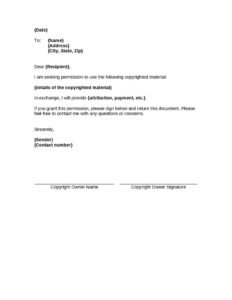
Copyrighted Material Request
Download a free Copyrighted Material Request letter template in PDF and DOCX to formally ask a rights holder for permission to use protected work.
DOCX
0
likes
Download Files
- DOCX
A Copyrighted Material Request is a formal letter you send to a copyright owner asking for written permission to use their protected work. People most often use it to legally reproduce, quote, perform, or publish someone else’s creative material before they ever hit publish. This template is free to download in both PDF and DOCX, with no signup required.
What Is a Copyrighted Material Request?
A Copyrighted Material Request is a written communication sent from a person or business (the requester) to the holder of a copyright (the owner or their representative) seeking permission to use a specific creative work. Copyright automatically protects original works such as books, articles, photographs, music, illustrations, software, and video, and the owner has the exclusive right to control how those works are copied and distributed. This letter documents exactly what you want to use and what you are offering in return, and it provides a signature line so the owner can grant permission in writing. Having that signed approval creates a clear, dated record that protects both parties and reduces the risk of an infringement dispute later.
When Do You Need a Copyrighted Material Request?
You should send this letter any time your intended use of someone else’s work goes beyond what the law clearly allows. Common situations include:
- Quoting a book or article at length in your own publication, report, or thesis.
- Reprinting a photograph or illustration on a website, in a newsletter, or in marketing materials.
- Using a song or audio clip in a video, podcast, presentation, or event.
- Republishing a chart, table, or excerpt from a research paper in a textbook or course pack.
- Displaying artwork or design elements created by another person in a commercial product.
- Adapting or translating an existing work into a new format or language.
Even when you believe a use might qualify as fair use, written permission removes the guesswork. A signed request is especially valuable for commercial projects, where the financial stakes and visibility are higher.
What a Copyrighted Material Request Should Have
A complete request leaves no ambiguity about who is asking, what they want, and what the owner is agreeing to. The essential elements are the recipient’s full name and mailing address, a clear and specific description of the copyrighted material you wish to use, a statement of what you are offering in exchange (attribution, a fee, a copy of the finished product, or another arrangement), and an explicit request for written permission. It should also include your name as the sender, your contact information, and a signature line where the copyright owner can grant approval. The more precisely you describe the work and the intended use, the more useful the granted permission will be.
How to Fill Out a Copyrighted Material Request
- Address the recipient. Enter the owner’s Name, Address, and City, State, Zip at the top so the letter reaches the correct rights holder.
- Open with a greeting. Fill in the Recipient name after “Dear” — use a personal name where possible, or the company or rights department.
- Describe the material. In the details of the copyrighted material field, identify the work precisely: title, author, publication, edition, page numbers, image file name, or time stamps. Note where and how you intend to use it.
- State your offer. Complete the attribution, payment, etc. field with what you will provide in return — a credit line, a one-time fee, a copy of the final work, or other terms.
- Invite questions. The letter closes by asking the owner to sign and return the document and to contact you with concerns.
- Sign and add contact details. Enter your name in the Sender field and your Contact number so the owner can reach you and respond.
Permission, Attribution, and Keeping Records
When the copyright owner signs and returns the letter, that signed page becomes your proof of permission. Store it with the project files alongside any related correspondence so you can produce it if questions arise years later. Be aware that permission is usually limited to exactly what you described — using the same material in a new edition, a different medium, or a much larger print run may require a fresh request. If the owner adds conditions, such as a specific credit wording or a usage time limit, honor them precisely. If you don’t receive a response, follow up politely; silence is not permission.
How This Differs From a License Agreement
A Copyrighted Material Request is a permission letter, not a full licensing contract. It is well suited to one-off, clearly defined uses where a simple signed approval is enough. For ongoing commercial use, large royalties, exclusive rights, or complex terms, a formal license or assignment agreement drafted with legal input is often more appropriate. Think of this letter as the practical first step that establishes consent in writing — it can stand on its own for many everyday situations and can also open the door to a more detailed agreement when needed.
Common Mistakes to Avoid
- Being vague about the material. “Some images from your site” is not enough — name and locate the exact work.
- Forgetting to specify the use. Permission to quote in a blog post does not automatically cover a printed book.
- Sending it to the wrong person. The author is not always the copyright owner; publishers or agencies often hold the rights.
- Leaving out your offer. Stating attribution or payment up front speeds up approval.
- Skipping the signature line. Without a returned, signed copy, you have a request but not documented permission.
- Assuming no reply means yes. Always wait for an affirmative, written response before using the work.
Frequently Asked Questions
What is a Copyrighted Material Request used for? It is used to formally ask a copyright owner for permission to reproduce, quote, perform, or publish their protected work. The letter documents your request and gives the owner a place to grant approval in writing, creating a clear record for both sides.
How do I fill out a Copyrighted Material Request? Add the owner’s name and address, greet the recipient, describe the exact material and how you’ll use it, state what you’ll offer in exchange, and sign with your name and contact number. Then send it and ask the owner to sign and return the document.
Is this letter legally binding? The letter itself is a request, but once the copyright owner signs it, their signed approval generally constitutes permission for the use you described. For high-value or ongoing uses, a more detailed license agreement may offer stronger protection.
Does it need to be notarized or witnessed? Notarization is generally not required for a permission letter; the owner’s signature is usually sufficient. Requirements can vary, so for significant commercial deals you may choose to use a formal contract reviewed by a professional.
Do I always need permission to use copyrighted work? Not always — some uses may fall under fair use or other exceptions, and works in the public domain are free to use. Because those rules are fact-specific and vary by situation, a written request is the safest path when you are unsure.
How much does this template cost? Nothing — the Copyrighted Material Request template is completely free to download in PDF and DOCX from Business Forms Pro, with no signup required. You can edit it to fit the specific work and terms of your request.
This template is provided as a general example for informational purposes only and is not legal advice. Copyright rules and permission requirements vary by jurisdiction and circumstance; consult a qualified attorney before relying on this document for any specific use.
Related Forms
- Merger Announcement Letter
- Notice of Impending Action
- Order Exceptions
- Landlord Smoking Warning
- Complaint Disavowal
- Project Delay Letter
Browse more in Business Letters.