
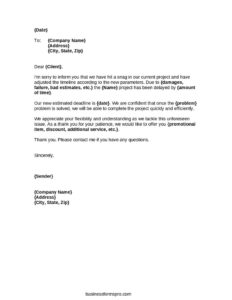
Project Delay Letter
Use this free Project Delay Letter template to professionally notify clients of a timeline change, explain the cause, and keep trust — free download in PDF and DOCX.
DOCX
1 downloads
0
likes
Download Files
- DOCX
A Project Delay Letter is a formal written notice that informs a client a project has fallen behind schedule, explains why, and provides a revised completion date. It is most commonly used when an unforeseen problem forces a contractor, agency, or vendor to push back a deadline and they want to preserve the client relationship. You can download this Project Delay Letter free in PDF and DOCX, with no signup required.
What Is a Project Delay Letter?
A Project Delay Letter is a professional communication sent by the party responsible for delivering a project to the client or stakeholder waiting on it. It documents that the original timeline can no longer be met, names the cause of the delay, and sets out a new estimated deadline. Beyond simply breaking the news, the letter manages expectations, demonstrates accountability, and often includes a gesture of goodwill to soften the disruption. Service providers, construction firms, software teams, manufacturers, and consultants all use this kind of letter. Because it creates a written record of the revised schedule and the reason behind it, the letter can also become a useful reference if questions about timing arise later.
When Do You Need a Project Delay Letter?
You should send a Project Delay Letter as soon as you know the original deadline is no longer realistic. Common situations include:
- Supply or material delays — a key component, shipment, or resource has not arrived on time, stalling progress.
- Damage or failure — equipment breakdown, defective work, or a technical failure requires rework before the project can continue.
- Inaccurate estimates — the original timeline was based on assumptions that proved too optimistic once work began.
- Staffing or capacity issues — illness, turnover, or competing priorities reduce the team’s ability to deliver on schedule.
- External factors — weather, permitting delays, third-party dependencies, or regulatory holdups outside your control.
- Scope changes — the client requested additions that extend the work beyond the original completion date.
In each case, sending the letter early gives the client time to adjust their own plans and signals that you are managing the situation responsibly rather than hiding from it.
What a Project Delay Letter Should Have
An effective Project Delay Letter is brief, honest, and forward-looking. It should clearly identify the project by name so there is no confusion about which engagement is affected. It must state the cause of the delay plainly without over-explaining or making excuses. Most importantly, it needs to communicate the new estimated deadline and how much time has been added. A reassuring tone matters: the letter should express confidence that the problem will be resolved and the work completed efficiently. Many strong delay letters also include a goodwill gesture — a discount, added service, or promotional item — to acknowledge the client’s patience. Finally, the letter should include the sender’s name, company, and contact details so the client can easily follow up.
How to Fill Out a Project Delay Letter
- Enter the {Date} at the top so the notice is timestamped.
- Address the recipient block with the {Company Name}, {Address}, and {City, State, Zip} of the client.
- Open the salutation with Dear {Client}, using the contact’s name for a personal tone.
- In the cause field, describe the reason for the delay — for example {damages, failure, bad estimates, etc.} — choosing wording that is accurate but professional.
- Name the affected project in the {Name} field so the client knows exactly which engagement is impacted.
- State the length of the delay in {amount of time}, such as two weeks or one month.
- Provide the revised completion {date} so the client has a clear new target.
- Reference the specific {problem} you are confident will be resolved.
- Offer a goodwill gesture in {promotional item, discount, additional service, etc.} to thank the client for their flexibility.
- Close with your name in {Sender} and your {Company Name}, {Address}, and {City, State, Zip}.
Tips for Delivering Difficult News Well
The way you frame a delay shapes how the client reacts to it. Lead with the facts, but pair them with a plan: stating the new deadline and your confidence in meeting it turns a setback into a managed situation. Avoid vague language like “sometime soon” — a concrete revised date builds trust far more than an open-ended apology. If the cause was within your control, a brief acknowledgment of responsibility is more credible than blaming outside forces. The goodwill gesture in this template is optional but powerful; even a modest discount or added service signals that you value the relationship enough to make amends.
Letter vs. Verbal Notice
A phone call may feel faster, but a written Project Delay Letter creates a record both sides can refer back to. It eliminates ambiguity about the revised deadline and the agreed-upon goodwill gesture, and it gives the client something concrete to share with their own team or stakeholders. Many professionals do both: call to deliver the news personally, then follow up with this letter to confirm the details in writing. If your contract has a notice clause, sending a written letter may also satisfy formal communication requirements.
Common Mistakes to Avoid
- Waiting too long to send it — notifying the client only after the deadline has passed damages trust far more than the delay itself.
- Being vague about the new date — always provide a specific revised deadline rather than a fuzzy estimate.
- Over-apologizing or over-explaining — one clear, sincere statement is more professional than a wall of excuses.
- Promising a goodwill gesture you can’t deliver — only offer a discount or service you are able to honor.
- Omitting contact details — the client should be able to reply or call with questions immediately.
- Forgetting to name the project — clients juggling multiple engagements need to know exactly which one is affected.
Frequently Asked Questions
What is a Project Delay Letter used for? It is used to formally notify a client that a project will not be finished on the original timeline, explain why, and provide a new estimated completion date. It helps manage expectations and preserve the working relationship during a setback.
How do I fill out a Project Delay Letter? Enter the date, the client’s contact information, and a salutation, then describe the cause of the delay, name the project, state how much time was added, and give the revised deadline. Finish with an optional goodwill gesture and your signature and contact details.
Is a Project Delay Letter legally binding? The letter itself is a communication rather than a contract, but it can carry contractual weight if your agreement requires written notice of schedule changes. Always review your project contract to see how delays and notices must be handled.
Should I include a discount or other goodwill gesture? It is optional, but a small discount, added service, or promotional item can go a long way toward keeping a client satisfied during a delay. Only offer something you are genuinely able to provide.
When should I send the letter? Send it as soon as you realize the original deadline cannot be met, not after it has already passed. Early notice gives the client time to adjust their own plans and demonstrates that you are managing the situation responsibly.
Is this Project Delay Letter template free to download? Yes. You can download this Project Delay Letter free in both PDF and DOCX formats with no signup required, and edit it to fit your specific project and client.
This Project Delay Letter template is a general example provided for informational purposes only and is not legal, financial, or contractual advice. Requirements and obligations regarding project timelines and notices vary by contract and jurisdiction, so consult a qualified professional before relying on this document.
Related Forms
- Missed Appointment Letter
- Out Of Stock Notice
- Employee Termination For Absenteeism
- Copyrighted Material Request
- Landlord Temporary Repairs
- 90 Days Past Due Letter
Browse more in Business Letters.