
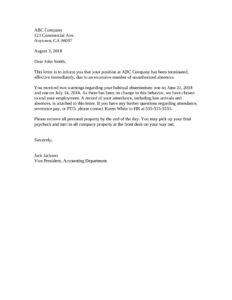
Employee Termination For Absenteeism
Download a free Employee Termination for Absenteeism letter template to formally document and communicate dismissal due to attendance issues, in PDF and DOCX.
DOCX
5 downloads
0
likes
Download Files
- DOCX
An Employee Termination for Absenteeism letter is a formal written notice from an employer informing an employee that their employment is being ended because of excessive or unexcused absences. It is most often used after repeated attendance violations and prior warnings have failed to correct the problem. You can download this template free in PDF and DOCX formats, with no signup required.
What Is an Employee Termination for Absenteeism Letter?
An Employee Termination for Absenteeism letter is an official document that an employer or human resources department issues to communicate the end of an employment relationship based on attendance problems. It typically references the company’s attendance policy, the specific dates the employee was absent or late, and any prior verbal or written warnings. The letter serves two purposes: it clearly notifies the employee of the decision and the effective date, and it creates a documented record that the termination followed a fair, consistent process. Because absenteeism cases can lead to disputes or unemployment claims, a well-written letter protects both parties by stating the facts plainly.
When Do You Need an Employee Termination for Absenteeism Letter?
This letter is appropriate after attendance issues have been addressed through your normal disciplinary steps and have not improved. Common situations include:
- An employee has accumulated unexcused absences beyond the limit set in your attendance policy.
- Repeated tardiness or early departures have continued despite documented coaching and warnings.
- An employee has been absent without notice or has failed to call in for several consecutive shifts (job abandonment).
- A pattern of absences around weekends, holidays, or scheduled busy periods has disrupted operations.
- An employee has exhausted approved leave and has not returned to work or requested an extension.
- Prior written warnings stated that further absences could result in termination, and another violation has occurred.
What an Employee Termination for Absenteeism Letter Should Have
A complete and defensible letter includes several core elements. It should clearly identify the company and the employee by name and position, state that employment is being terminated, and give the effective date. It should summarize the reason — excessive absenteeism — and reference the specific policy that was violated. Strong letters list the relevant absence dates and the prior warnings the employee received, demonstrating that the decision was not sudden or arbitrary. Finally, it should cover practical next steps: final pay, return of company property, benefits or COBRA information where applicable, and a point of contact for questions. Keeping the tone professional and factual is essential.
How to Fill Out an Employee Termination for Absenteeism Letter
- Add your company name, address, and the date the letter is issued at the top.
- Enter the employee’s full name, job title, and department so the record is unambiguous.
- Open with a direct statement that the employee’s employment is being terminated and provide the effective termination date.
- State the reason clearly: termination due to excessive or unexcused absenteeism.
- Reference the specific attendance or leave policy the employee violated, naming the policy or section if possible.
- List the documented absence dates and any prior verbal or written warnings, including their dates, to show a consistent process was followed.
- Explain final pay arrangements, the return of company equipment, badges, or keys, and any benefits or COBRA details.
- Provide a contact name and phone number or email for follow-up questions.
- Close professionally, then sign and print the name and title of the manager or HR representative issuing the letter.
Documenting the History Behind the Decision
The strength of an absenteeism termination rests on the paper trail that precedes it. Before sending this letter, gather attendance records, time clock data, written warnings, and any acknowledgment forms the employee signed. Where your policy uses a progressive discipline system — verbal warning, first written warning, final written warning, then termination — confirm that each step was applied and documented. Citing this history in the letter, or in an attached summary, makes clear the employee had notice and an opportunity to improve. Consistency matters too: applying the same standard to similarly situated employees reduces the risk of claims that the decision was unfair or discriminatory.
Delivering the Letter and Final Steps
Decide in advance how the letter will be delivered. Many employers hand it to the employee during a brief in-person or remote meeting and follow up with a mailed or emailed copy for the record. Keep the conversation short, factual, and respectful, and avoid debating individual absences in the moment. After delivery, retain a signed copy in the employee’s personnel file along with the supporting documentation. Process the final paycheck according to your state’s timing rules, collect company property, and disable system access. If the employee files for unemployment, the letter and attendance records become key supporting evidence.
Common Mistakes to Avoid
- Terminating without prior documented warnings, which makes the decision look abrupt and hard to defend.
- Counting protected absences — such as approved FMLA leave, jury duty, or legally protected sick time — as policy violations.
- Leaving out specific dates and instead using vague phrases like “frequent absences.”
- Using an emotional, accusatory, or sarcastic tone instead of neutral, factual language.
- Forgetting to address final pay, benefits, and the return of company property.
- Applying attendance rules inconsistently across employees, which can lead to fairness or discrimination claims.
Frequently Asked Questions
What is an Employee Termination for Absenteeism letter? It is a formal notice from an employer ending an employee’s job because of excessive or unexcused absences. The letter states the reason, the effective date, and the practical details like final pay and property return. It also documents that the company followed a fair process before reaching the decision.
How do I fill out the letter? Start with your company information and the date, then identify the employee by name and position. State that employment is ending, give the effective date, cite the attendance policy that was violated, and list the relevant absence dates and prior warnings. Finish with final pay, benefits, and a contact, then sign as the issuing manager or HR representative.
Do I need to give warnings before terminating for absenteeism? Most employers follow a progressive discipline process with verbal and written warnings before termination, and many company policies require it. Documented warnings strengthen the letter and help defend the decision if it is challenged. Always follow your own written policy and any applicable laws.
Is this termination letter legally binding? The letter itself documents and communicates a decision rather than creating a contract. Whether the termination is lawful depends on employment laws, any contract or collective bargaining agreement, and whether absences were legally protected. Review the situation carefully, especially around protected leave.
Can I terminate an employee for absences that were legally protected? No — absences covered by laws such as FMLA, the ADA, jury duty, or protected sick leave generally cannot be used as grounds for termination. Counting protected time against an employee can create serious legal exposure. Separate protected absences from policy violations before deciding.
How much does this template cost? This Employee Termination for Absenteeism letter template is completely free to download from Business Forms Pro in both PDF and DOCX formats. There is no signup or payment required. You can customize it to match your company’s policies and branding.
This template is a general example provided for informational purposes only and is not legal, HR, or employment advice. Employment laws and termination requirements vary by jurisdiction and individual circumstances. Consult a qualified employment attorney or HR professional before terminating an employee.
Related Forms
- Furlough Letter
- Internal Promotion Announcement
- Job Letter Confirm Verbal Offer
- Promotion Letter
- Demand Payment on Promissory Note
- Cease and Desist Copyright
Browse more in Business Letters.