
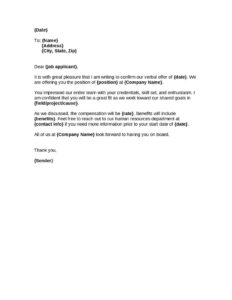
Job Letter Confirm Verbal Offer
Use this free Job Letter Confirm Verbal Offer template to put a spoken job offer in writing, with key terms spelled out — free download in PDF and DOCX.
DOCX
0
likes
Download Files
- DOCX
A Job Letter Confirm Verbal Offer is a short business letter an employer sends to a candidate to put a spoken job offer in writing, restating the agreed position, pay, and start date so both sides have a clear record. People most often use it right after a phone or in-person offer to prevent misunderstandings before the candidate formally accepts. You can download this template free in PDF and DOCX, with no signup required.
What Is a Job Letter to Confirm a Verbal Offer?
A job letter to confirm a verbal offer is a written follow-up to a job offer that was first made out loud — over the phone, in a meeting, or in a hallway conversation. It is typically issued by the hiring manager, recruiter, or HR department and addressed to the chosen candidate. The letter documents the essential terms that were discussed: job title, salary or hourly rate, start date, and any conditions of employment. Its purpose is to translate an informal conversation into a clear, professional record so neither party relies on memory. While it often precedes a full employment contract, the confirmation letter alone reassures the candidate and signals that the company is serious and organized.
When Do You Need a Job Letter to Confirm a Verbal Offer?
- A hiring manager phoned a candidate with an offer and wants to confirm the details in writing the same day.
- HR extended an offer in a meeting and needs to document the agreed salary and start date before onboarding begins.
- A small business owner made a quick verbal offer and wants a simple, professional letter rather than a long contract.
- A recruiter promised a position by phone and the candidate has asked for something in writing before resigning from their current job.
- A company wants to confirm an offer that depends on conditions such as a background check, reference check, or proof of eligibility to work.
- An employer is hiring a seasonal, part-time, or contract worker and needs a brief written record of the terms discussed.
What a Confirmation Letter Should Have
To be useful and unambiguous, a verbal offer confirmation letter should restate every material term that was discussed. At minimum it should include the company name and date, the candidate’s name and address, the exact job title, the reporting manager or department, the compensation (salary or hourly rate and pay frequency), and the agreed start date. It should also note the employment type — full-time, part-time, or contract — and any conditions the offer depends on, such as a successful background check. A warm but professional tone, a request for the candidate to confirm acceptance, and a signature from the appropriate company representative round out a complete letter.
How to Fill Out a Job Letter to Confirm a Verbal Offer
- Add your company name and letterhead at the top, along with the current date the letter is being sent.
- Enter the candidate’s full name and mailing address in the recipient block so the letter is properly addressed.
- Open with a friendly line confirming that you are putting your recent verbal offer in writing and that you are pleased to do so.
- State the exact job title and the department or reporting manager the candidate will work under.
- Spell out the compensation — the annual salary or hourly rate, the pay frequency, and any sign-on or bonus details discussed.
- Confirm the start date and the employment type (full-time, part-time, temporary, or contract), plus core hours if relevant.
- List any conditions the offer depends on, such as references, a background check, or work authorization.
- Ask the candidate to confirm acceptance by a specified date and explain how (signed reply, email, or call).
- Close with a welcoming sentence, then add the sender’s name, title, and signature.
How This Differs From a Full Offer Letter or Contract
It helps to understand where this letter sits among related hiring documents. A verbal offer confirmation letter is intentionally brief — its job is to capture the spoken offer quickly and warmly. A full offer letter is usually more detailed, covering benefits, paid time off, at-will language, and policies. An employment contract goes further still, binding both parties to specific obligations and often used for executives or fixed-term roles. Many employers send the confirmation letter first to lock in the basics, then follow with a complete offer letter or contract once HR finalizes the paperwork. If you only need to send one document, choose the one that matches the level of formality your role and company require.
Tips for a Clear, Professional Letter
- Send the letter promptly — ideally the same day or the next business day after the verbal offer — so momentum and goodwill stay high.
- Mirror exactly what was said on the call; if a number or date changed, note the change clearly rather than glossing over it.
- Keep the tone enthusiastic and human; a verbal offer often signals a personal connection, and the letter should reflect that.
- Include a clear deadline for the candidate to respond so your hiring timeline stays on track.
- Have HR or a manager review the letter before sending to confirm the title, pay, and conditions are correct.
Common Mistakes to Avoid
- Leaving out the start date or salary, which are the two details candidates most want confirmed in writing.
- Promising terms in the letter that differ from what was said verbally, creating confusion or distrust.
- Forgetting to mention conditions like background checks, so the candidate is surprised later.
- Using vague language about pay (“competitive salary”) instead of a specific figure and pay frequency.
- Omitting a response deadline or instructions, leaving the candidate unsure how to accept.
- Sending the letter without a named sender, title, and signature, which weakens its credibility.
Frequently Asked Questions
What is a job letter to confirm a verbal offer? It is a short written letter from an employer to a candidate that documents a job offer first made out loud. It restates the title, pay, start date, and any conditions so both sides have a clear, professional record before formal acceptance.
Is a verbal offer confirmation letter legally binding? A confirmation letter can carry weight as evidence of what was offered, but whether it creates binding obligations depends on its wording and your local employment laws. Many employers add at-will or conditional language; if you need certainty, have a qualified professional review the letter before sending.
How do I fill out the template? Add your company details and the date, address the candidate, then state the job title, compensation, start date, employment type, and any conditions. Close by asking the candidate to confirm acceptance by a set date and sign with your name and title.
Does this letter need to be signed or notarized? A signature from the hiring manager or HR representative is recommended to show the offer is official, but notarization is generally not required for a confirmation letter. Always check your company policy and any applicable local rules.
How is this different from a full offer letter? A confirmation letter is a quick, focused summary of the spoken offer, while a full offer letter typically adds benefits, policies, and detailed terms. Employers often send the confirmation first and follow with a complete offer letter or contract.
How much does this template cost? Nothing — you can download the Job Letter Confirm Verbal Offer template free from Business Forms Pro in both PDF and DOCX formats, with no signup required. Edit it to match your role and company before sending.
This template is a general example provided for informational purposes only and is not legal, financial, or HR advice. Employment laws and requirements vary by jurisdiction, so consult a qualified professional before relying on this document.
Related Forms
- Notice of Sale Ending
- Auto Insurance Verification Letter
- Reference Request
- Disputed Invoice
- Prospective Lead
- Internal Promotion Announcement
Browse more in Business Letters.