
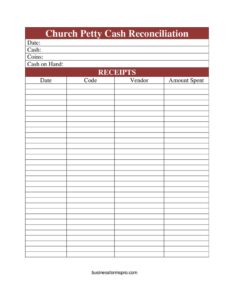
Church Petty Cash Reconciliation
Download a free Church Petty Cash Reconciliation template to track cash on hand, receipts, and spending with accurate, transparent records — free download.
PDF
DOCX
5 downloads
0
likes
Download Files
- DOCX
A Church Petty Cash Reconciliation is a simple accounting worksheet that compares the cash physically counted in a church’s petty cash box against the receipts and spending recorded for the same period. Churches use it most often to confirm that every dollar spent from the small-cash fund is accounted for and supported by a receipt. You can download this template free in PDF and DOCX, with no signup required.
What Is a Church Petty Cash Reconciliation?
A Church Petty Cash Reconciliation is a record that a treasurer, bookkeeper, or finance volunteer completes to verify the balance of a church’s petty cash fund. It documents the actual cash and coins counted on a given date, the total cash on hand, the receipts collected for purchases, and an itemized list of money spent by date, expense code, vendor, and amount. The goal is to show that the starting fund minus the documented spending equals the cash remaining in the box. This protects the church’s finances, supports good stewardship of donated money, and creates a clean paper trail for audits, board review, and annual financial reporting.
When Do You Need a Church Petty Cash Reconciliation?
Reconciling petty cash is a routine task, but certain moments make it essential:
- At the end of each month, when the treasurer closes the books and reports balances to the finance committee or board.
- Before replenishing the petty cash box, so the amount added matches the receipts turned in.
- When a different volunteer or staff member takes custody of the cash fund and a clean handoff count is needed.
- Ahead of an annual audit, financial review, or denominational reporting deadline.
- After a busy season such as Christmas, Easter, or a fundraising event when many small cash purchases were made.
- Any time the cash in the box does not appear to match expectations and a discrepancy must be investigated.
What a Church Petty Cash Reconciliation Should Have
A complete reconciliation worksheet ties the physical count to the recorded activity. It should include the reconciliation date, a breakdown of the cash and coins counted, the total cash on hand, and the total of receipts collected. It should also list each expense individually so spending can be categorized and verified. Strong records include an expense code or account category for each purchase, the vendor or payee, and the exact amount spent. Finally, a good worksheet leaves room for the person counting to sign and for a second person to review, since two-person verification is a basic safeguard for any church handling cash.
How to Fill Out a Church Petty Cash Reconciliation
- Enter the Date of the reconciliation at the top so the count is tied to a specific point in time.
- Count the paper money and record the total in the Cash field.
- Count the change and record the total in the Coins field.
- Add cash and coins together and enter the result as Cash on Hand — this is the physical balance in the box.
- Gather every receipt for the period and total them in the Receipts field.
- In the spending log, enter the Date of each individual purchase.
- Assign an expense Code (account or budget category) to each line so spending can be sorted later.
- Record the Vendor or payee for each purchase.
- Enter the Amount Spent for that line item, then repeat for every transaction.
- Confirm that the starting fund minus total amount spent equals your cash on hand. If it balances, sign and file the form.
Reconciling the Box: Making the Numbers Agree
The math behind a petty cash reconciliation is straightforward but unforgiving: the cash on hand plus the total of all receipts should equal the fund’s established balance. For example, if your petty cash fund is set at $200 and you have $63.50 in cash and coins, your receipts should total $136.50. If they do, the box balances and you can replenish it by writing a check for $136.50 to bring it back to $200. If the totals do not match, treat the gap as a flag rather than a rounding nuisance — recount the cash, recheck your addition, and confirm every receipt was logged with the correct amount spent. Small, recurring discrepancies often trace back to a missing receipt, a transposed number, or a purchase that was never recorded.
Why Expense Codes Matter for Churches
The Code field is more than bookkeeping detail. By assigning each purchase to a category — office supplies, hospitality, children’s ministry, building maintenance, and so on — the church can roll petty cash spending into its broader budget reports. This helps ministry leaders see where small dollars are going and keeps the petty cash fund from becoming an untracked catch-all. Consistent coding also makes year-end reporting and audits faster, because reviewers can trace every dollar to a purpose and a vendor without guesswork.
Common Mistakes to Avoid
- Logging a purchase without keeping the matching receipt, which leaves the spending unverifiable.
- Combining cash and coins into one number without counting them separately, making errors harder to catch.
- Skipping the expense code, so spending cannot be tied back to a budget category.
- Letting one person count, record, and approve with no second-person review.
- Reconciling only occasionally instead of every month, allowing small errors to pile up.
- Replenishing the box from offering cash without documenting it, which breaks the audit trail.
Frequently Asked Questions
What is a Church Petty Cash Reconciliation? It is a worksheet that compares the cash physically counted in a church’s petty cash box against the receipts and recorded spending for a period. It confirms that the fund balances and that every purchase is documented. Churches use it for transparency, stewardship, and audit readiness.
How often should a church reconcile petty cash? Most churches reconcile at least monthly and again before replenishing the fund. High-activity periods, such as major holidays or fundraising events, may call for more frequent counts. Regular reconciliation keeps small errors from accumulating into larger discrepancies.
Who should complete the reconciliation? Typically the treasurer, bookkeeper, or a designated finance volunteer counts and records the cash, while a second person reviews and verifies the totals. Separating the counting role from the approving role is a basic internal control. This two-person check protects both the church and the volunteers handling cash.
What do I do if the petty cash does not balance? Recount the cash and coins, re-add your receipt totals, and confirm every purchase was logged with the correct vendor and amount. Often the gap comes from a missing receipt or a recording error. If you cannot resolve a discrepancy, document it and report it to the finance committee.
Does this form need to be notarized or witnessed? No. A petty cash reconciliation is an internal accounting record, not a legal contract, so it does not require notarization. A signature from the preparer and a reviewer is usually all that is needed for good internal control.
Is this template free to download? Yes. You can download the Church Petty Cash Reconciliation free in both PDF and DOCX formats with no signup required. The DOCX version is editable, so you can add your church name, adjust the expense codes, or change the fund amount to match your needs.
This template is a general example provided for informational purposes only and is not accounting, tax, or legal advice. Financial recordkeeping and reporting requirements vary by jurisdiction and by denomination — consult a qualified accountant or financial professional to ensure your church’s practices meet applicable standards.
Related Forms
- Wedding Reception Fees
- Ordination Anniversary Card 2 (2 per page)
- Prayer List
- Virgin Holy Card (2 per page)
- Baptism Holy Card (2 per page)
- Virgin Mary Holy Card (2 per page)
Browse more in Church.